
Spike Camera Autofocus via Frequency-Domain Spectral-Centroid Migration
Abstract
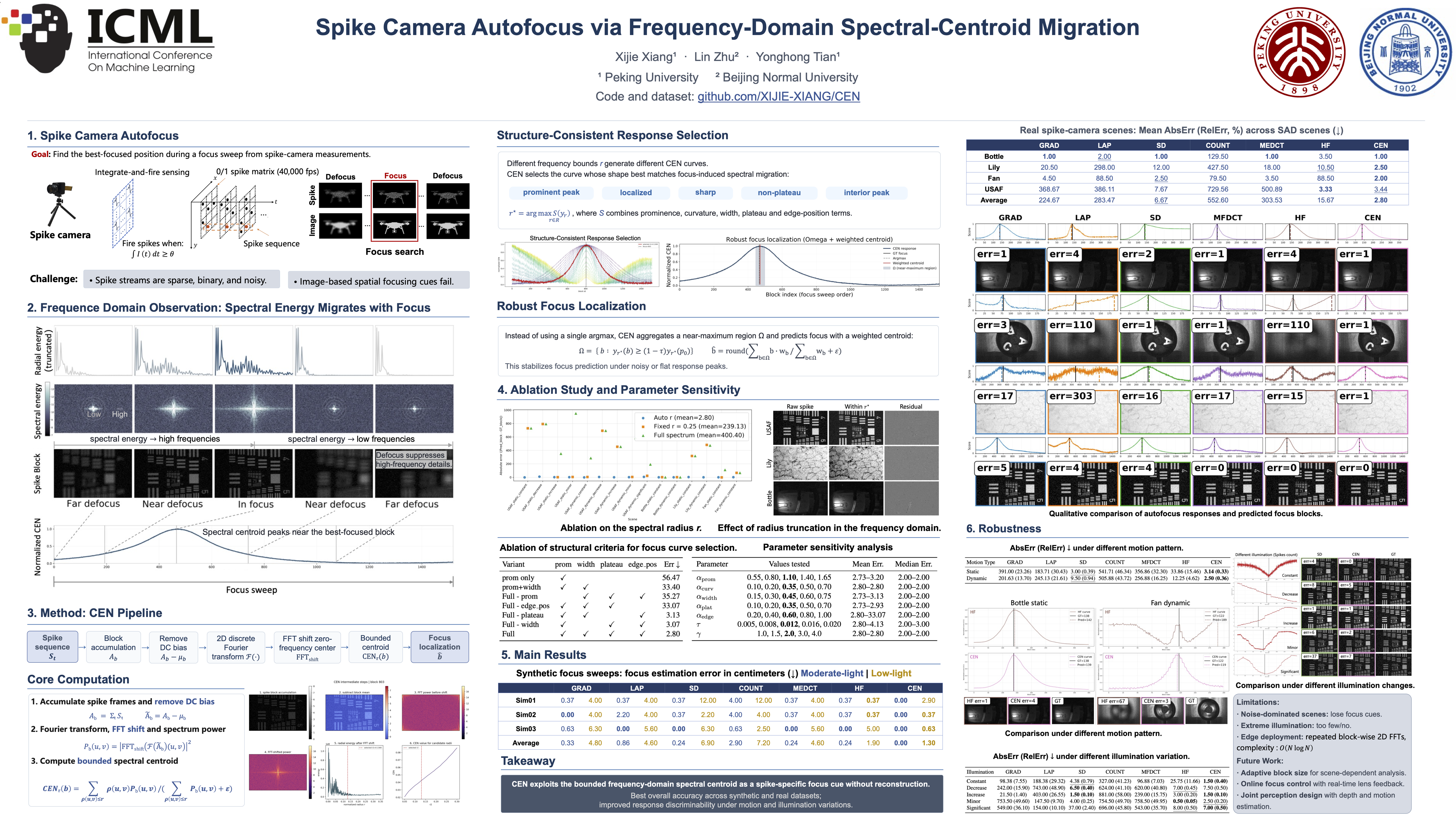
Autofocus for spike cameras is challenging because their sparse binary measurements do not provide reliable instantaneous gradients, and noise or illumination drift often breaks the unimodal assumptions behind conventional focus measures. We show that during a focus sweep, the stable sensor-observable cue is a persistent migration of spectral energy in the frequency domain: energy shifts outward toward higher frequencies when approaching focus and recedes under renewed defocus. Building on this observation, we propose CEN (Centroid-based Energy Navigation), a frequency-domain autofocus method that measures spectral migration via a bounded spectral centroid computed on accumulated spike blocks, without image reconstruction or explicit edge extraction. To handle multi-peak and irregular responses in real scenes, CEN further performs structure-consistent response identification, selecting the frequency bound whose curve exhibits a clear, localized, interior extremum, followed by robust peak localization using a weighted near-maximum centroid. Experiments on spike-camera dataset demonstrate that CEN achieves the best overall accuracy and response discriminability across diverse scenes, motion types, and illumination variation patterns.
Lay Summary
Spike cameras are a new type of visual sensor that can capture very fast changes with low power, but they do not record ordinary images like standard cameras. This makes autofocus difficult, because many common autofocus methods depend on clear image details that spike cameras do not directly provide. In this paper, we study how the information recorded by a spike camera changes when the lens moves from blurry to sharp and then blurry again. We find that, although the raw measurements are sparse, the overall pattern of visual detail changes in a consistent way during this focus sweep. Based on this observation, we design a method called CEN that tracks this change directly from spike data, without first reconstructing normal images. The method also chooses the most reliable focus signal when the measurements are noisy or affected by motion and lighting changes. Experiments on both simulated and real spike-camera data show that CEN estimates focus more accurately and more reliably than previous methods. This work may help spike cameras become more practical for fast, low-power vision systems such as robotics, intelligent sensing, and neuromorphic imaging.