
FUSE: Full‑spectrum Unlearnable Examples via Spectral Equalization
Abstract
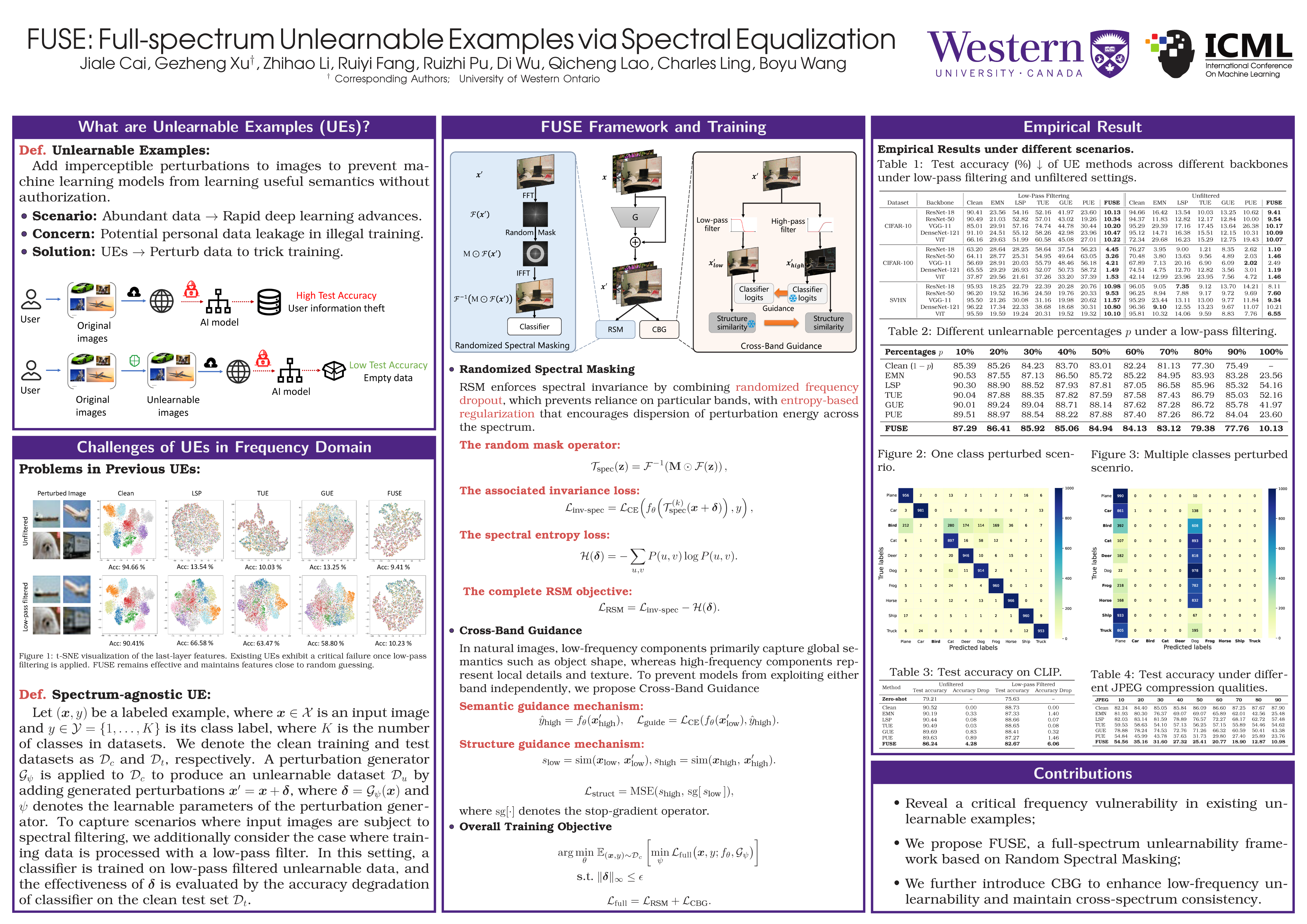
Unlearnable examples (UEs) protect training data by injecting imperceptible perturbations so that models fail to extract exploitable representations. In this paper, we reveal that existing UEs exhibit a critical failure once low-pass filtering is applied, indicating that the effective perturbation signals for unlearnability concentrate predominantly in high frequencies. Hence, we argue that reliable UEs should remain effective across the full spectrum. To this end, we propose Full-spectrum Unlearnable Examples via Spectral Equalization (FUSE), which aims to generate spectrum-agnostic perturbations by equalizing the contributions from different bands and enforcing cross-band consistency. Specifically, FUSE adopts a Random Spectral Masking (RSM) strategy during generator training, which randomly removes a contiguous frequency band, forcing the remaining bands to maintain unlearnability. In addition, FUSE further integrates Cross-Band Guidance (CBG), which enforces mutual consistency between high- and low-frequency components, thereby further enhancing low-frequency unlearnability and regulating high-frequency perturbations to preserve the semantic fidelity of images. Extensive experiments across multiple datasets, architectures, and spectral filtering demonstrate the strong protection achieved by FUSE.
Lay Summary
Many modern AI systems are trained on large collections of online images, often without the creators’ knowledge or permission. One proposed way to protect such data is to slightly modify images so that the changes are invisible to humans but prevent AI models from learning useful information from them. These modified images are called unlearnable examples. In this work, we show that many existing protection methods fail once images are slightly smoothed or compressed, because they mainly rely on fragile high-frequency signals that are easy to remove. To address this problem, we propose a new method called FUSE, which spreads the protective signal more broadly across the image instead of concentrating it in only one type of visual pattern. As a result, the protection remains effective even after common image processing operations. We evaluate FUSE on multiple datasets and AI model architectures, and show that it consistently provides stronger and more reliable protection than previous approaches. Our findings suggest that future data protection methods should be designed to remain robust under realistic image transformations and processing conditions.