
RECOVER: Reliable Detection of Unauthorized Data Usage in Text-to-Image Diffusion Models via Inversion Robustness
Abstract
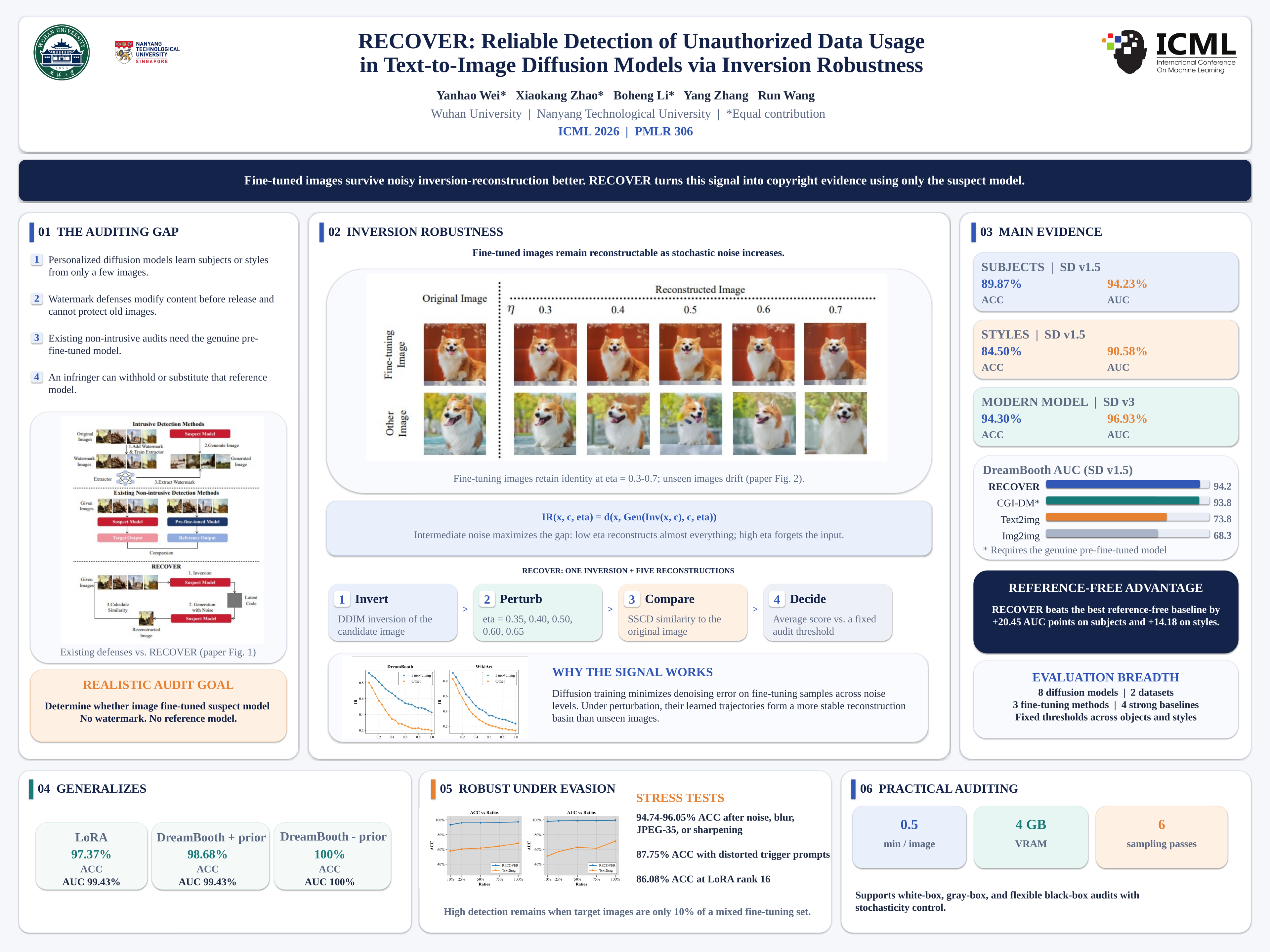
Text-to-Image diffusion models have achieved remarkable success in image generation and are increasingly fine-tuned for personalized use cases. However, many personalized models may incorporate unauthorized data during the fine-tuning process, raising growing concerns about potential copyright infringements. Existing methods either require intrusive modifications to the images to be protected, which not only fail to safeguard previously released images but may also degrade image quality, or rely on the availability of the pre-fine-tuned model, thereby limiting their applicability. To bridge this gap, in this paper, we propose the first non-intrusive copyright authentication framework without pre-fine-tuned model. We reveal that if a model is fine-tuned on a specific image, it learns the denoising trajectory of that image across varying noise levels, allowing it to stably reconstruct the image even under noise perturbations. Motivated by this insight, we propose Reliable dEteCtion Of unauthorized data usage via inVErsion Robustness (RECOVER), an effective non-intrusive detection method without pre-fine-tuned model. Unlike existing methods that rely on external watermarks or discrepancies between the suspect and pre-fine-tuned models, RECOVER directly leverages the robustness observed during the inversion–reconstruction process of the suspect model to determine whether an image was used for fine-tuning. Extensive experiments demonstrate that RECOVER is effective across a wide range of scenarios, consistently outperforming existing methods. Our code is publicly available here.
Lay Summary
AI image generators are often trained on copyrighted artwork without permission. Existing methods to detect this theft are impractical: they either require artists to alter their images beforehand (like adding invisible watermarks), or they require investigators to have access to the original, baseline AI model for comparison. We introduce RECOVER, a new detection tool that requires neither. We discovered that if an AI model was trained on a specific image, it essentially memorizes it. If we add visual "static" to a picture and ask the AI to clean it up, an AI that copied the image will easily and perfectly reconstruct it, while an innocent AI will struggle. This provides creators with a highly effective, practical way to prove their art was used without having to modify their original work.