
Adaptive Multi-Round Allocation with Stochastic Arrivals
Abstract
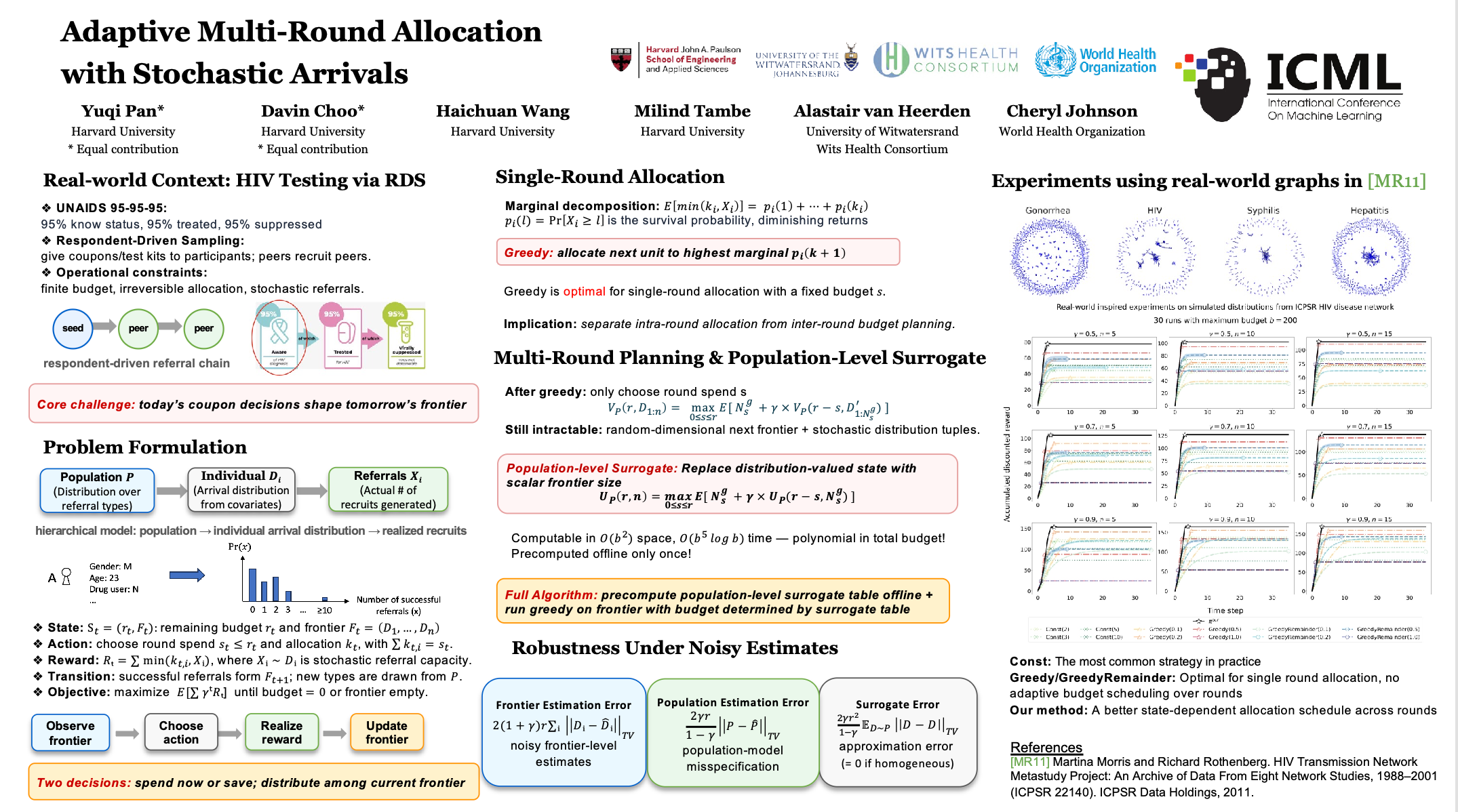
We study a sequential resource allocation problem motivated by adaptive network recruitment, in which a limited budget of identical resources must be allocated over multiple rounds to individuals with stochastic referral capacity. Successful referrals endogenously generate future decision opportunities while allocating additional resources to an individual exhibits diminishing returns. We first show that the single-round allocation problem admits an exact greedy solution based on marginal survival probabilities. In the multi-round setting, the resulting Bellman recursion is intractable due to the stochastic, high-dimensional evolution of the frontier. To address this, we introduce a population-level surrogate value function that depends only on the remaining budget and frontier size. This surrogate enables an exact dynamic program via truncated probability generating functions, yielding a planning algorithm with polynomial complexity in the total budget. We further analyze robustness under model misspecification, proving a multi-round error bound that decomposes into a tight single-round frontier error and a population-level transition error. Finally, we evaluate our method on real-world inspired recruitment scenarios.
Lay Summary
This paper studies how to allocate a limited budget over time when people can recruit others. The goal is to recruit as many people, as quickly as possible, while being able to exploit distributional estimates on how effective a person is at recruiting others. We prove that a simple greedy rule is optimal for a single round, but planning over multiple rounds is much harder. To tackle this, we design a population-level surrogate for subsequent rounds to enable an efficient planning algorithm. Our proposed method is then empirically validated on real-world inspired recruitment scenarios.