
Autobidding Auctions with LLM-Powered Creatives
Abstract
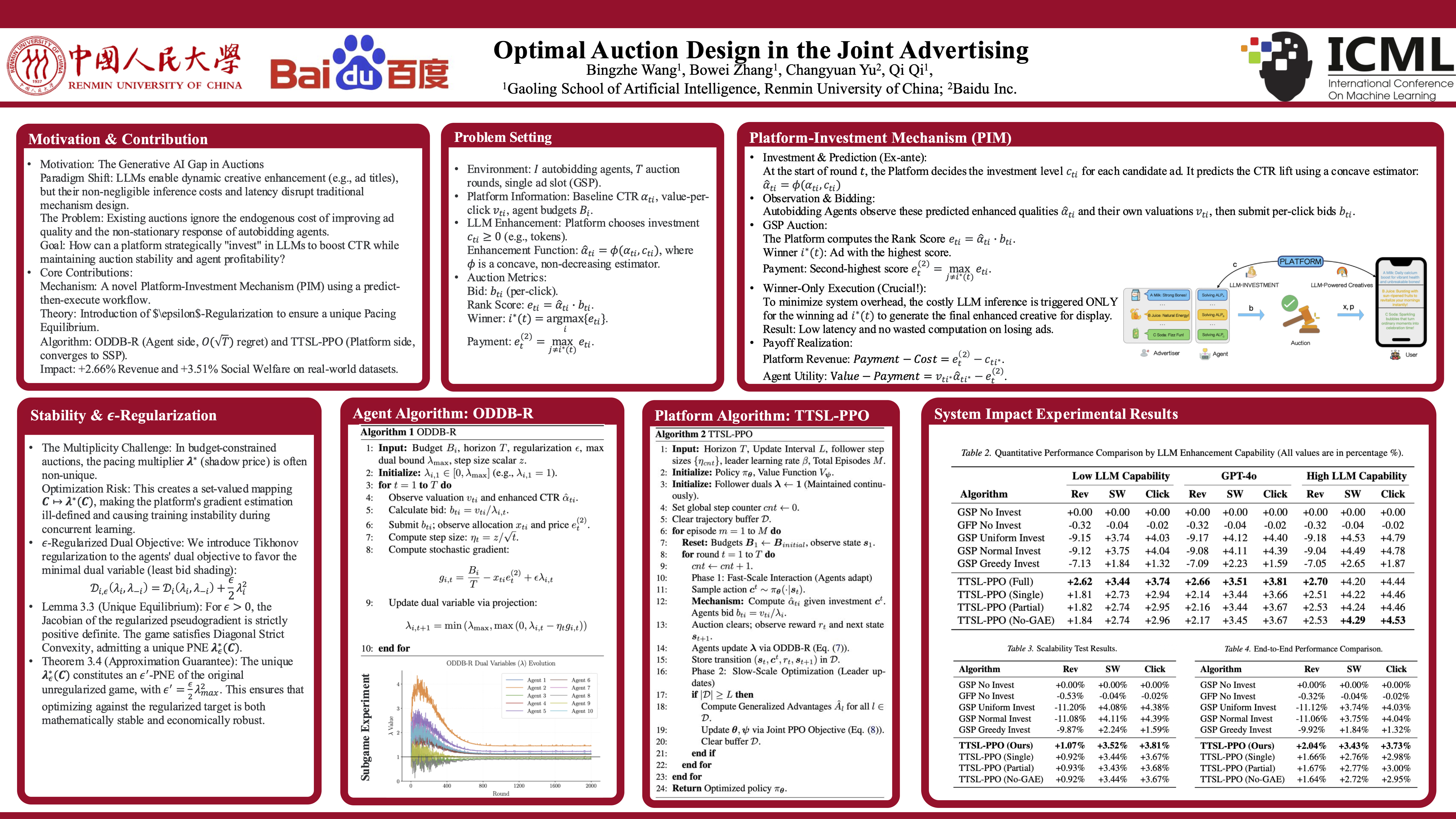
The integration of Large Language Models (LLMs) into ad auctions for dynamic creative enhancement presents a paradigm shift, yet introduces significant computational costs disrupting traditional mechanism design. This paper provides a comprehensive game-theoretic and algorithmic framework for such LLM-augmented auctions. We model the system as a dynamic Stackelberg game where the platform (leader) strategically invests in creative enhancement to maximize net revenue, while autobidding agents (followers) respond to enhanced ad qualities under budget constraints. To endogenize inference costs, we propose the Platform-Investment Mechanism (PIM). We develop the Online Dual-Descent Bidding with Regularization (ODDB-R) algorithm for agents to learn optimal bidding strategies in this non-stationary environment. For the platform, we formulate the investment problem as a continuous control task and solve it using a Two-Timescale Stackelberg Learning with Proximal Policy Optimization (TTSL-PPO) algorithm, which provably converges to a Stackelberg Stationary Point. Extensive experiments on large-scale real-world datasets and state-of-the-art LLMs demonstrate that our framework significantly outperforms heuristic baselines in revenue, social welfare, and user engagement.
Lay Summary
Online advertising is undergoing a transformation as AI begins to automatically rewrite ad titles to make them more relevant to users. However, using powerful AI models to enhance thousands of ads in real-time is incredibly expensive and risks slowing down the auction system. Current auction designs also struggle to balance these high costs against the potential for increased profits. We solved this by creating a mathematical framework where the ad platform acts as a strategic investor. Instead of rewriting every ad, our system predicts which improvements are worth the cost and only uses the expensive AI to generate a final title for the winning ad. We also developed a learning algorithm that helps the platform adjust its investment strategy as the market changes and advertisers respond. Our tests on large-scale real-world data demonstrate that this approach significantly boosts revenue and user engagement while keeping computational costs manageable. This work provides a vital blueprint for the future of digital markets, showing how platforms can use AI not just to set prices, but to actively improve the quality of the content they deliver to users.