
Bilevel Optimization over Saddle Points of Zero-Sum Markov Games
Abstract
Lay Summary
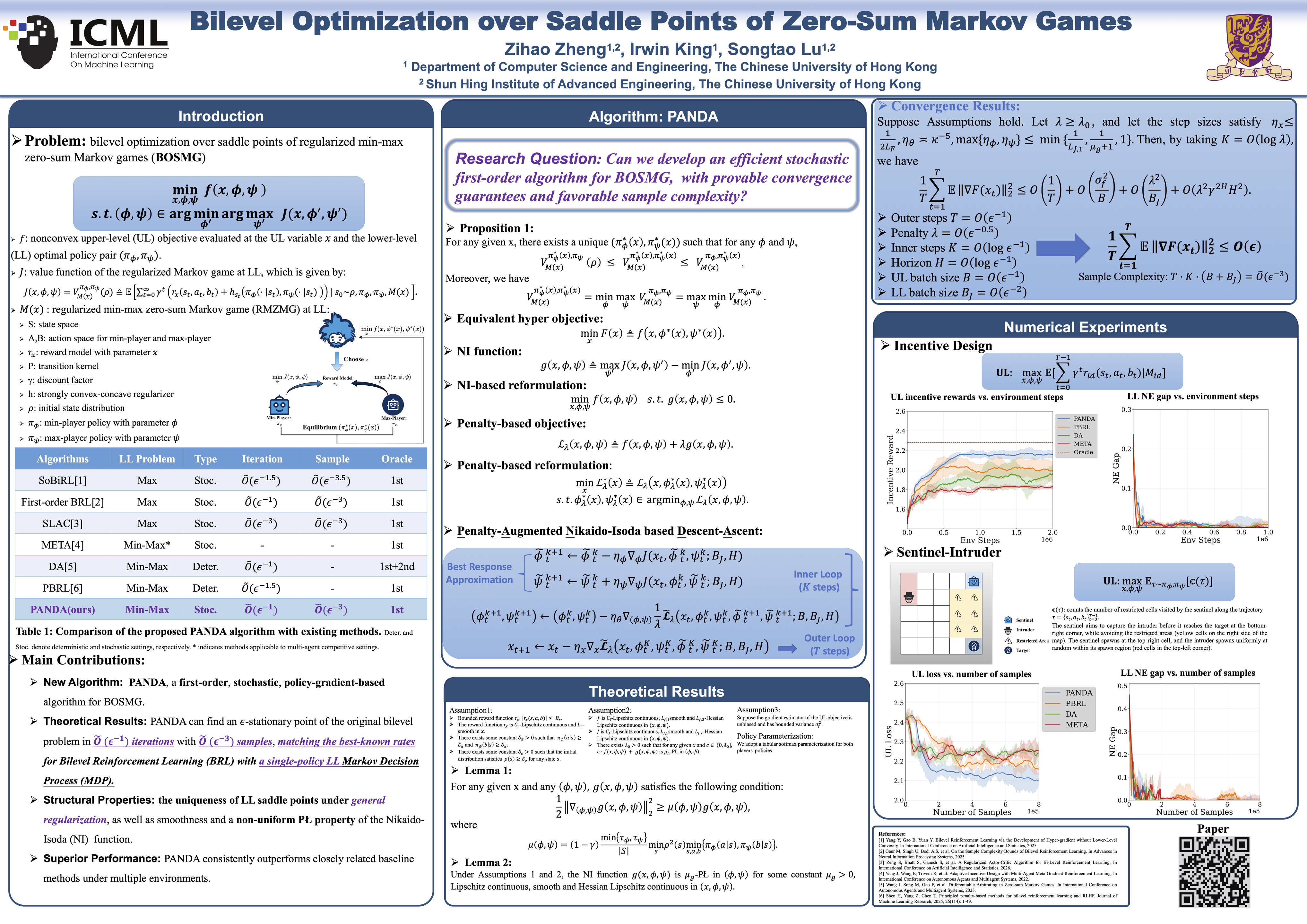
Many reinforcement learning (RL) problems involve two levels of decision-making. For example, an upper-level (UL) learner may set rules or incentives, while lower-level (LL) decision-makers respond strategically to those choices. Existing bilevel RL methods usually assume that the LL decision process involves only one policy, which makes them less suitable for competitive settings where two sides interact with conflicting goals. This paper studies a more general setting where the LL problem is a regularized two-player zero-sum Markov game. We propose PANDA, a new first-order learning algorithm for solving this type of bilevel RL problem. PANDA uses a penalty-based formulation and a game-theoretic measure called the Nikaido–Isoda function to guide learning, avoiding expensive second-order computations and difficult hypergradient calculations. We prove that PANDA converges under broad conditions, without requiring the UL or LL objectives to be convex. Our theoretical rates match the best known results for simpler bilevel RL settings, and experiments show that PANDA performs better than closely related baselines. This work provides a more practical foundation for learning in hierarchical RL problems with strategic competition.