
Explainable Forensics of Manipulated Segments in Untrimmed Long Videos
Abstract
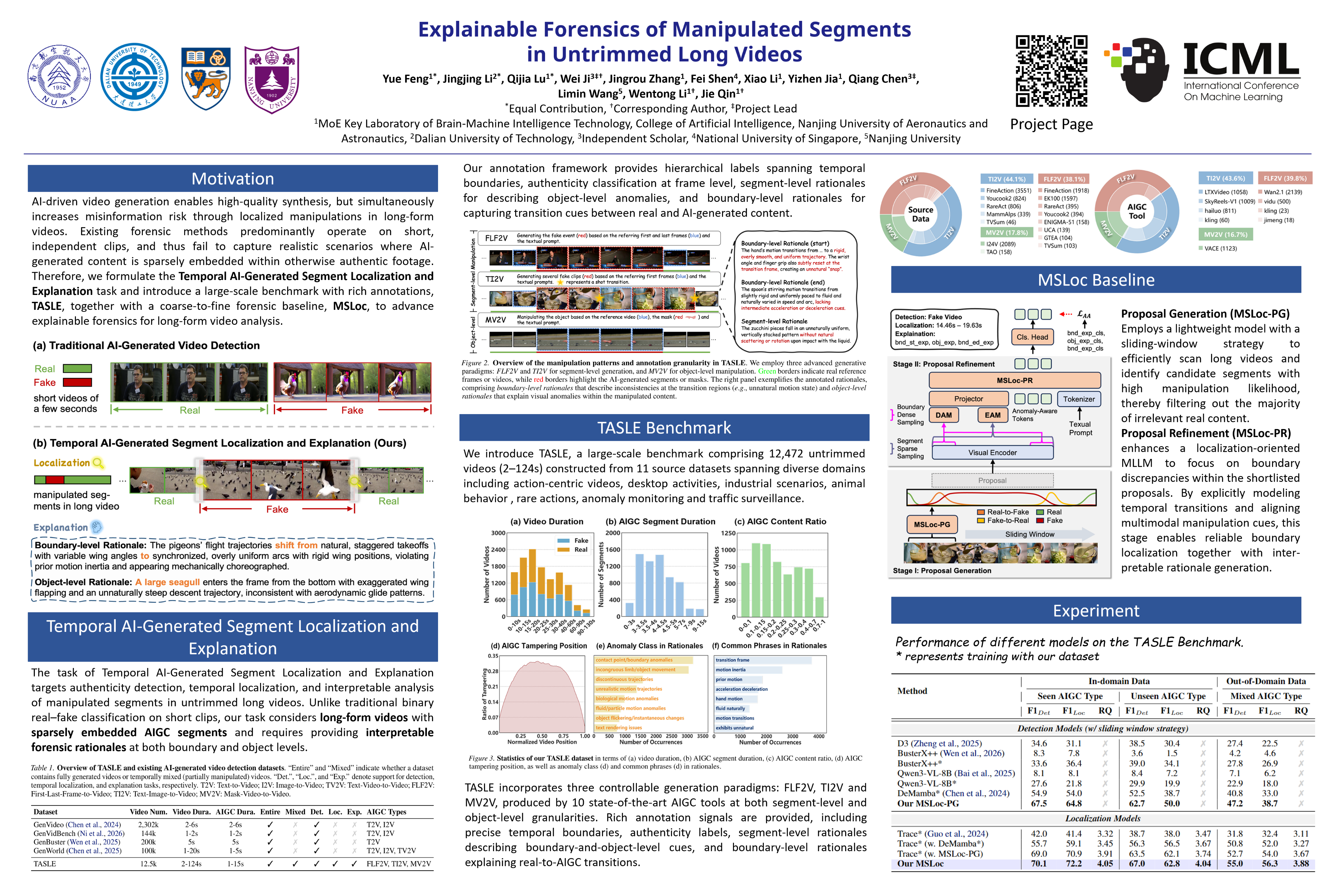
The rapid advancement of AI-driven video generation has transformed content creation, while simultaneously increasing the risk of misinformation through localized manipulations in long-form videos. Existing video forensic methods predominantly operate on short, independent clips, and thus fail to capture realistic scenarios where AI-generated content is sparsely embedded within otherwise authentic footage. To bridge this gap, we formulate the task of Temporal AI-Generated Segment Localization and Explanation, which targets authenticity detection, temporal localization, and interpretable analysis of manipulated segments in untrimmed long videos. We further introduce TASLE, a large-scale benchmark comprising 12,472 untrimmed videos with diverse manipulation patterns and rich annotation signals, including temporal boundaries, authenticity labels, and segment-level rationales. In addition, we propose MSLoc, a coarse-to-fine forensic baseline that combines a boundary-sensitive proposal generation module for efficient long-video scanning with an MLLM-based refinement module for precise boundary localization and interpretable reasoning. Experiments validate the effectiveness of the proposed baseline, highlighting the importance of segment-level explainable forensics for long-form AI-generated video analysis. Dataset and code will be made publicly available.
Lay Summary
AI-generated videos are now so realistic that someone could replace a few seconds of a real video with fake footage without anyone noticing. Current detection tools can only tell whether a short clip is entirely real or entirely fake, but fail when fakes are hidden inside longer videos. We built a dataset of over 12,000 long videos with hidden fake segments, annotated with where the fakes are and what gives them away. We also developed a two-step detection method that first roughly scans a full video to flag suspicious segments, then zooms in to pinpoint the tampered boundaries and explain the reasoning — like a detective surveying a scene and then examining the evidence. As AI video generation becomes more accessible, this work helps researchers build better tools for spotting hidden manipulations and protecting the public from video-based misinformation.