
Beyond Continuity: Simulation-free Reconstruction of Discrete Branching Dynamics from Single-cell Snapshots
Abstract
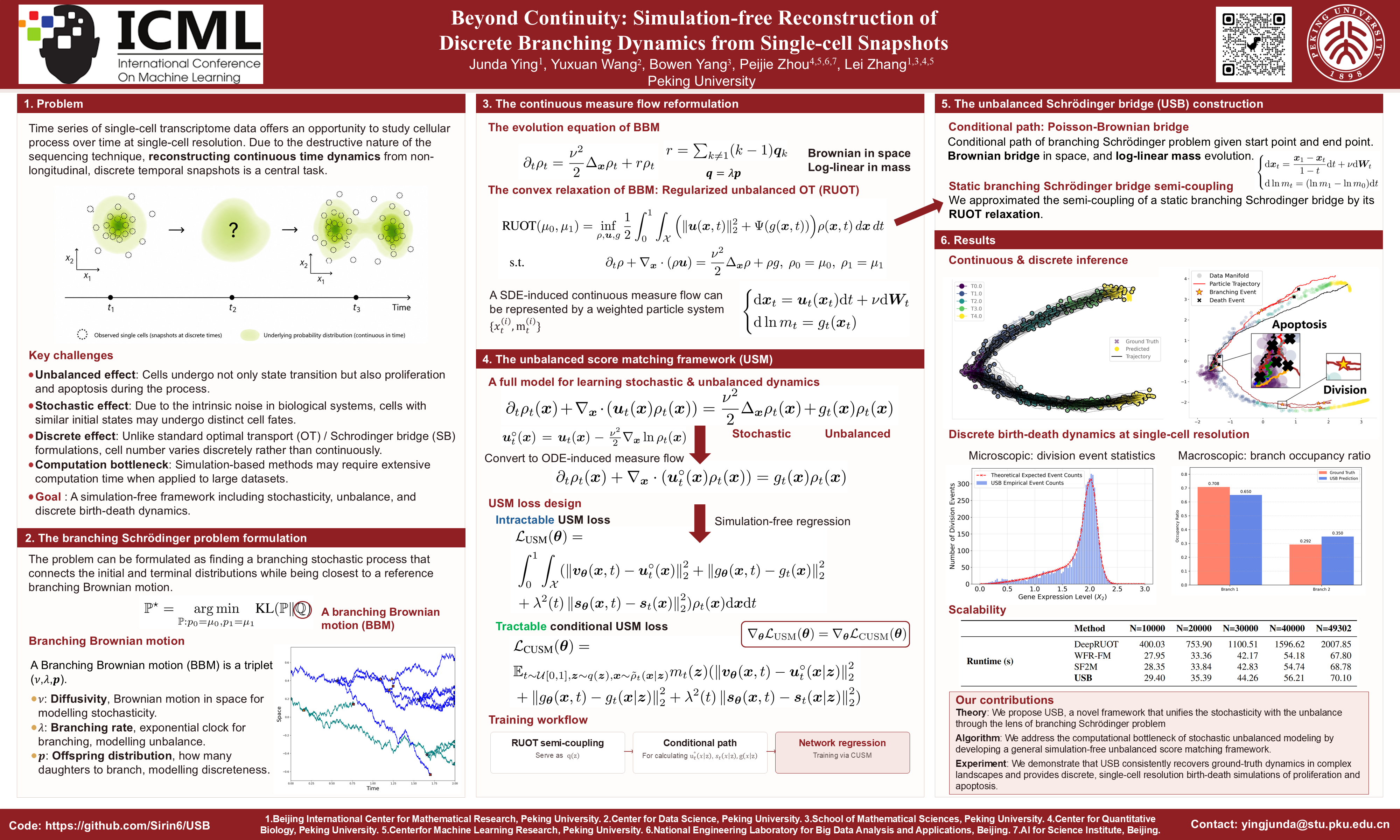
Inferring cellular trajectories from destructive snapshots is complicated by the challenges of stochasticity and non-conservative mass dynamics such as cell proliferation and apoptosis. Existing unbalanced Optimal Transport (OT) methods treat mass as a continuous fluid, performing inference at the population level. However, this macroscopic view often fails to capture the discrete, jump-like nature of birth-death events at single-cell resolution, which is essential for understanding lineage branching and fate decisions. We present Unbalanced Schrödinger Bridge (USB), a simulation-free framework for learning underlying dynamics that effectively integrates both stochastic and unbalanced effects which also models the discrete, jump-like birth–death dynamics at single-cell resolution. Theoretically, USB provides a tractable solution to the Branching Schrödinger Bridge (BSB) problem, offering a rigorous microscopic interpretation where individual cells undergo both Brownian motion and discrete birth-death jumps. Technically, the method implements an efficient solver by introducing a simulation-free training objective that effectively scales to high-dimensional omics data. Empirically, we demonstrate on both simulated and real-world datasets that USB not only achieves trajectory reconstruction performance better than or comparable to deterministic baselines but also uniquely enables realistic discrete simulation of birth-death dynamics at single-cell resolution.
Lay Summary
Given snapshots of single-cell sequencing data at discrete time points, we wondered what happens between these time points. Utilizing unbalanced Schr\"odinger bridge, we tried to find the most likely stochastic process which interpolates these snapshots, simutaneously modelling the cell proliferation/apoptosis, noisy dynamics, and discrete cell number variation. Our work can be used to reconstruct continuous trajectories from observed snapshots. A more realistic trajectory helps understand the complex dynamics of biological processes.