
Physics-Informed Pre-training on Efficient Electron-Density Images for Organic Material Property Prediction
Zhixiang Cheng ⋅ Hongxin Xiang ⋅ Mingquan Liu ⋅ Tengfei Ma ⋅ Yingzhuo Tu ⋅ Wenjie Du ⋅ Bosheng Song ⋅ Yiping Liu ⋅ xiangxiang Zeng
Abstract
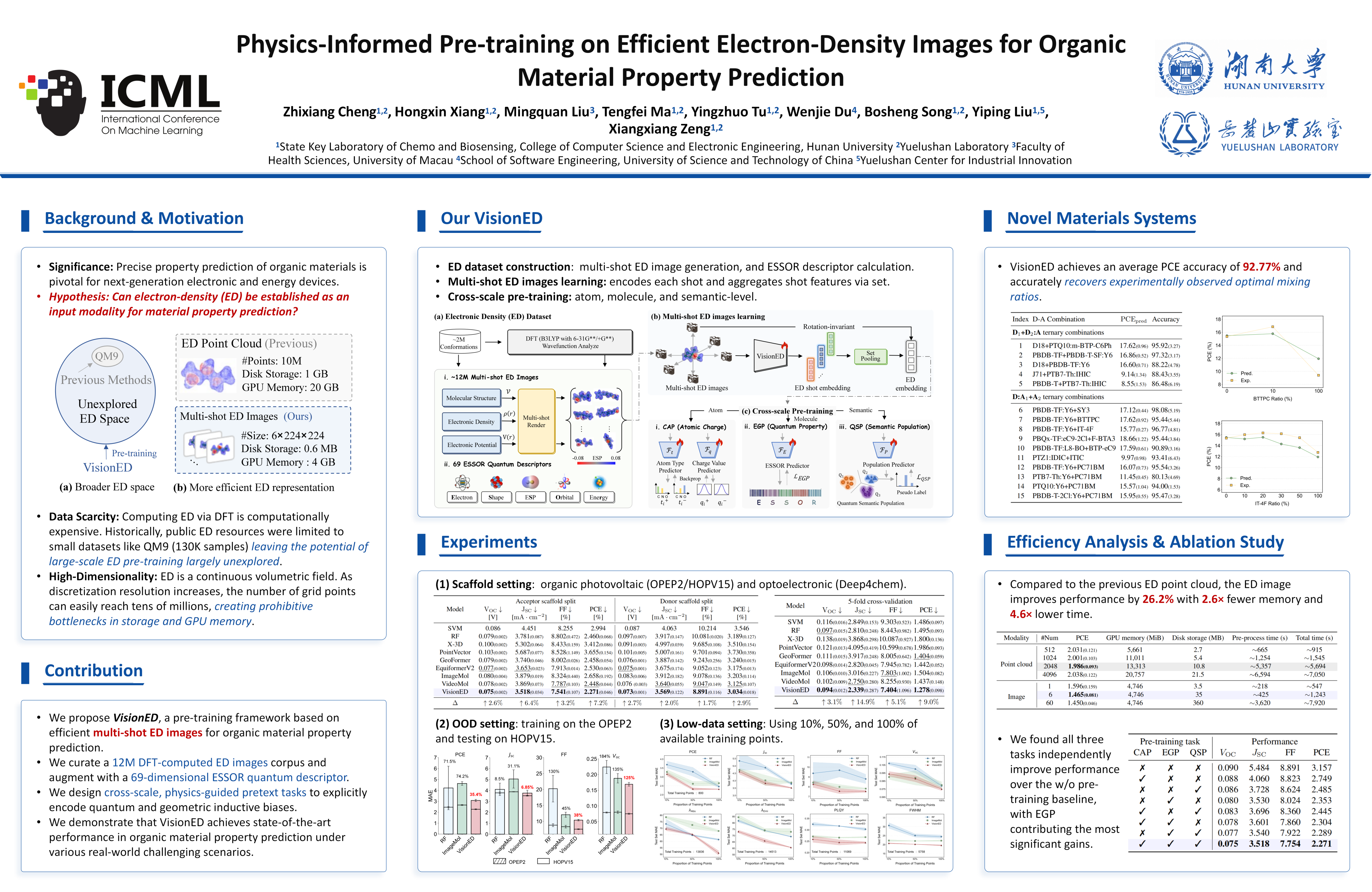
Precise property prediction of organic materials is pivotal for next-generation electronic and energy devices. In density functional theory (DFT), the electron density (ED) serves as the fundamental determinant of material properties. Yet, establishing it as an input modality for material property prediction has been impeded by two practical barriers: scarce large-scale ED data and the enormous computational complexity of ED representation. To bridge these gaps, we introduce VisionED, an efficient physics-informed model pre-trained on electron-density images. We curate a dataset of 2 million molecules and represent ED as multi-shot images that efficiently encode both geometric and electronic structure. VisionED is then pre-trained on 12 million multi-shot ED images via cross-scale, physics-informed pretext tasks. Empirical evaluations on photovoltaic and organic chromophore datasets show that VisionED outperforms state-of-the-art baselines by up to 27.0\%, exhibiting superior robustness under distribution shifts and data scarcity. Notably, the model generalizes to unseen device-scale applications, successfully recovering experimental trends and mixing-ratio effects in ternary blends with an average accuracy of 92.77\%. Moreover, relative to the previous ED point cloud, the ED image improves performance by 26.2\% with 2.6$\times$ fewer memory and 4.6$\times$ lower time. The code and data are available at https://github.com/ZhixiangCheng/VisionED.
Lay Summary
Accurately predicting the properties of organic materials is crucial for designing better solar cells, displays, and energy devices. A molecule’s electron density (ED), which describes how electrons are distributed, contains rich information about how the material will behave. However, existing ED representations are often too computationally expensive for practical machine learning. We propose VisionED, a physics-informed model that uses efficient ED images instead of costly ED point clouds. Pre-trained on 12 million ED images, VisionED learns physics-aware patterns that improve property prediction across organic materials.
Video
Chat is not available.
Successful Page Load