
DITING: A Weak Degradation Listener for Battery Lifetime Early Prediction
Abstract
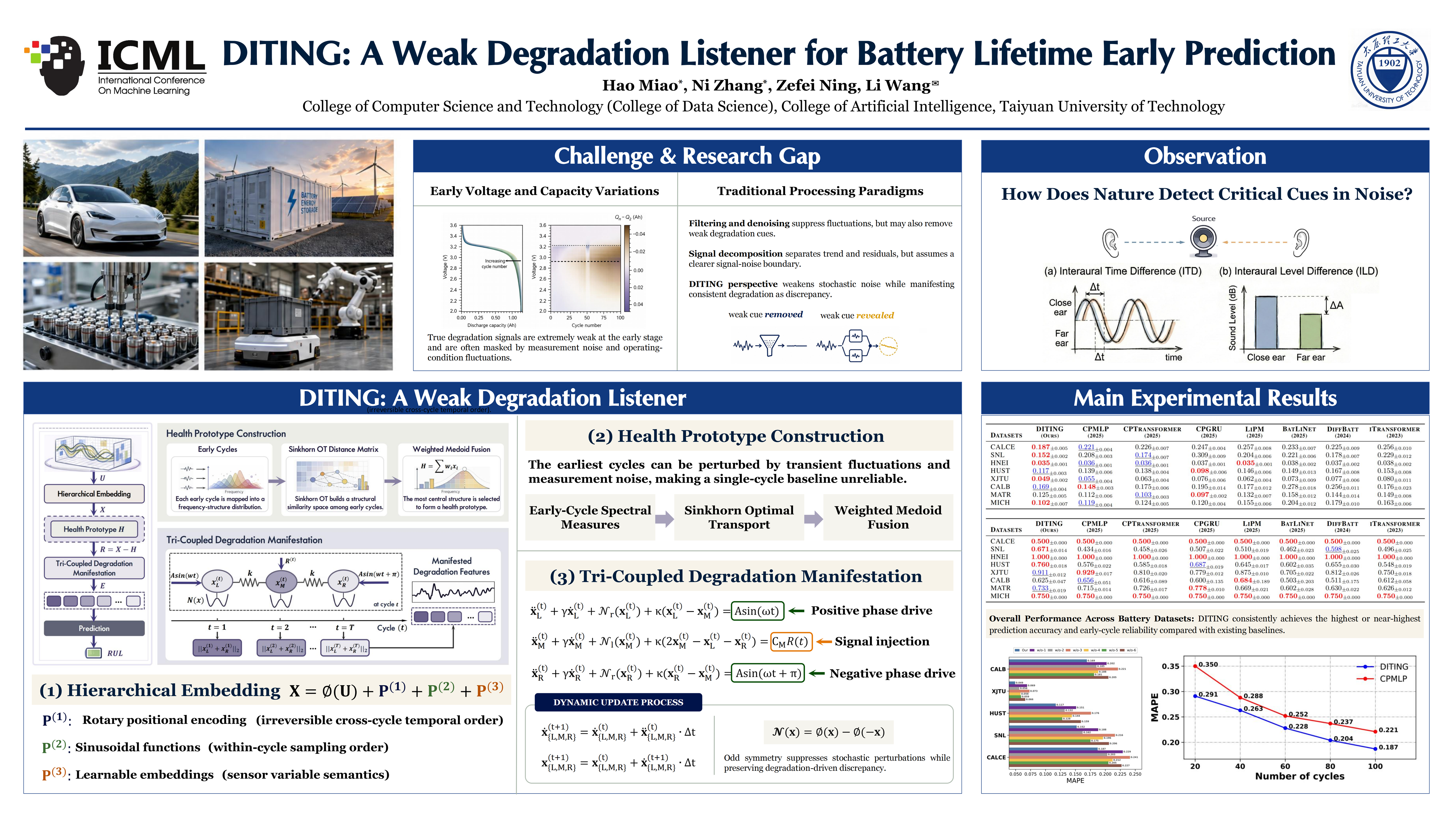
Battery lifetime early prediction is crucial for safety assessment and decision planning, yet early-stage degradation signals are extremely weak and difficult to distinguish from stochastic noise. Existing methods primarily rely on denoising or signal decomposition, which may lose critical degradation cues. In nature, most organisms exhibit the binaural effect, exploiting discrepancies between left and right auditory inputs to enhance perceptual reliability. Inspired by this, we propose DITING, a weak degradation listener for battery lifetime early prediction. We first employ optimal-transport-based selective matching to extract a robust health template from initial cycles, and further design a tri-coupled degradation manifestation mechanism to distinguish degradation signals from noise. By exploiting the randomness of noise, matched responses under symmetric coupling suppress stochastic fluctuations, while degradation-driven cumulative deviations propagate through the coupling process to form stable bilateral discrepancies, thereby amplifying weak early-stage cues for lifetime prediction. Experiments on various datasets demonstrate that DITING achieves state-of-the-art performance and provides more reliable early support for full-lifecycle battery management.
Lay Summary
Rechargeable batteries are central to electric vehicles, grid storage, and portable electronics, but their lifetime is difficult to estimate when only the first few charging cycles are available. At this early stage, the signs of aging are often weak and easily hidden by random measurement variations. A common strategy is to remove noise, but this can also remove the small changes that later determine battery failure. We propose DITING, a machine learning method inspired by the way biological hearing systems compare signals from two ears to detect weak sounds in noisy environments. The method first builds a reliable reference for the battery’s early healthy state. It then compares two mirrored responses to the remaining signal, so that random fluctuations tend to cancel while consistent aging-related changes become easier to observe. This work provides a new way to extract early degradation information from noisy battery data. It may support earlier lifetime estimation, safer battery use, and better planning for battery maintenance and replacement.