
Explicit representation of germline and non-germline residues improves antibody language modeling
Abstract
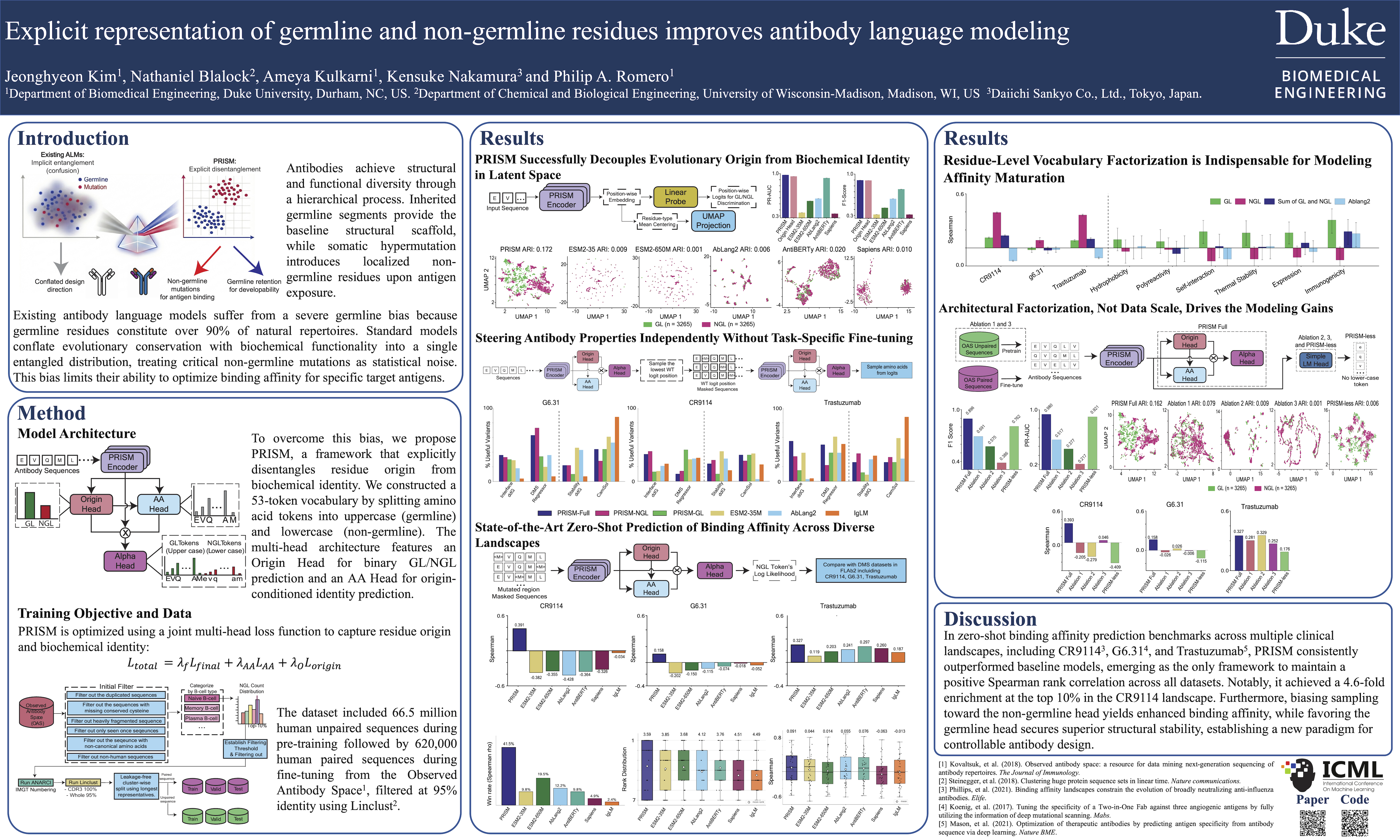
Antibodies originate from germline templates and are diversified by somatic hypermutation, producing sequences in which conserved germline residues scaffold structure while rare non-germline (NGL) substitutions refine antigen binding. Current antibody language models (ALMs) treat all residues equivalently and inherit a germline bias that systematically down-weights functionally critical NGL mutations as statistical noise. We introduce PRISM, a germline-aware ALM that explicitly represents germline and non-germline residues as distinct token types over a factorized 53-token vocabulary. PRISM achieves state-of-the-art pseudo-perplexity in hypervariable CDRs and is uniquely positively correlated with experimental binding affinity across three deep mutational scanning landscapes on which all compared ALMs anti-correlate. The dual-vocabulary further enables property-specific controllable generation previously unattainable with entangled ALMs. NGL-directed sampling improves physics-based binding scores while GL-directed sampling preserves stability and solubility. These results establish disentangled germline/non-germline representation as a substantive advance in antibody language modeling.
Lay Summary
Antibodies are the body's targeted defense molecules, and they are also one of medicine's most successful drug classes, used to treat cancer, autoimmune disease, and infections. Each antibody starts from a generic "germline" template, and our immune system then sprinkles a small number of rare mutations across it that determine which target the antibody actually grabs onto. AI models that design antibodies have struggled with this imbalance: because more than 90% of an antibody matches its template, models learn to treat the rare mutations, exactly the parts that drive function, as noise to be ignored. We built PRISM, an antibody language model that gives template residues and mutated residues their own separate identities in its vocabulary, rather than mixing them together. This lets the model learn the two kinds of positions independently, and lets users dial each one up or down at will. PRISM predicts which antibody mutations improve binding strength on every benchmark we tested, where existing models often predict the opposite. It also lets designers tune binding and manufacturability separately, a long-standing trade-off in therapeutic antibody engineering.