
MER-DG: Modality-Entropy Regularization for Multimodal Domain Generalization
Abstract
Lay Summary
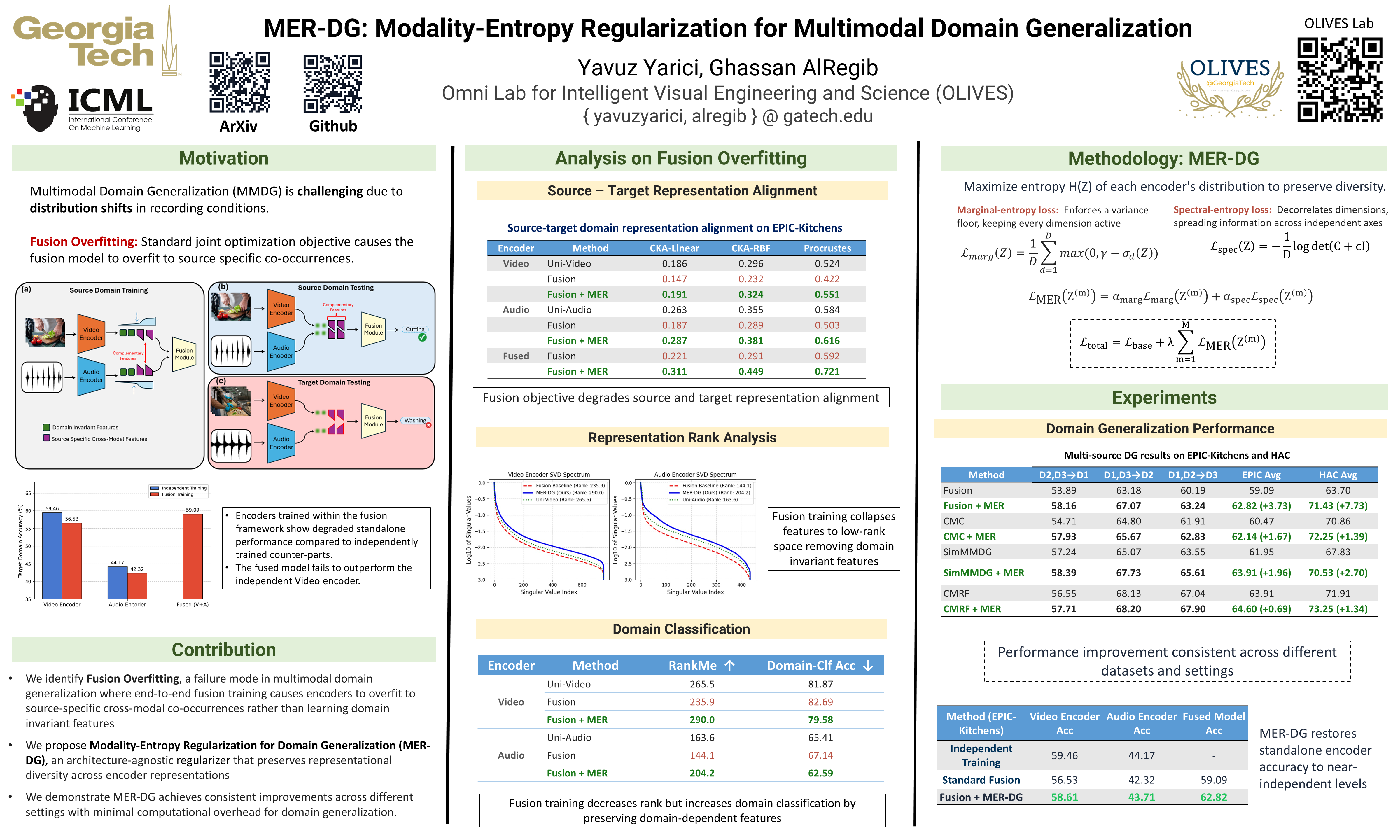
AI systems increasingly combine different types of data, such as video and audio, since each provides complementary information about what is happening. But these systems often fail when deployed in environments that differ from their training conditions, and we identified a specific reason why. When the video and audio parts of the model are trained jointly, each learns to lean on the other in ways tied to the training environment, a phenomenon we call Fusion Overfitting. Consider a model trained to recognize chopping in quiet home kitchens: the video stream learns to expect a particular sound pattern, and the audio stream a particular motion. This shortcut works at home but fails in a noisy commercial kitchen, where those patterns no longer line up. Our method, MER-DG, encourages each part of the model to keep its internal features diverse during training, so neither becomes overly reliant on the other. It works as a simple add-on to existing multimodal systems. Across two action-recognition benchmarks, MER-DG improves accuracy by about 5% on standard models and 2% on the best existing methods, with the largest gains when inputs are noisy or one stream is missing, situations common in real-world deployment.