
CURE: Consistency-under-Unified Semantic Regularization for Generalized Category Discovery
Abstract
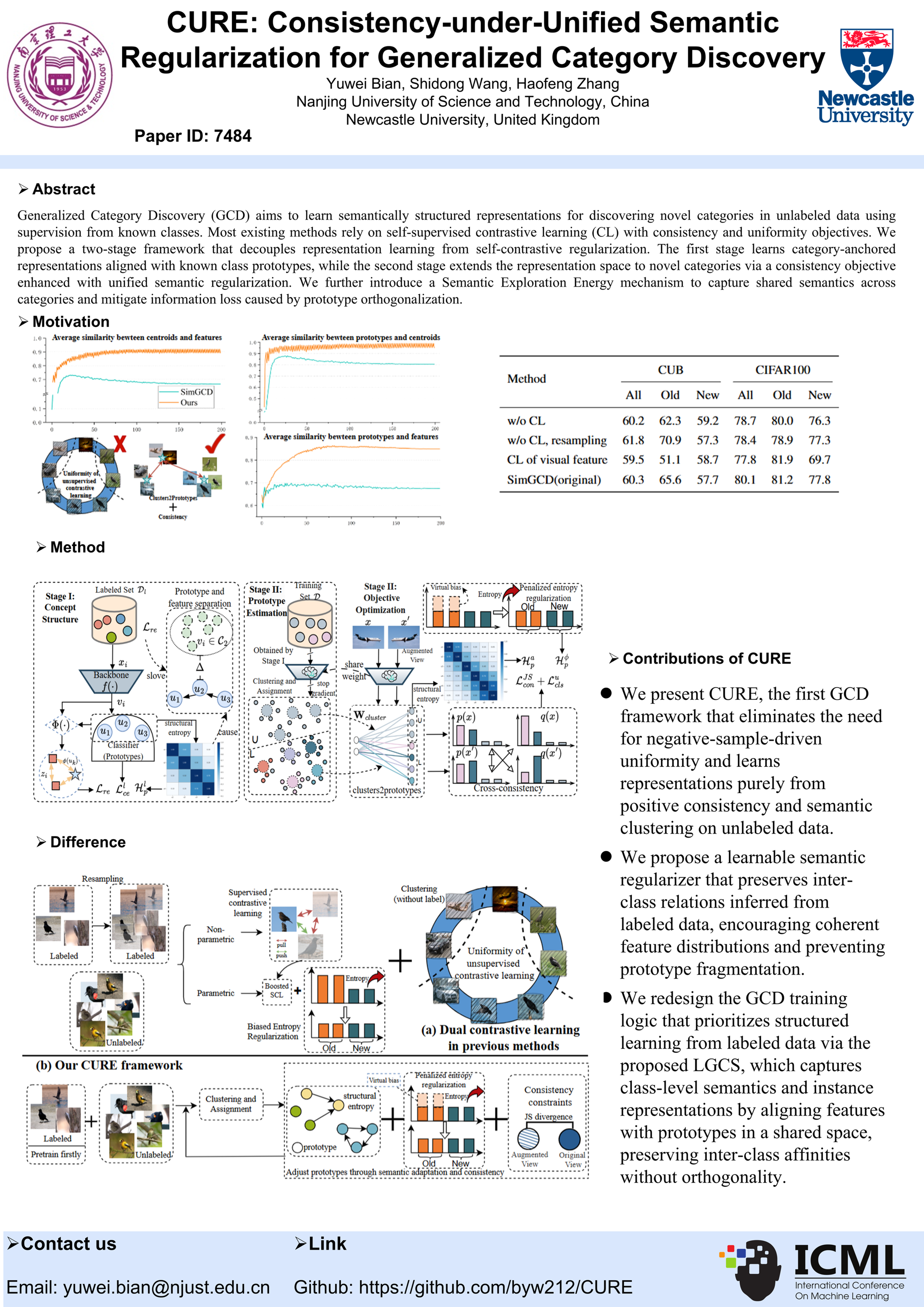
Generalized Category Discovery (GCD) aims to learn semantically structured representations for discovering novel categories in unlabeled data using supervision from known classes. Most existing methods rely on self-supervised contrastive learning (CL) with consistency and uniformity objectives. We identify an inherent optimization conflict between these objectives: while uniformity enforces global feature dispersion, it can hinder the formation of class-discriminative and semantically coherent structures. To address this issue, we propose a two-stage framework that decouples representation learning from self-contrastive regularization. The first stage learns category-anchored representations aligned with known class prototypes, while the second stage extends the representation space to novel categories via a consistency objective enhanced with unified semantic regularization. We further introduce a Semantic Exploration Energy mechanism to capture shared semantics across categories and mitigate information loss caused by prototype orthogonalization. The resulting framework, termed Consistency-under-Unified Semantic Regularization(CURE), achieves state-of-the-art performance on multiple benchmarks and substantially reduces the performance gap between known and novel categories.
Lay Summary
Generalized Category Discovery studies how an AI system can learn from some labeled examples while also finding new, previously unseen categories in unlabeled data. For example, a system may know several types of birds and then be asked to organize many new bird images, some of which belong to species it has never been told about. Many existing approaches try to spread all images apart while also keeping similar images together. However, these two goals can sometimes work against each other: forcing everything to be too evenly separated may make it harder for the system to form clear and meaningful groups. We propose CURE, a two-step learning framework that separates these goals. First, the model learns reliable knowledge from the labeled categories. Then, it uses this knowledge to better explore and organize the unlabeled data, including new categories. CURE also preserves shared information across different categories, so the model does not lose useful common patterns while trying to separate categories.