
Certified Circuits: Stability Guarantees for Mechanistic Circuits
Abstract
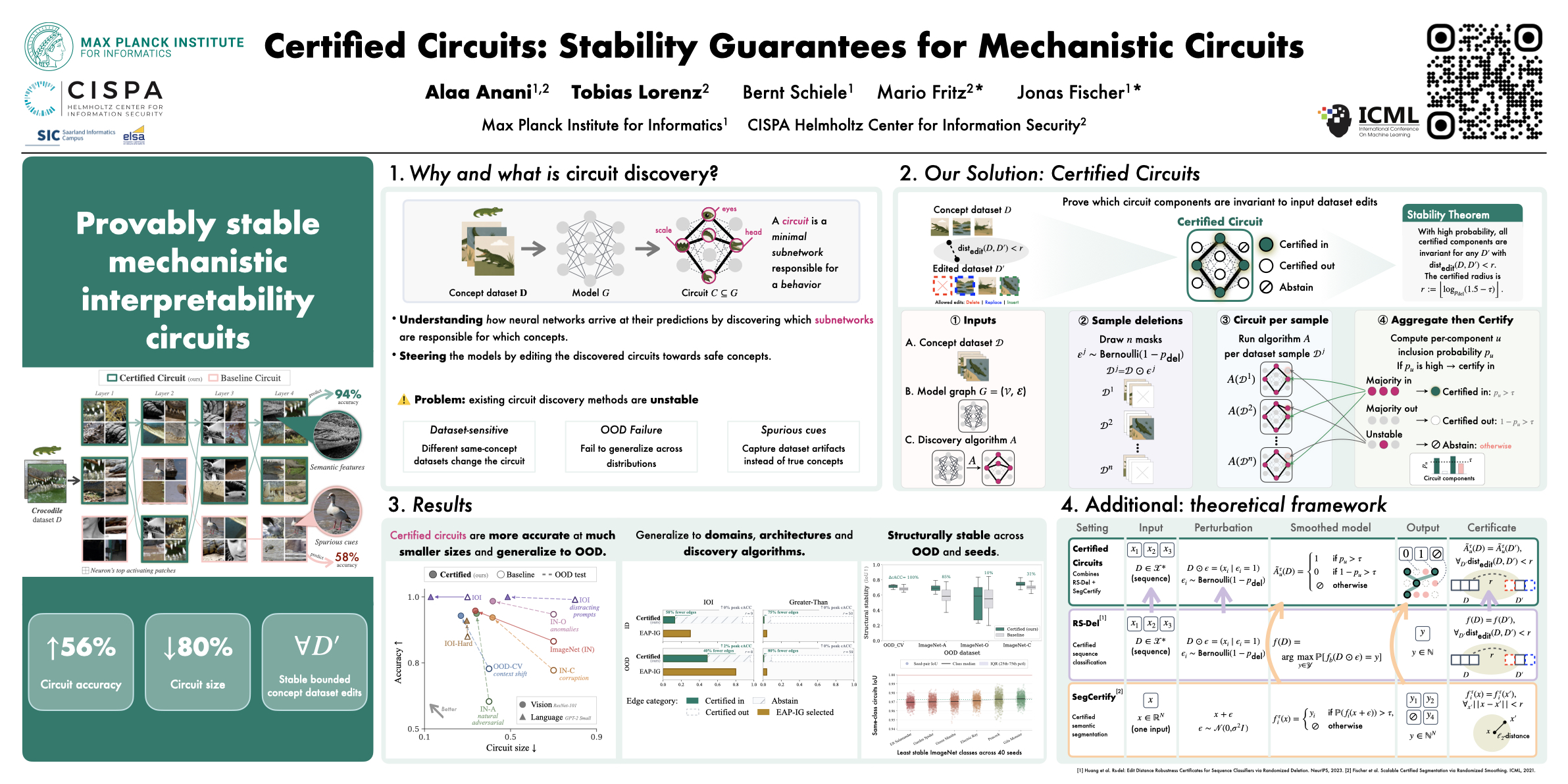
Understanding how neural networks arrive at their predictions is essential for debugging, auditing, and deployment. Mechanistic interpretability pursues this goal by identifying circuits—minimal subnetworks responsible for specific behaviors. However, existing circuit discovery methods are brittle: circuits depend strongly on the chosen concept dataset and often fail to transfer out-of-distribution, raising doubts whether they capture the concept or merely dataset-specific artifacts. We introduce Certified Circuits, which provide provable stability guarantees for circuit discovery. Our framework wraps any black-box discovery algorithm with randomized data subsampling to certify that inclusion decisions over circuit components—neurons or edges of the model graph, depending on the base algorithm—are invariant to bounded edit-distance perturbations of the concept dataset. Unstable components are abstained from, yielding circuits that are more compact and more accurate. We validate across three architectures (ResNet, ViT, GPT-2) on vision (ImageNet and four OOD datasets) and language (IOI, IOI-Hard, Greater-Than) tasks. Certified circuits achieve up to 56% higher accuracy and up to 80% fewer components, and remain reliable where baselines degrade. Certified Circuits puts circuit discovery on formal ground by producing mechanistic explanations that are provably stable and better aligned with the target concept. Code: https://github.com/AlaaAnani/certified-circuits.
Lay Summary
Modern AI systems can make accurate predictions, but it is often hard to understand which parts of the system are responsible for a specific behavior. Researchers study “circuits”: small groups of internal components that appear to explain how a model recognizes a concept, such as a crocodile in an image or a grammatical pattern in text. However, existing methods for finding these circuits can be unstable: changing just a few examples in the dataset may lead to a different circuit, making it unclear whether the circuit captures the real concept or accidental details of the data. We introduce Certified Circuits, a method that makes circuit discovery more reliable. Our approach repeatedly runs a circuit-finding method on random subsets of the data and keeps only the components whose role is stable across these changes. This gives a formal guarantee that the selected circuit will not change under a bounded number of dataset edits. Across image and language models, Certified Circuits produces smaller, more accurate circuits that generalize better to new settings. This can help researchers build more trustworthy explanations of AI behavior.