
MAST: Motif-Augmented Diffusion with Search Tree for Spectroscopic Molecular Structure Elucidation
Abstract
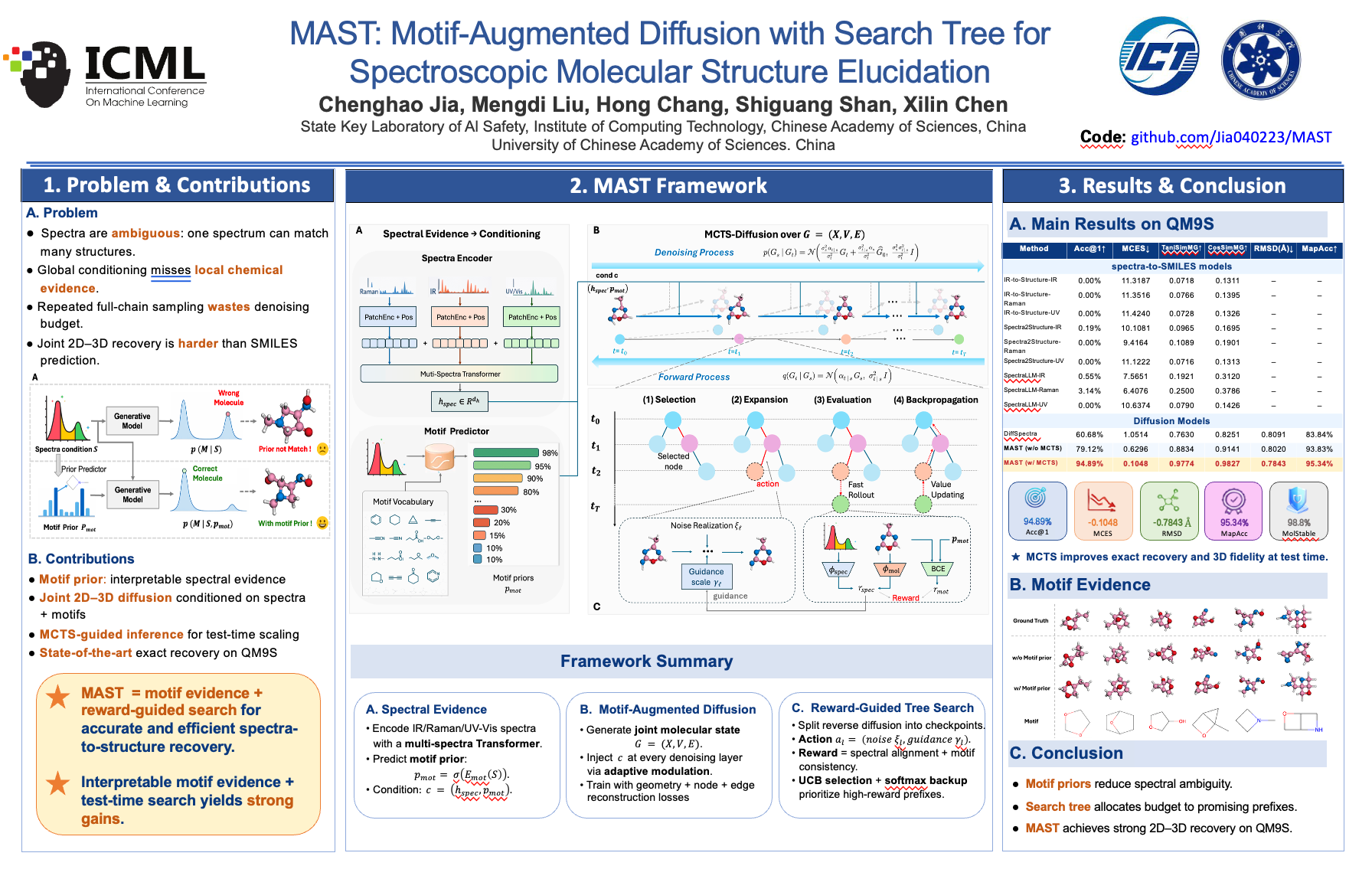
Elucidating molecular structures from spectra is a foundational problem in chemical and materials characterization, yet remains challenging due to spectral ambiguity and the vast molecular space. Although recent diffusion-based generators show strong promise for spectra-conditioned elucidation, existing methods struggle to learn robust spectra-structure relationships from limited paired data when relying solely on global spectral representation. Moreover, the repeated full sampling inference strategy incurs substantial computation overhead. To address these limitations, we propose MAST, a Motif-Augmented diffusion framework with Search Tree, for joint 2D-3D spectroscopic molecular structure elucidation. MAST introduces explicit, interpretable motif priors as intermediate evidences throughout denoising, reducing conditional ambiguity and facilitating spectra-conditioned optimization. We further cast diffusion sampling as reward-guided tree search to prioritize high-reward denoising trajectories, yielding a compact set of spectra-consistent candidates under limited budgets. On the QM9S multi-spectra benchmark, MAST achieves 94.89% exact recovery and improves 3D fidelity, while preserving high chemical validity and stability. Code is available at https://github.com/Jia040223/MAST.
Lay Summary
This paper studies how to automatically infer molecular structures from spectra, which are signals commonly used in chemistry to identify materials and compounds. This is difficult because different molecules can produce very similar spectra, making the problem ambiguous. We propose MAST, a method that uses learned chemical motif clues and an efficient search strategy to generate molecular structures that better match the given spectra. Instead of repeatedly generating many full candidates from scratch, MAST focuses computation on more promising generation paths, improving both accuracy and efficiency. Experiments on a multi-spectra molecular benchmark show that MAST improves exact structure recovery and 3D structure quality while maintaining chemically valid molecules. This approach may help accelerate chemical and materials characterization by providing reliable candidate molecular structures from spectral measurements.