
ADHD Disease Detection Based on Short- and Long-Term Brain Function Encoding and Memory Graph Network
Abstract
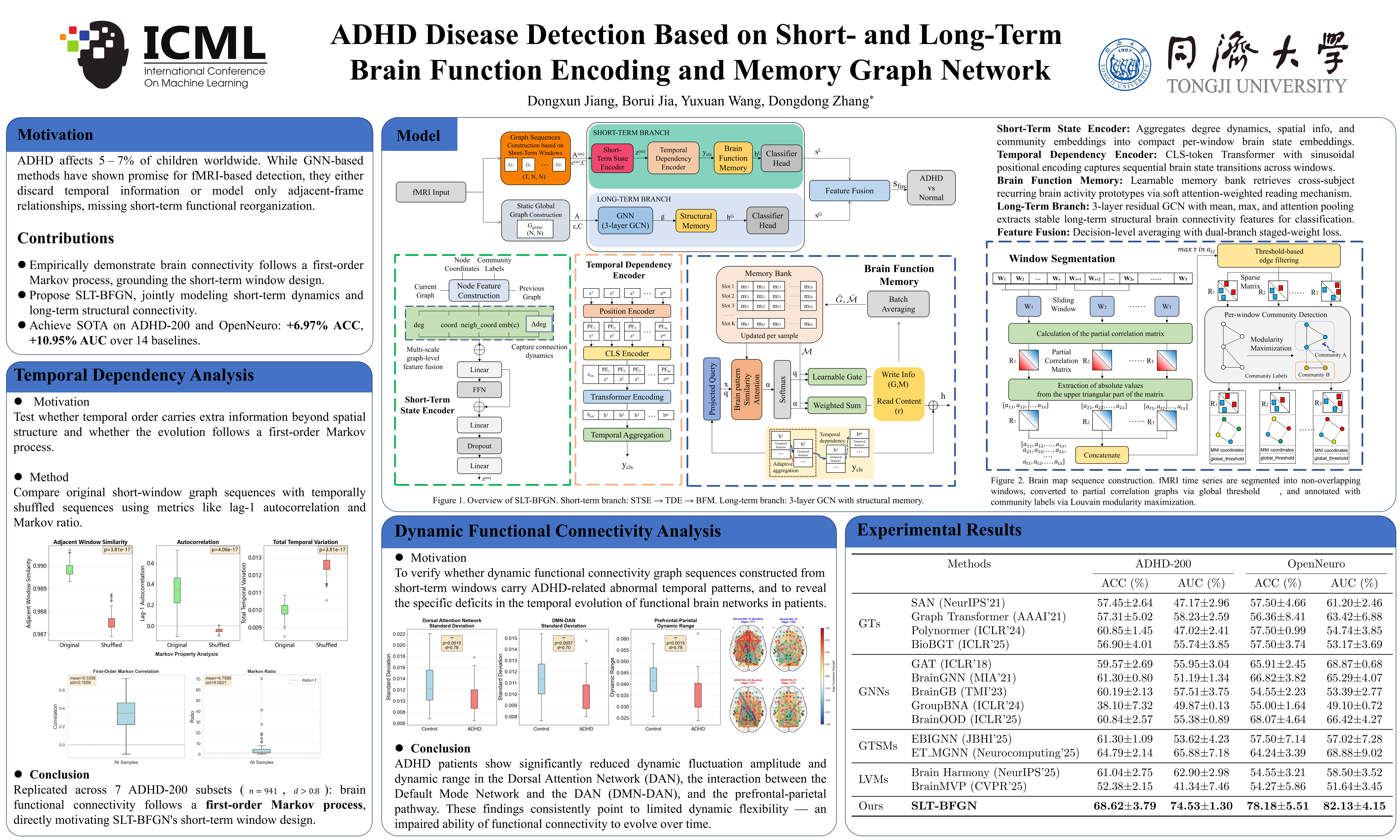
Graph-based attention deficit hyperactivity disorder (ADHD) detection methods have been extensively studied, but comparatively less attention has been paid to short-term brain functional reorganization. In this paper, we propose an ADHD disease detection model based on short- and long-term brain function encoding and memory graph network. We first exploit a novel brain map sequence construction method based on short-term windows to extract short-term brain function features. Then, we design a short-term state and temporal dependency encoder to characterize short-term sequence patterns of brain function. Furthermore, a brain function memory is introduced to capture the association of brain activity patterns and historical sequence patterns. Concurrently, GNN-based long-term brain function feature extraction network is used to extract brain structure features, which are fused with short-term features for ADHD detection. Experimental validation on the publicly available neuroimaging datasets ADHD-200 and OpenNeuro-ds002424 demonstrates the superior performance of our model in brain disorder detection.
Lay Summary
ADHD is one of the most common neurodevelopmental conditions in children, affecting attention, impulse control, and daily functioning. Diagnosing it reliably is difficult, as it relies heavily on behavioral observation. Brain scans can offer more objective clues — but most existing AI-based methods treat the brain's activity as a single static picture, missing the moment-to-moment fluctuations that may be the most telling signs of the disorder. We develop a method that analyzes how the brain's internal communication patterns shift over short time windows. We show that these short-term dynamics follow a predictable sequential structure, and design a model that captures both these fleeting patterns and the brain's stable long-term organization. A memory component allows the system to compare each patient's brain dynamics against recurring patterns accumulated across many subjects. Evaluated on two independent brain imaging datasets, our approach substantially outperforms existing methods. This work demonstrates that the timing of brain activity changes — not just their average strength — carries important diagnostic information, and may contribute to more objective, data-driven tools for identifying ADHD.