
StitchCUDA: An Automated Multi-Agents End-to-End GPU Programing Framework with Rubric-based Agentic Reinforcement Learning
Abstract
Lay Summary
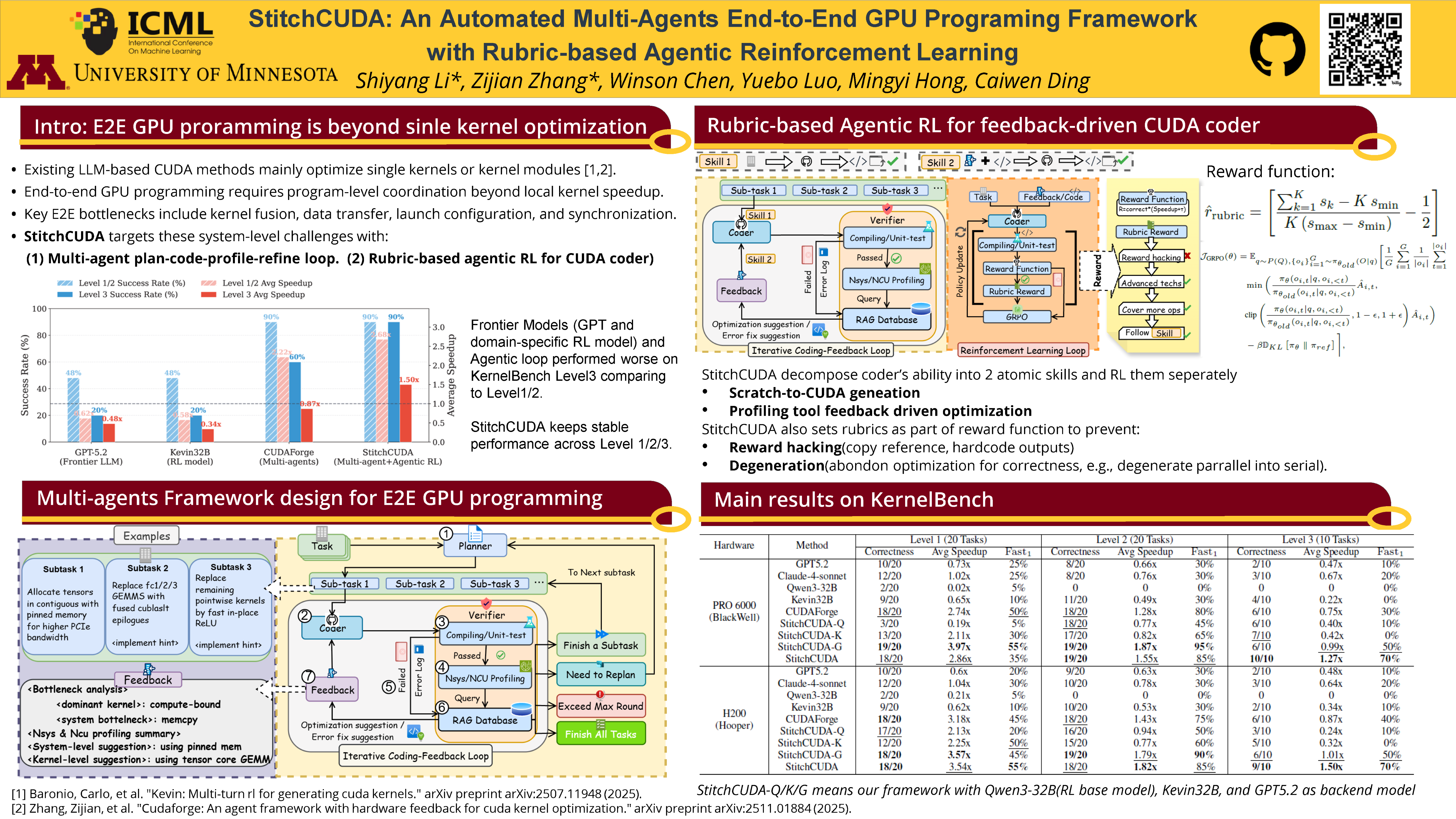
Writing fast programs for GPUs is essential for modern AI, but it usually requires expert knowledge of both low-level GPU code and how different parts of a full program work together. Recent AI coding systems can help write small GPU kernels, but they often struggle when asked to optimize an entire program with many interacting operations. We built StitchCUDA, an Agentic AI system that divides this hard task among three specialized agents: one plans the optimization strategy, one writes CUDA code, and one tests, profiles, and gives feedback. To make the coding agent better over time, we train it with reinforcement learning, but also use human-designed rubrics to discourage shortcuts such as copying PyTorch code or hardcoding answers. This helps the system learn not only to produce correct GPU programs, but also to follow profiling feedback and apply meaningful optimizations such as kernel fusion and data-movement improvements. On end-to-end GPU programming benchmarks, StitchCUDA achieves much higher success rates and faster programs than prior single-model, reinforcement-learning-only, and multi-agent baselines. This work matters because it moves AI-based GPU programming closer to practical software engineering, where performance depends on the whole system rather than one isolated kernel.