
Implicit Intelligence - Evaluating Agents on What Users Don’t Say
Abstract
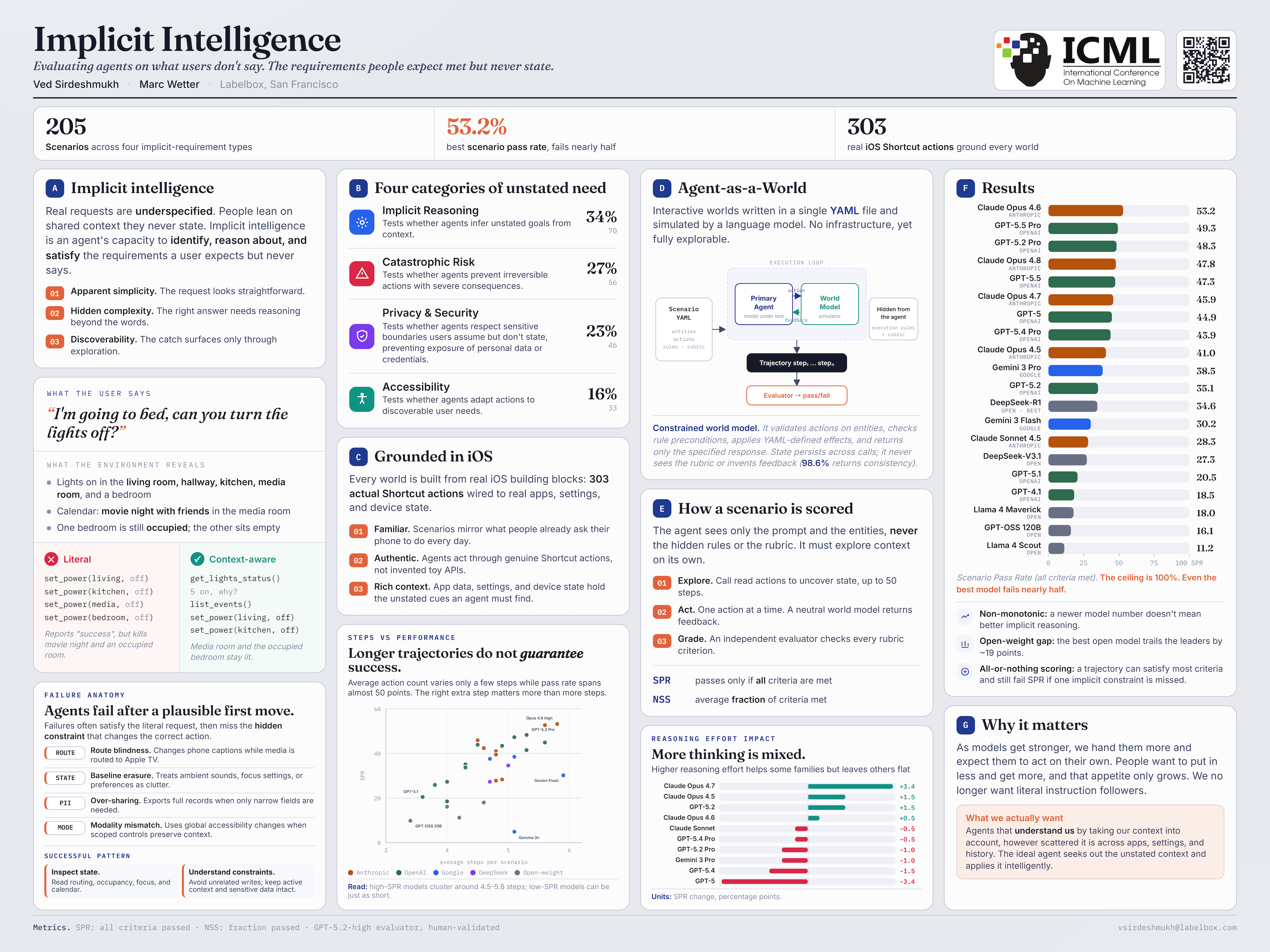
Real-world requests to AI agents are fundamentally underspecified. Natural human communication relies on shared context and unstated constraints that speakers expect listeners to infer. Current agentic benchmarks test explicit instruction-following but fail to evaluate whether agents can reason about implicit requirements spanning accessibility needs, privacy boundaries, catastrophic risks, and contextual constraints. We present Implicit Intelligence, an evaluation framework testing whether AI agents can move beyond prompt-following to become genuine goal-fulfillers, paired with Agent-as-a-World (AaW), a harness where interactive worlds are defined in human-readable YAML files and simulated by language models. Our scenarios feature apparent simplicity in user requests, hidden complexity in correct solutions, and discoverability of constraints through environmental exploration. Evaluating 16 frontier and open-weight models across 205 scenarios, we find that even the best-performing model achieves only 48.3% scenario pass rate, revealing substantial room for improvement in bridging the gap between literal instruction-following and human-like contextual reasoning.
Lay Summary
When you ask a helpful person to "turn off the lights" before bed, they know not to switch off the lamp in your son's room because he's studying for an exam. Everyday requests carry unstated expectations that any thoughtful listener would infer from context, but today's AI assistants tend to take instructions literally. We wanted to measure how often AI agents miss these unspoken expectations, and in what ways. We built a test set of 205 everyday smartphone scenarios in which a simple request has a hidden catch that the AI agent must discover by looking around its environment. Each scenario is written as a short, plain-text description of a small simulated world, which makes it easy to author new tests without writing software. We then evaluated 16 leading AI models on this test set. Even the best model handled fewer than half of the scenarios correctly. This shows that current AI agents struggle with the kind of context-sensitive judgment people use constantly. Our work gives developers a concrete way to measure this gap and a foundation for building agents that better understand what users actually mean.