
E-VAds: An E-commerce Short Videos Understanding Benchmark for MLLMs
Abstract
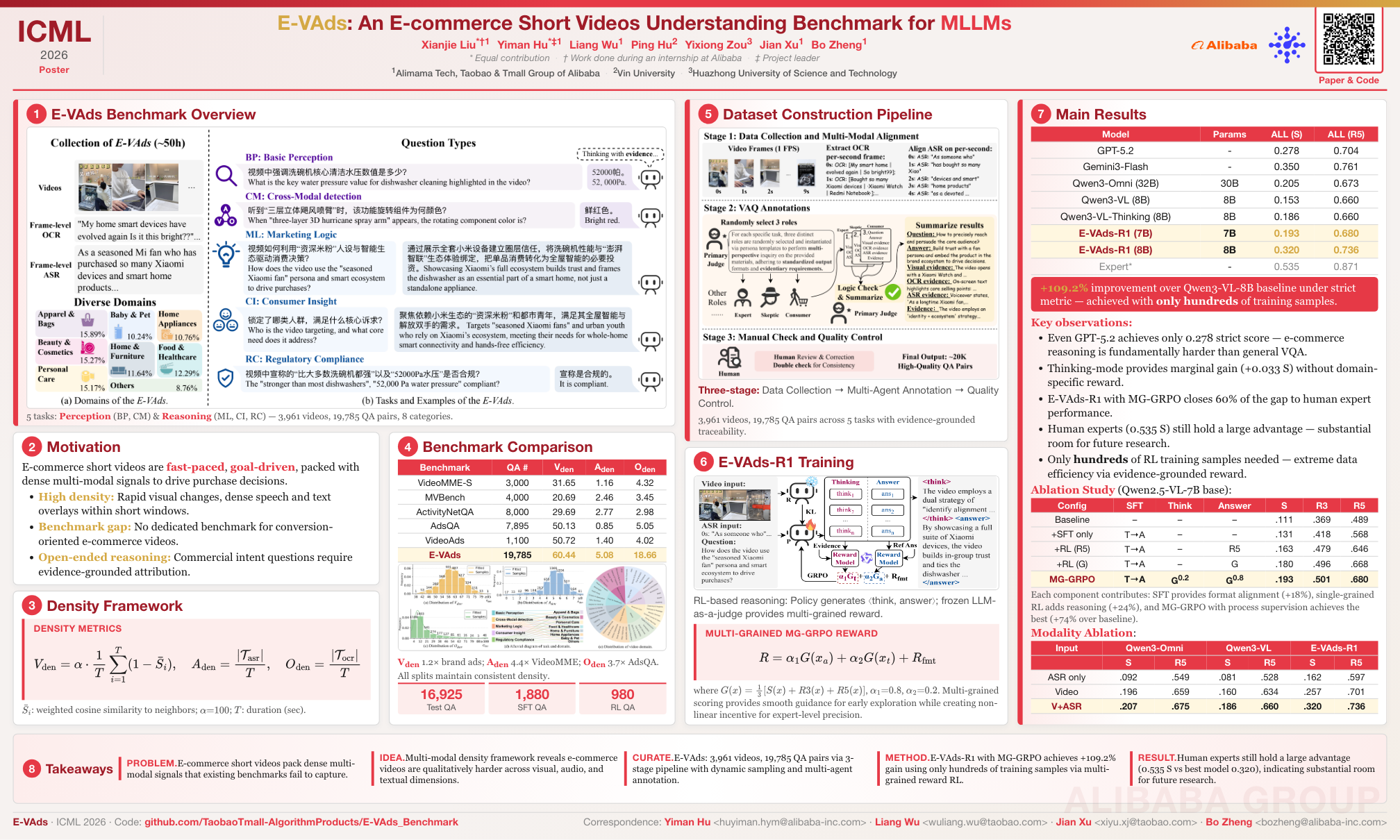
E-commerce short videos represent a high-revenue segment of the online video industry characterized by a goal-driven format and dense multi-modal signals. Current models often struggle with these videos because existing benchmarks focus primarily on general-purpose tasks and neglect the reasoning of commercial intent. In this work, we first propose a multi-modal information density assessment framework to quantify the complexity of this domain. Our evaluation reveals that e-commerce content exhibits substantially higher density across visual, audio, and textual modalities compared to mainstream datasets, establishing a more challenging frontier for video understanding. To address this gap, we introduce E-commerce Video Ads Benchmark, which is the first benchmark specifically designed for e-commerce short video understanding. We curated 3,961 high-quality videos from Taobao covering a wide range of product categories and used a multi-agent system to generate 19,785 open-ended Q&A pairs. These questions are organized into Perception and Cognition and Reasoning, which consist of five distinct tasks. Finally, we develop E-VAds-R1, an RL-based reasoning model featuring a multi-grained reward design called MG-GRPO. This strategy provides smooth guidance for early exploration while creating a non-linear incentive for expert-level precision. Experimental results demonstrate that E-VAds-R1 achieves a 109.2\% performance gain in commercial intent reasoning with only a few hundred training samples. Data is available at https://github.com/TaobaoTmall-AlgorithmProducts/E-VAds_Benchmark.
Lay Summary
E-commerce short videos drive significant revenue in online entertainment, yet they challenge AI systems by combining persuasive marketing with dense visual, audio, and textual content. Existing models, though effective on general video tasks, often overlook the commercial intent in these clips. We developed a method to measure information density across content types, revealing that e-commerce videos are substantially more complex than those in current datasets. We then created the first benchmark for e-commerce short video understanding, curating nearly four thousand Taobao product videos and generating close to twenty thousand question-answer pairs that assess both basic perception and deeper reasoning about shopping goals. Using a learning approach with a carefully designed feedback system, our model achieves more than double the performance on commercial intent reasoning with only a few hundred training examples. This work advances AI capabilities to better support sellers and shoppers in the growing world of online video commerce.