
SPUR: Scale-Partitioned Uncertainty Rectification for Robust UAV-on-UAV Interception
Abstract
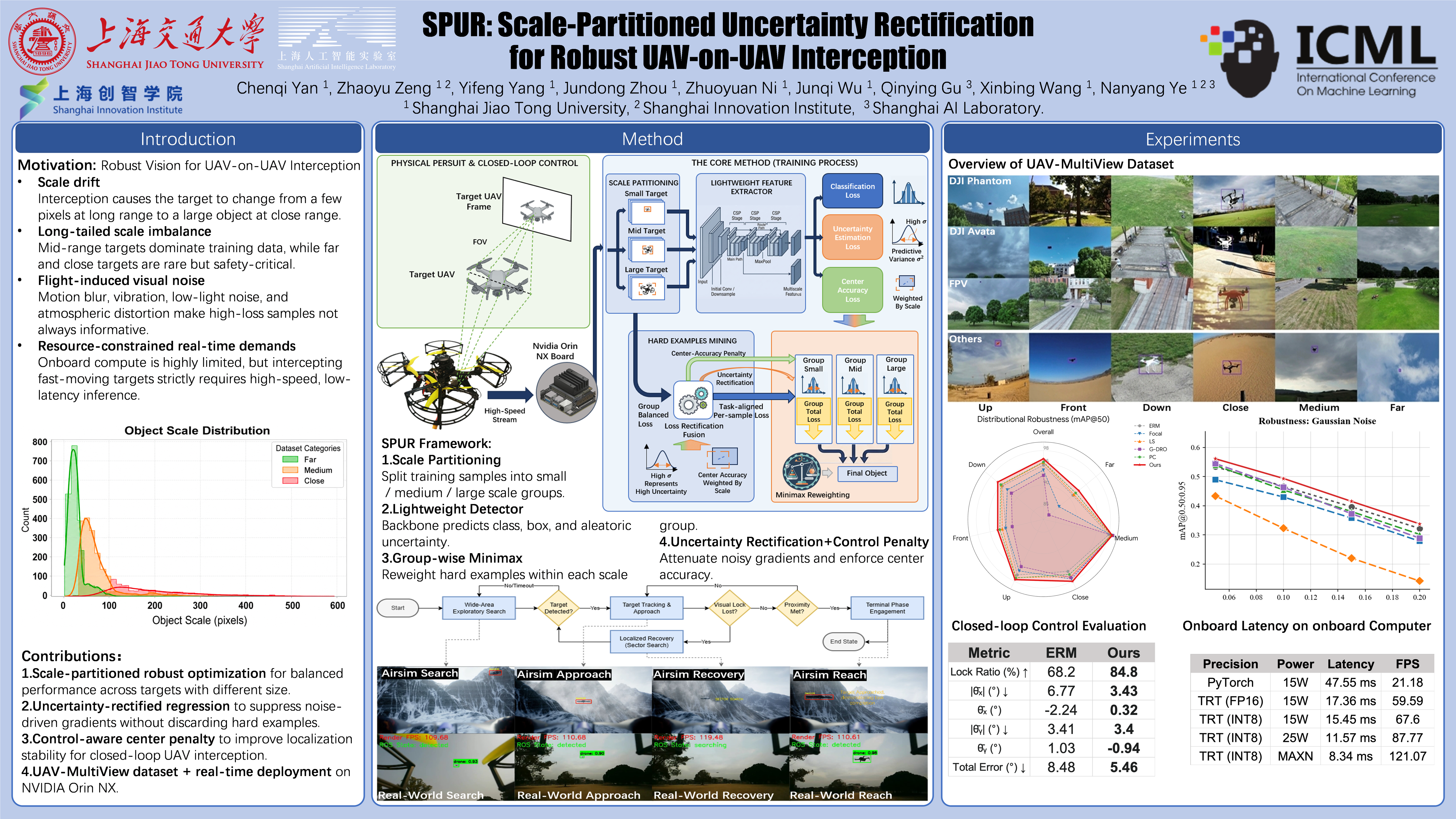
Robust aerial target detection for autonomous UAV-on-UAV pursuit is severely hindered by continuous scale drift, long-tailed scale imbalance, and flight-induced visual noise, rendering standard empirical risk minimization strategies poorly aligned with real-world deployment. To address these challenges, we propose a scale-aware robust optimization framework that performs group-wise minimax optimization over scale-partitioned data, ensuring balanced robustness across long-, mid-, and close-range engagement regimes. We further introduce an uncertainty-rectified regression loss to suppress noise-driven errors without discarding informative hard examples, complemented by a control-aligned center accuracy penalty that prioritizes the localization precision required for stable flight control. Extensive experiments demonstrate that our method yields substantially improved robustness under visual degradation, with significantly slower decay in detection mAP and center-point accuracy compared to baselines. Validated through both photorealistic simulations and real-world flight tests, our system achieves real-time performance of 120 FPS on an embedded NVIDIA Orin NX platform, confirming its practical efficacy for high-speed interception.
Lay Summary
Catching unauthorized drones using other autonomous drones is difficult because the target constantly changes size as it gets closer, and the chasing drone's camera frequently captures blurry or noisy images during high-speed flight. Standard artificial intelligence models struggle in these conditions, as they tend to favor average-sized targets and can easily be confused by visual noise. To solve this, we developed a new training method that forces the AI to pay equal attention to targets at all distances, ensuring it works reliably whether the target is far away or very close. Our system also learns to estimate image quality, allowing the AI to safely ignore bad data caused by camera noise without discarding genuinely difficult tracking scenarios. Additionally, it forces the AI to pinpoint the exact center of distant targets, which is essential for steering the chasing drone smoothly and preventing flight instability. Extensive simulations and real-world flight tests demonstrate that our approach makes drone tracking significantly more reliable and accurate, processing high-speed video in real-time on small, onboard computers.