
ALAS: Additive Learnable Alpha-Stable Kernels for Flexible Bayesian Optimization
Weibo Huang ⋅ Cheng Hua
Abstract
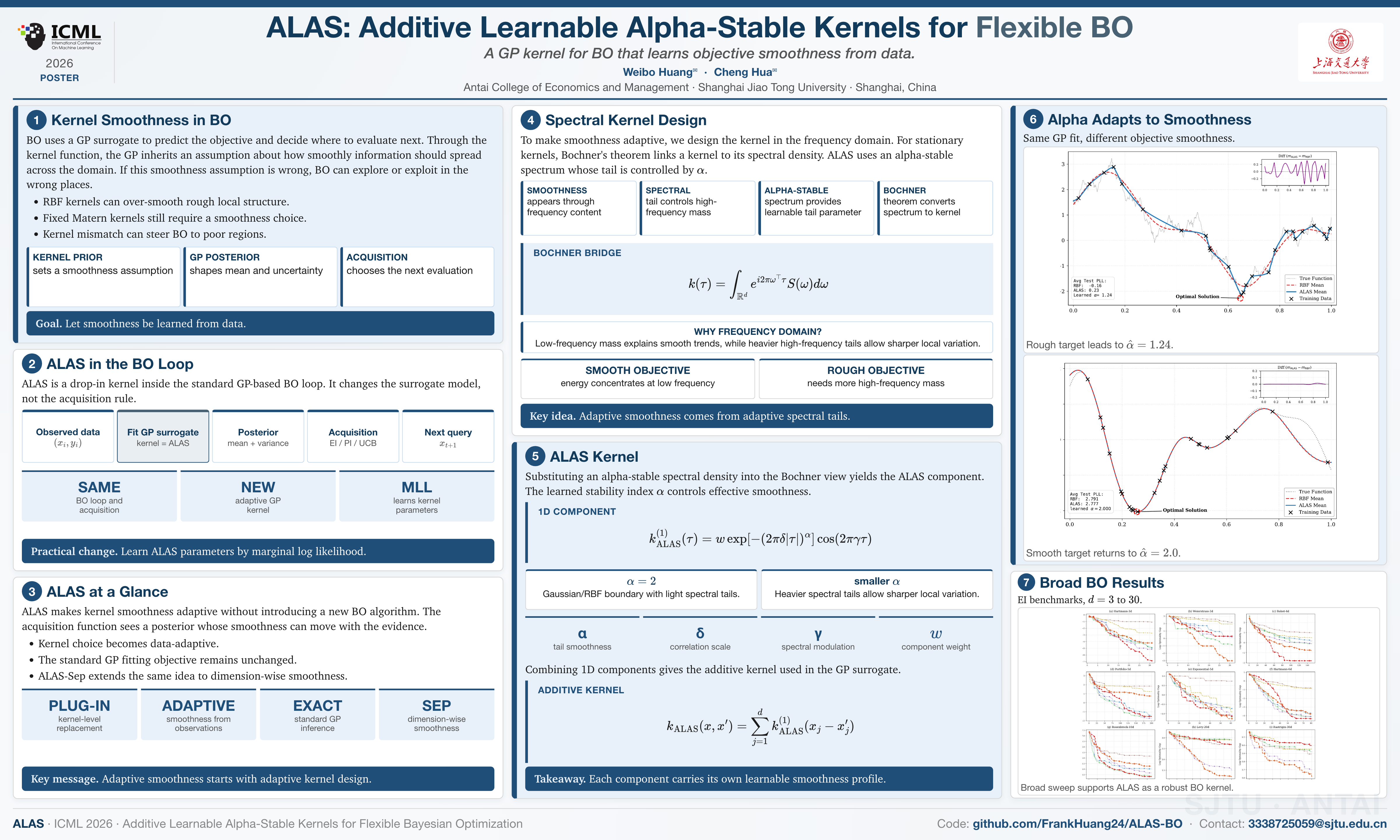
Bayesian Optimization is widely used for expensive black-box optimization, yet its success often depends on choosing a kernel that matches the objective’s unknown structure. In this work, we propose ALAS, a flexible Gaussian Process kernel family built from symmetric $\alpha$-stable spectral components. By learning the stability parameter $\alpha$, ALAS adapts its effective smoothness from data, capturing both smooth trends and sharp irregularities. We present two parameterizations: ALAS, a single stationary component with joint spectral modulation, and ALAS-Sep, a separable variant that learns dimension-wise tail behavior to improve robustness on approximately decomposable objectives. Experiments on standard benchmarks and real-world surrogates demonstrate strong and robust performance across diverse settings.
Lay Summary
Bayesian optimization is widely used to optimize expensive black-box objectives under limited evaluation budgets. In Gaussian process surrogates, the kernel function encodes assumptions about smoothness, so a mismatch between the kernel and the objective can lead to biased models and inefficient sampling. This paper introduces ALAS, an adaptive spectral kernel family that learns its effective smoothness from data. Experiments on benchmark and real-world surrogate problems show robust performance across smooth, rough, and oscillatory settings.
Video
Chat is not available.
Successful Page Load