
MemCast: Memory-Driven Time Series Forecasting with Experience-Conditioned Reasoning
Abstract
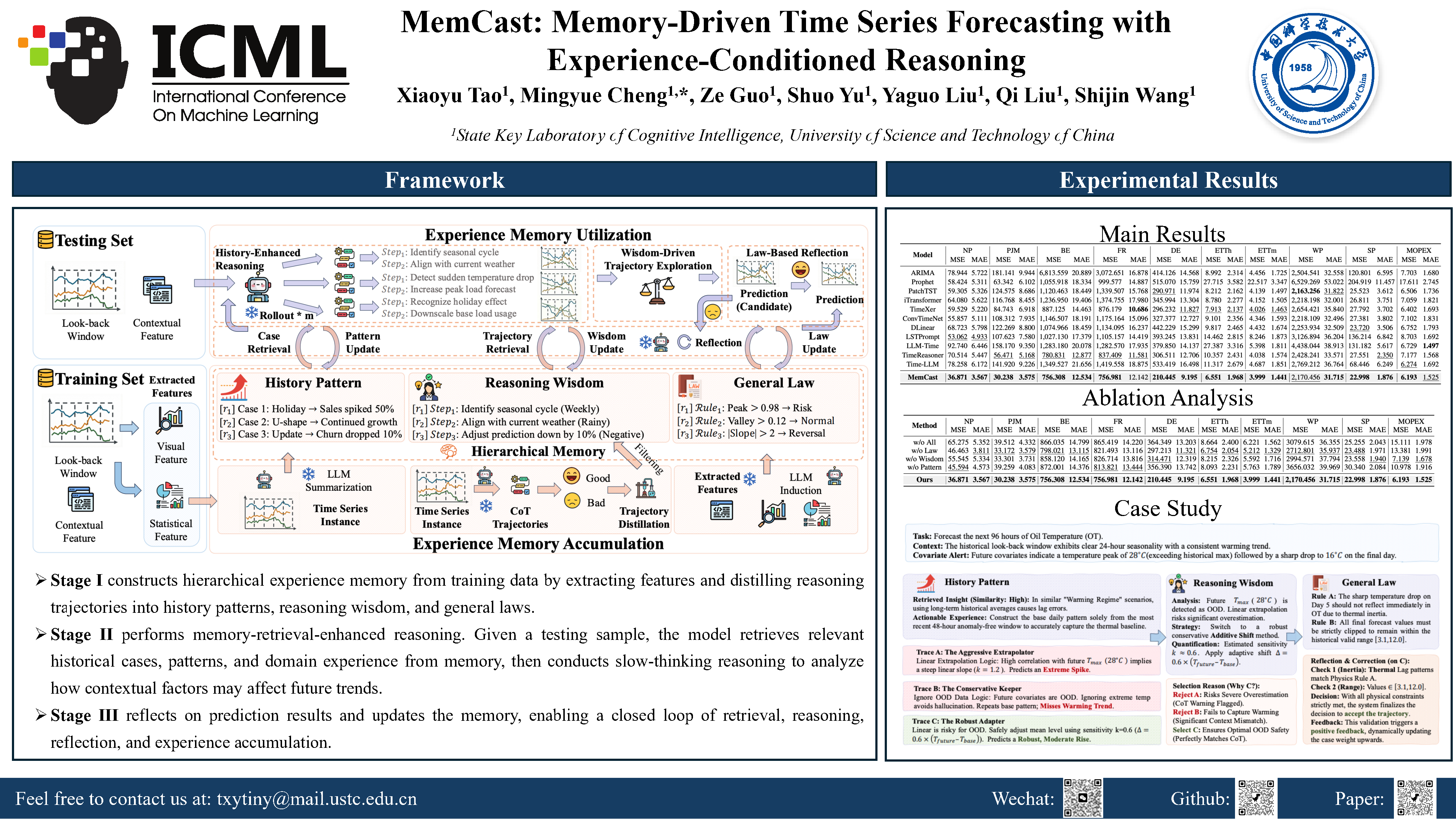
Time series forecasting (TSF) plays a critical role in decision-making for many real-world applications. Recently, large language model (LLM)- based forecasters have made promising advancements. Despite their effectiveness, existing methods often lack explicit experience accumulation and continual evolution. In this work, we propose MemCast, a learning-to-memory framework that reformulates TSF as an experience-conditioned reasoning task. Specifically, we learn experience from the training set and organize it into a hierarchical memory. This is achieved by summarizing prediction results into historical patterns, distilling inference trajectories into reasoning wisdom, and inducing extracted temporal features into general laws. Furthermore, during inference, we leverage historical patterns to guide the reasoning process and utilize reasoning wisdom to select better trajectories, while general laws serve as criteria for reflective iteration. Additionally, to enable continual evolution, we design a dynamic confidence adaptation strategy that updates the confidence of individual entries without leaking the test set distribution. Extensive experiments on multiple datasets demonstrate that MemCast consistently outperforms previous methods, validating the effectiveness of our approach. Our code is available at https://github.com/Xiaoyu-Tao/MemCast-TS.
Lay Summary
Forecasting future changes from past observations is important in many real-world scenarios, such as energy management, traffic planning, finance, and industrial monitoring. Recent forecasting methods based on large AI models have shown promising results, but they often make each prediction separately and do not explicitly accumulate useful experience from previous forecasting cases. This limits their ability to learn from recurring patterns and improve over time. In this paper, we propose MemCast, a forecasting framework that helps the model make predictions by using past experience. Instead of relying only on the model’s internal knowledge, MemCast builds a memory from the training data. This memory contains three types of useful information: similar historical cases, reasoning strategies that have worked well before, and general rules about how time series tend to change. When facing a new forecasting task, MemCast retrieves relevant experience from this memory to guide the prediction process, compare possible future trends, and revise unreliable results. We also design a mechanism that allows the memory to update its confidence over time without using information from future test data. Experiments on multiple forecasting datasets show that MemCast consistently improves prediction accuracy over previous methods. These results suggest that explicitly accumulating and reusing forecasting experience can make AI-based forecasting more accurate, reliable, and adaptable.