
TextMesh4D: Zero-shot Text-to-4D Mesh Generation
Abstract
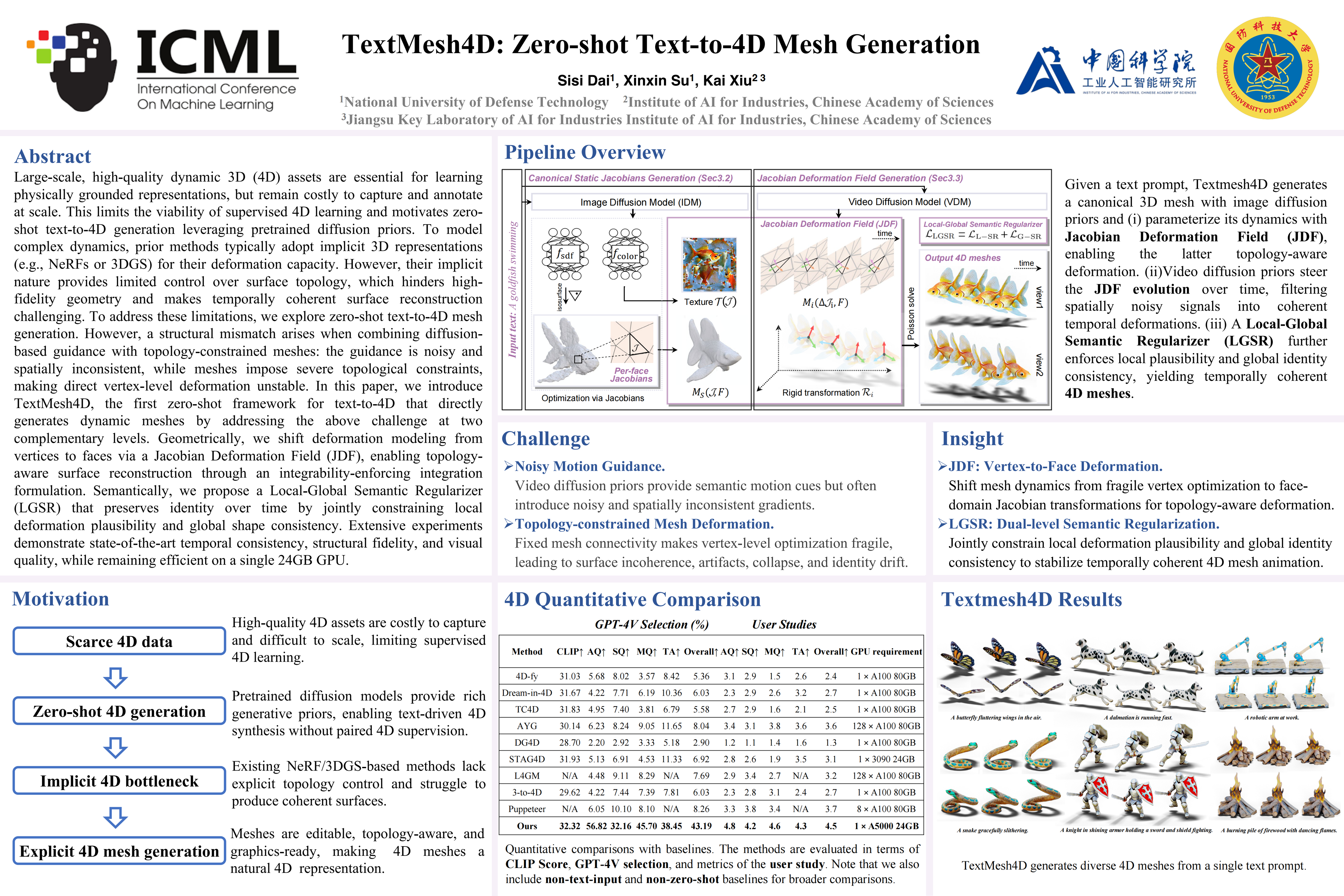
Large-scale, high-quality dynamic 3D (4D) assets are essential for learning physically grounded representations, but remain costly to capture and annotate at scale. This limits the viability of supervised 4D learning and motivates zero-shot text-to-4D generation leveraging pretrained diffusion priors. To model complex dynamics, prior methods typically adopt implicit 3D representations (e.g., NeRFs or 3DGS) for their deformation capacity. However, their implicit nature provides limited control over surface topology, which hinders high-fidelity geometry and makes temporally coherent surface reconstruction challenging. To address these limitations, we explore zero-shot text-to-4D mesh generation. However, a structural mismatch arises when combining diffusion-based guidance with topology-constrained meshes: the guidance is noisy and spatially inconsistent, while meshes impose severe topological constraints, making direct vertex-level deformation unstable. In this paper, we introduce TextMesh4D, the first zero-shot framework for text-to-4D that directly generates dynamic meshes by addressing the above challenge at two complementary levels. Geometrically, we shift deformation modeling from vertices to faces via a Jacobian Deformation Field (JDF), enabling topology-aware surface reconstruction through an integrability-enforcing integration formulation. Semantically, we propose a Local-Global Semantic Regularizer (LGSR) that preserves identity over time by jointly constraining local deformation plausibility and global shape consistency. Extensive experiments demonstrate state-of-the-art temporal consistency, structural fidelity, and visual quality, while remaining efficient on a single 24GB GPU.
Lay Summary
Creating dynamic 3D (4D) objects from text is driving new advances in games, animation, virtual reality, and digital content creation. Among different 4D representations, mesh-based assets are highly editable and compatible with standard 3D production pipelines. However, text-to-4D mesh generation in a zero-shot manner remains underexplored, because noisy video guidance makes direct vertex deformation unstable, often causing tearing, stretching, and identity drift. TextMesh4D addresses this challenge by optimizing per-face Jacobian transformations, allowing each surface triangle to rotate and stretch before integrating these local changes into a coherent moving surface. It further regularizes motion at both local and global levels, allowing local parts to deform naturally while preserving the object’s overall identity. Experiments demonstrate that TextMesh4D achieves state-of-the-art temporal consistency, structural fidelity, and visual quality, while running on a single 24GB GPU.