
Deterministic Component Mining for Multi-Framework UI2Code Generation
Abstract
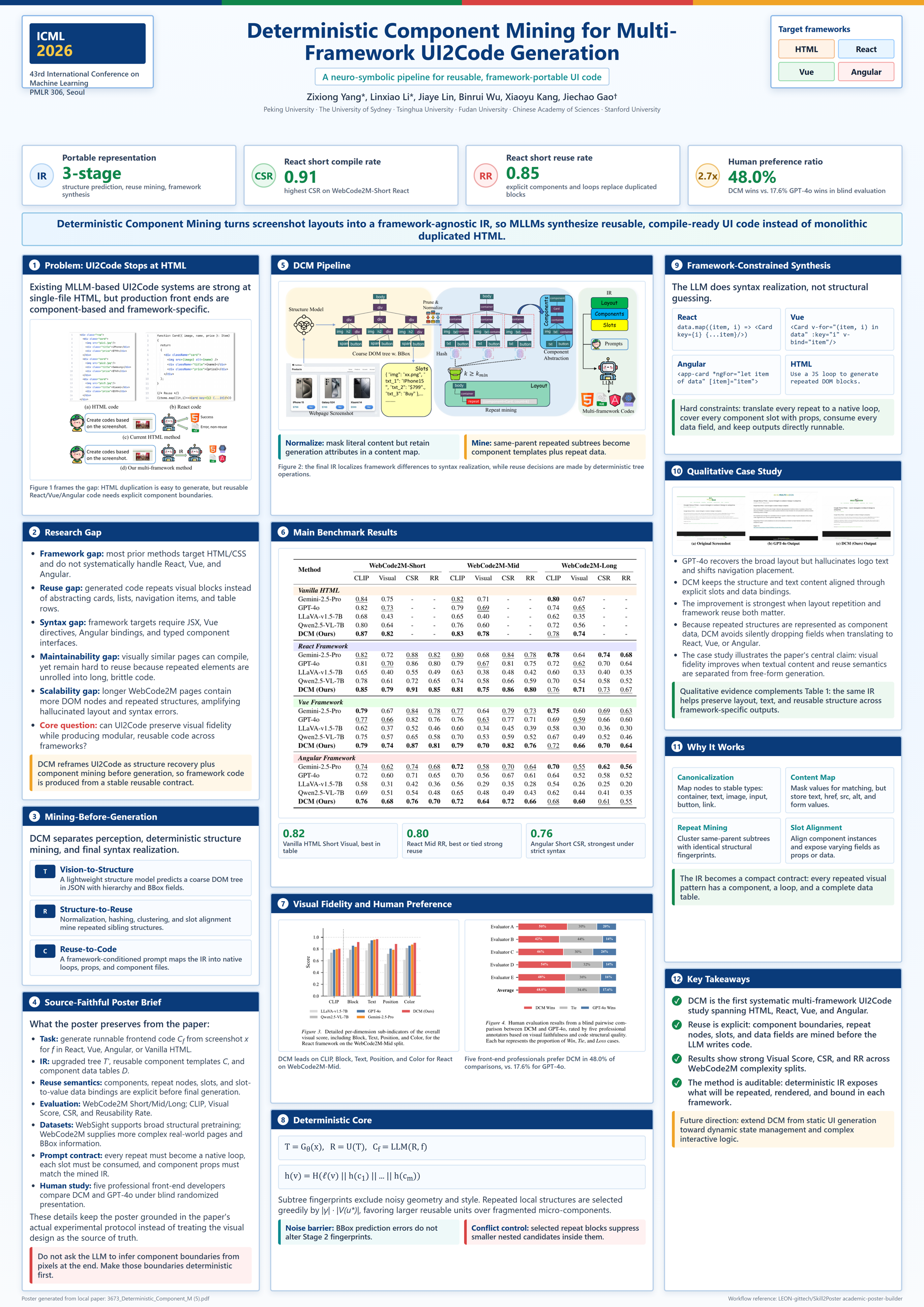
Automating User Interface (UI) generation substantially improves productivity and accelerates development by reducing engineering time and manual effort. Despite recent progress of Multimodal Large Language Models (MLLMs) in UI2Code, most existing approaches focus on a single HTML/CSS form and fail to systematically incorporate front-end frameworks such as React, Vue, and Angular. Moreover, their outputs are often verbose and hard to reuse at the component level. To address those issues, we propose Deterministic Component Mining (DCM), a multi-stage pipeline that couples MLLMs with a compact intermediate representation to enable multi-framework and component-oriented code generation. Firstly, a lightweight structure model predicts the representation of the DOM tree in JSON format, capturing the coarse layout from a webpage screenshot. Subsequently, we formulate deterministic rules to normalize the predicted DOM tree and mine reusable components with repetitive patterns via structural hashing and clustering, thereby yielding a portable intermediate representation. Finally, we employ a framework-conditioned prompting strategy governed by a binding specification and a file-block protocol to emit HTML/React/Vue/Angular code with explicit component props and repeat constructs. Extensive experiments demonstrate that DCM significantly outperforms baselines on automatic evaluation metrics and component-level reuse, while delivering consistent gains in multi-framework portability and overall code structural quality.
Lay Summary
Turning design mockups into code is every developer's least favorite chore. Current AI tools can automate this, but they spit out one tangled mess of code and only speak one framework. We built DCM, which eyes a screenshot like a seasoned programmer, sniffs out repeating patterns, packages them into clean building blocks, and translates them into React, Vue, or Angular. Experiments show DCM produces tidier, more reusable code, freeing developers to tackle problems that actually need a human brain.