
Infinite-Dimensional Generative Diffusions via Doob’s h-Transform
Abstract
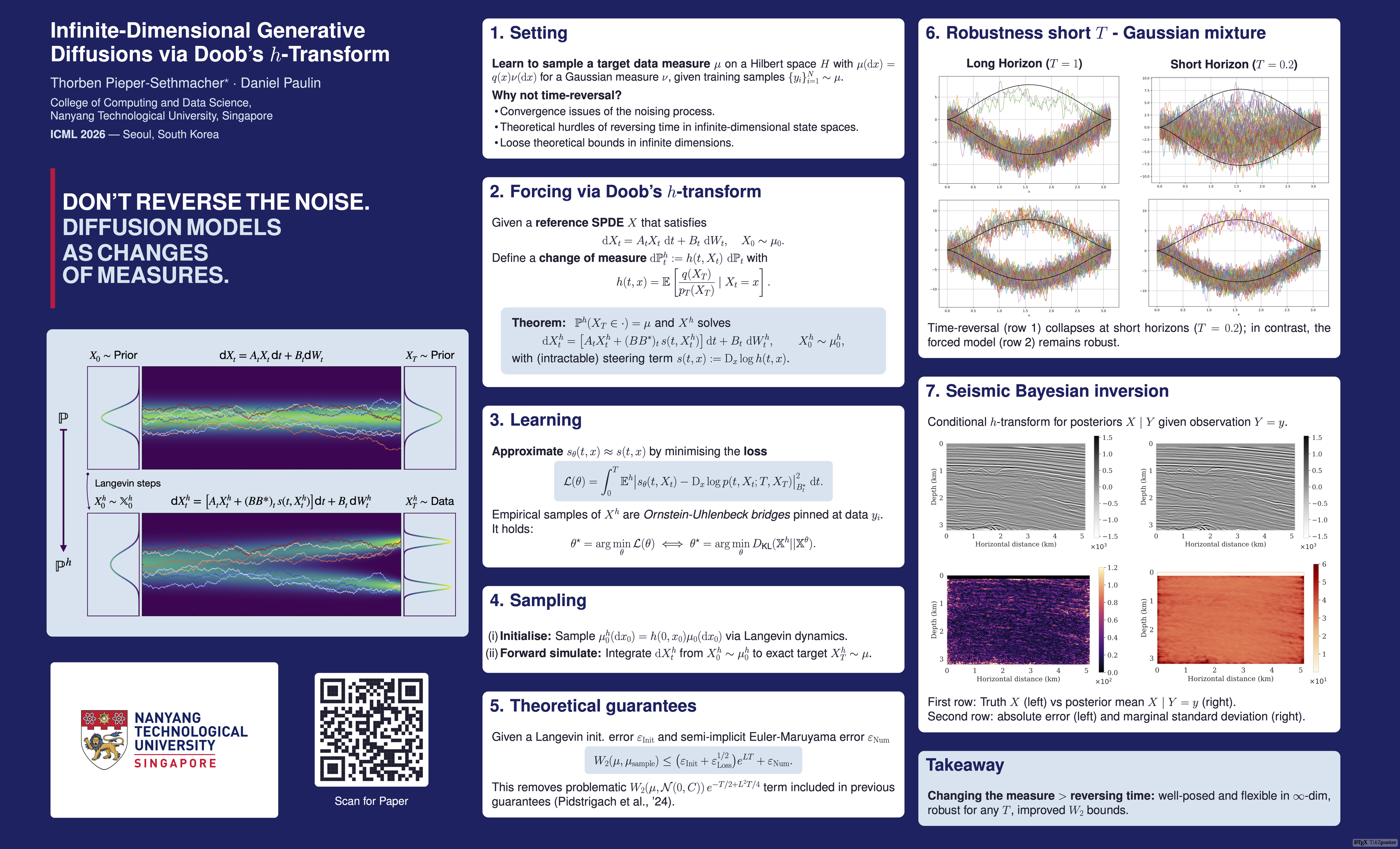
This paper introduces a rigorous framework for defining generative diffusion models in infinite dimensions via Doob's h-transform. Rather than relying on time reversal of a noising process, a reference diffusion is forced towards the target distribution by an exponential change of measure. Compared to existing methodology, this approach readily generalises to the infinite-dimensional setting, hence offering greater flexibility in the diffusion model. The construction is derived rigorously under verifiable conditions, and bounds with respect to the target measure are established. We show that the forced process under the changed measure can be approximated by minimising a score-matching objective and validate our method on both synthetic and real data.
Lay Summary
(1) Problem: Models that generate new data, such as highly detailed images or other functions, often rely on a technique called 'diffusion'. Diffusion works based on the idea of perturbing existing data by continuously adding random noise until it becomes unrecognisable and fully random. A model can then be trained to reverse this process, thus generating new data points from pure random noise. However, for 'infinite-dimensional' data - e.g. image data that has inherent structure at any arbitrary resolution - this traditional reverse-engineering approach may be limited to simple noising processes in order to respect the infinite-dimensional nature of the problem. This limits the types of problems these models can effectively solve. (2) Solution: To tackle this, we designed a new mathematical framework to generate infinite-dimensional data. Instead of running a noising process backwards in time, we apply a technique that forces a random process towards the desired target data by continuously 'steering' it in the right direction. This approach scales seamlessly to infinite dimensions and can still be trained using standard machine learning optimization methods. (3) Impact: The new framework offers greater flexibility for generative models acting in infinite-dimensional space. Our work allows researchers to generate more complex types of infinite-dimensional data with strong mathematical guarantees, which we have successfully validated empirically.