
Beyond Point-wise Neural Collapse: A Topology-Aware Hierarchical Classifier for Class-Incremental Learning
Abstract
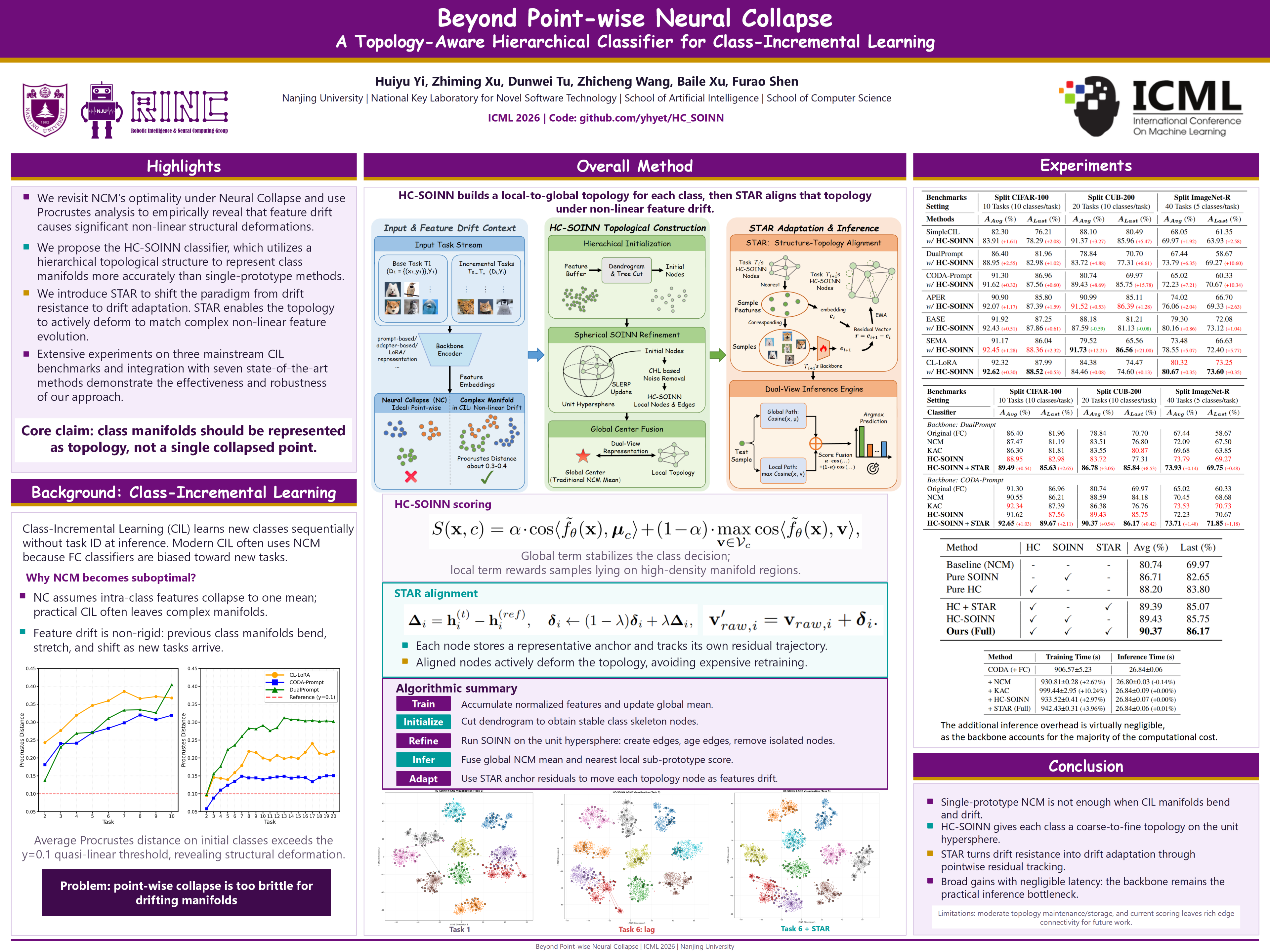
The Nearest Class Mean (NCM) classifier is widely favored in Class-Incremental Learning (CIL) for its superior resistance to catastrophic forgetting compared to Fully Connected layers. While Neural Collapse (NC) theory supports NCM's optimality by assuming features collapse into single points, non-linear feature drift and insufficient training in CIL often prevent this ideal state. Consequently, classes manifest as complex manifolds rather than collapsed points, rendering the single-point NCM suboptimal. To address this, we propose Hierarchical-Cluster SOINN (HC-SOINN), a novel classifier that captures the topological structure of these manifolds via a ``local-to-global'' representation. Furthermore, we introduce Structure-Topology Alignment via Residuals (STAR) method, which employs a fine-grained pointwise trajectory tracking mechanism to actively deform the learned topology, allowing it to adapt precisely to complex non-linear feature drift. Theoretical analysis and Procrustes distance experiments validate our framework's resilience to manifold deformations. We integrated HC-SOINN into seven state-of-the-art methods by replacing their original classifiers, achieving consistent improvements that highlight the effectiveness and robustness of our approach. Code is available at \url{https://github.com/yhyet/HC_SOINN}.
Lay Summary
(1) Problem: When artificial intelligence learns new tasks sequentially, it often forgets what it learned before. To prevent this, researchers typically use a single "average point" to represent and remember an old category. However, as the AI keeps learning, its internal representations of these old categories shift and warp into complex shapes. A simple average point can no longer accurately represent them. (2) Solution: To solve this, we created a new classification method called HC-SOINN. Instead of relying on a single point, it builds a multi-point map to capture the complete structural shape of a category. We also developed a tracking mechanism, STAR, which watches how these category shapes distort over time. STAR actively bends and adjusts the map to perfectly match the evolving categories without needing to relearn them from scratch. (3) Impact: By upgrading traditional AI models with our method, they become significantly better at retaining old knowledge while mastering new information. This brings us closer to building sustainable, lifelong-learning AI agents for dynamic applications like autonomous robotics and medical diagnosis, saving the massive energy costs of constant retraining.