
Entropy-Aware On-Policy Distillation of Language Models
Abstract
Lay Summary
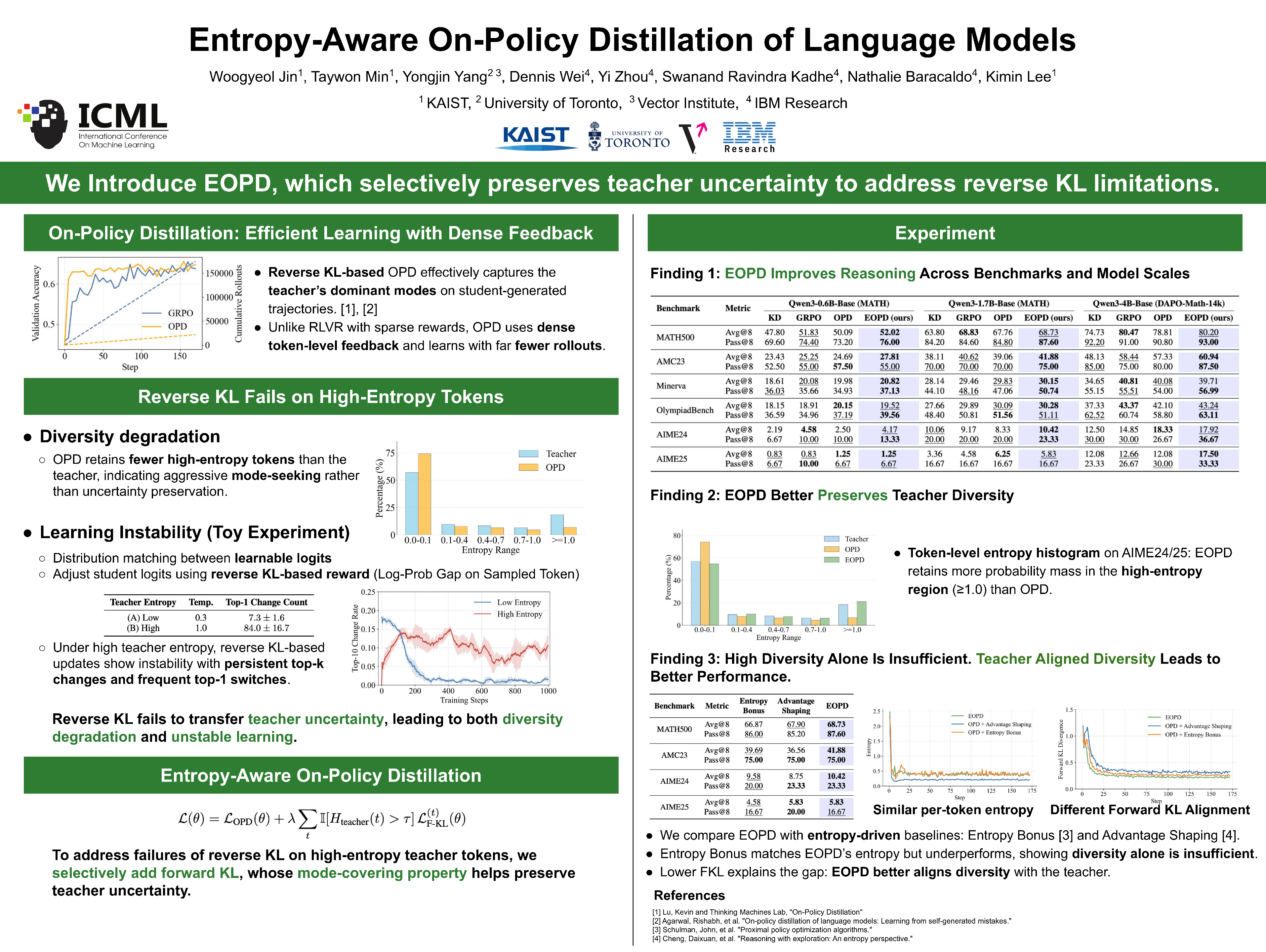
Large AI language models are powerful but heavy and expensive to run, so a technique called "distillation" is widely used to transfer their abilities into smaller, more efficient models. Existing methods train the small model (the "student") to imitate only the most confident answers of the large model (the "teacher"). The problem appears in hard tasks like math, where many different solution paths are valid: even when the teacher deliberately keeps several possibilities open, the student fixates on just one. As a result, the student loses its ability to explore diverse solutions, and its training becomes unstable. We taught the model to tell apart the moments when the teacher is confident from the moments when it is hesitant. When the teacher is confident, the student learns to follow its answer directly, as before. But when the teacher is weighing several possibilities, the student learns to preserve that full range of options instead of collapsing onto one. Because this extra guidance is applied only when it is needed, our method keeps training efficient while transferring the teacher's richer reasoning far more faithfully. Small models trained this way explore diverse solutions better and consistently solve more math reasoning problems correctly. This helps build compact, efficient AI with strong reasoning ability without relying on large, costly models, which in turn can reduce the computational and environmental cost of using AI.