
A robust PPG foundation model using multimodal physiological supervision
Abstract
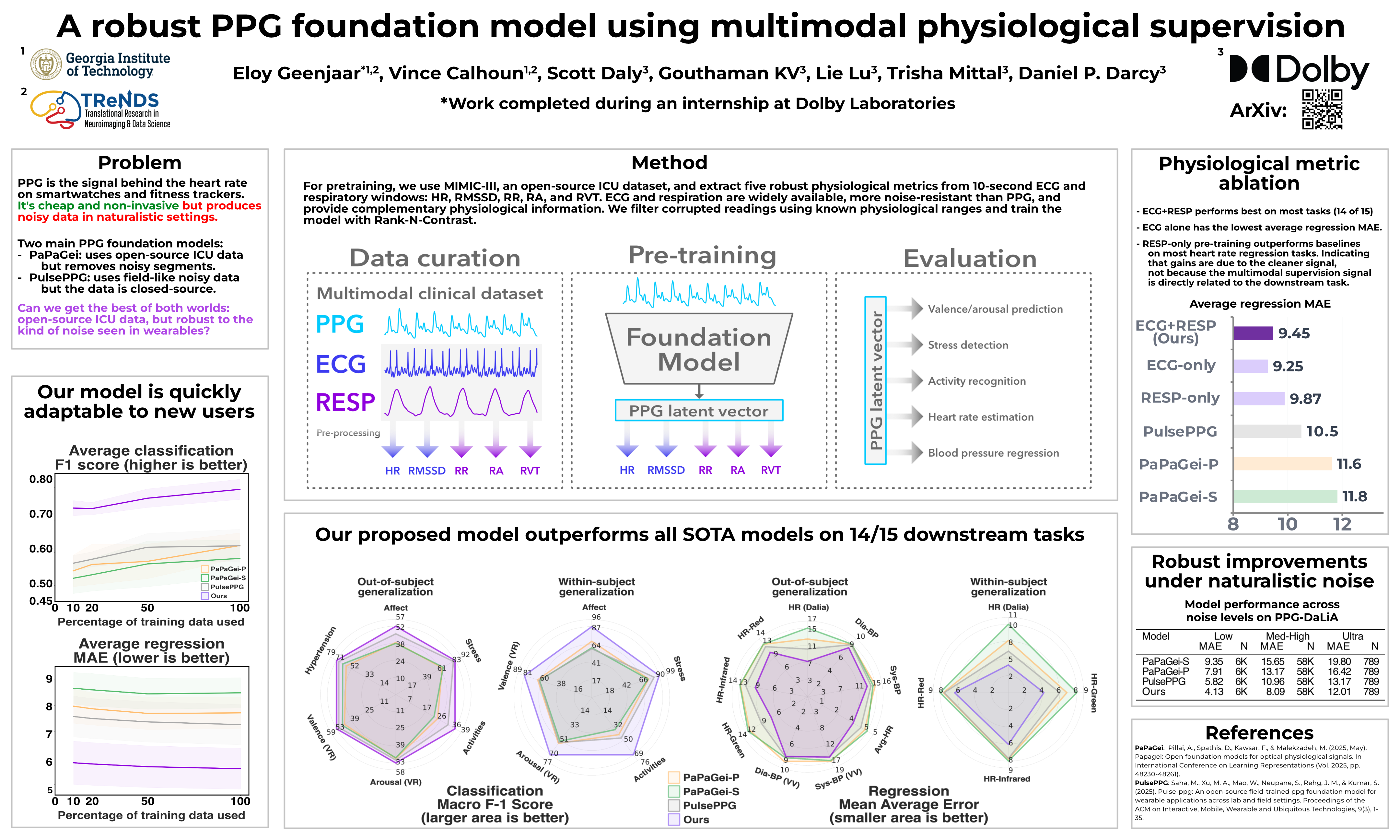
Photoplethysmography (PPG), a non-invasive measure of changes in blood volume, is widely used in both wearable devices and clinical settings. Recent PPG foundation models either use open-source ICU datasets with pretraining paradigms that require curated data and thus complicate generalization to field-like data, or use closed-source field-like PPG data. In contrast, we propose a PPG foundation model that does not require high-quality or field-like pretraining data, and instead leverages accompanying electrocardiogram and respiratory signals in ICU datasets to select contrastive samples during pretraining. Our approach allows the model to retain and learn from noisy PPG segments, improving robustness at inference. Our model, pretrained on 3x fewer subjects than existing state-of-the-art approaches, achieves performance improvements on 14 out of 15 diverse downstream tasks, including field-like daily activity and heart rate prediction. Our results demonstrate that multimodal supervision can integrate complementary physiological information to improve the robustness of PPG foundation models and enhance their generalization to consumer-grade data.
Lay Summary
Photoplethysmography (PPG), a light-based method that measures blood flow, is widely used in smartwatches and hospital monitors to track heart rate and other health signals. However, current methods for analyzing PPG often rely on very clean hospital data or large private wearable datasets. Because clean hospital data looks very different from data recorded during everyday activities like walking, these methods often become less reliable in real-world settings. To address this problem, we developed a new artificial intelligence (AI) model that uses publicly available hospital data without requiring perfectly clean signals. Instead of discarding noisy measurements, our model uses biological signals recorded at the same time as the PPG, including heart activity and breathing patterns, to help it learn meaningful relationships even from noisy data. Despite being trained on data from three times fewer patients than previous models, our model performs better on 14 out of 15 health prediction tasks, including heart rate estimation during everyday activities. Our results show that combining multiple clinical signals during training can help build more reliable wearable health AI systems for real-world use.