
Teaching Molecular Dynamics to a Non-Autoregressive Ionic Transport Predictor
Abstract
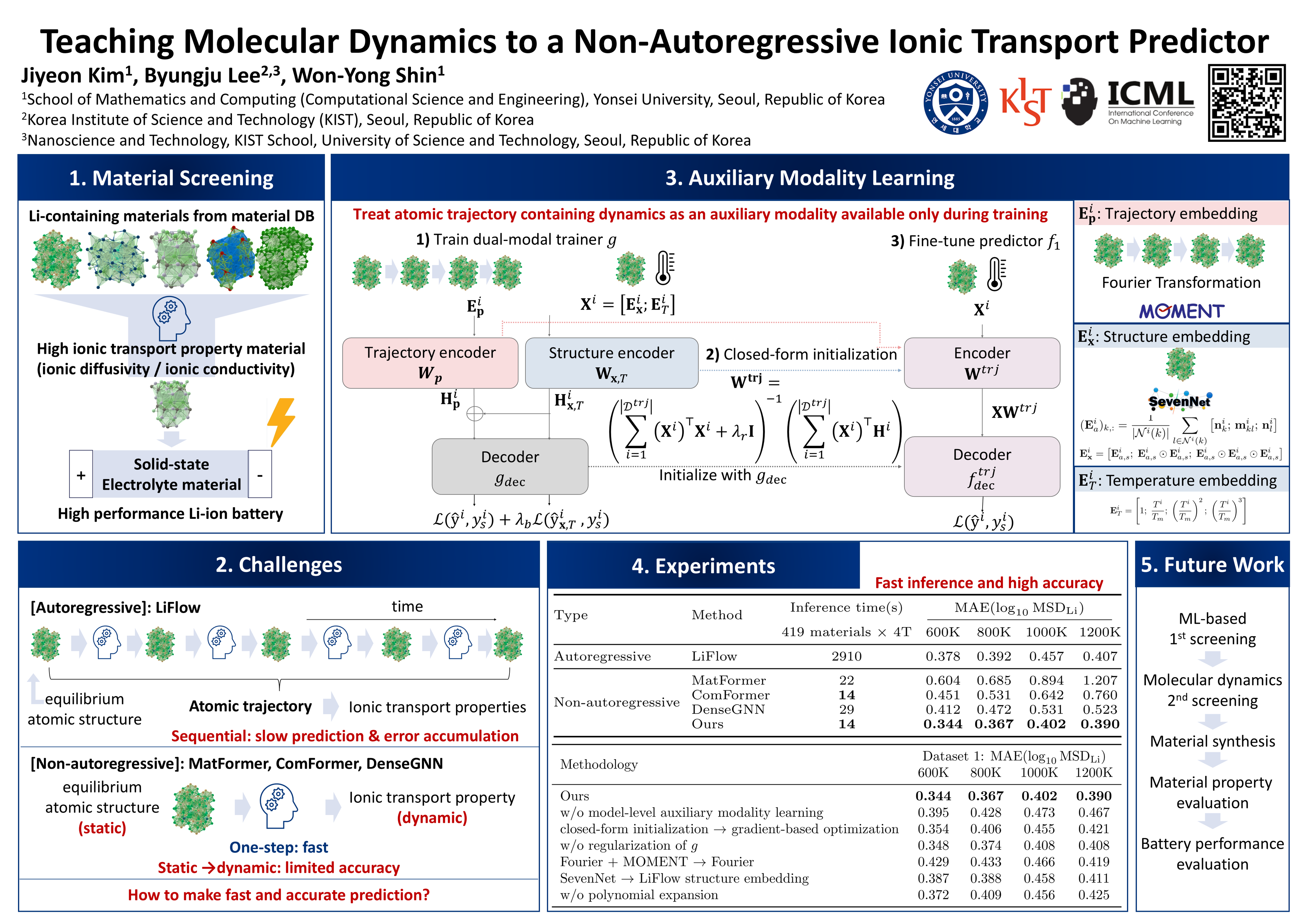
Unlike most static material properties widely studied in the machine learning literature, ionic transport properties are inherently dynamic, making their fast and accurate prediction from static atomic structures challenging. The current standard approach, molecular dynamics (MD) simulations, suffers from prohibitively high computational cost. Recent autoregressive learning-based MD acceleration methods requiring sequential inference remain slow and prone to error accumulation; in contrast, existing non-autoregressive material property prediction models are less accurate because they fail to exploit dynamics. Moreover, existing methods typically benefit from datasets either with or without atomic trajectories, but not both. To overcome these limitations, we propose a non-autoregressive learning framework based on auxiliary modality learning, which treats atomic trajectories as an auxiliary modality during training but does not require them at inference. This enables the predictor to learn dynamics without sequential inference while benefiting from both types of datasets. As a result, our framework achieves over 200 times speedup compared to autoregressive models on the dataset with atomic trajectories while substantially reducing prediction error relative to non-autoregressive benchmarks across both types of datasets. Our code is available at https://github.com/jykim-git/MD.
Lay Summary
Ionic transport properties describe how easily ions move through a material, which is important for applications such as lithium-ion batteries. Because these properties depend on how atoms move over time, they are difficult to predict accurately from a single static atomic structure. While the standard way to estimate them is to simulate atomic motion, this is computationally expensive and time-consuming. To address this challenge, we propose a learning framework that uses atomic motion information during training to improve accuracy, but does not require predicting atomic motion when making predictions. This allows our model to predict ionic transport properties both quickly and accurately. Our approach can enable more efficient screening of large numbers of candidate materials and support the discovery of improved materials for lithium-ion battery applications.