
PULSE: Generative Phase Evolution for Non-Stationary Time Series Forecasting
Abstract
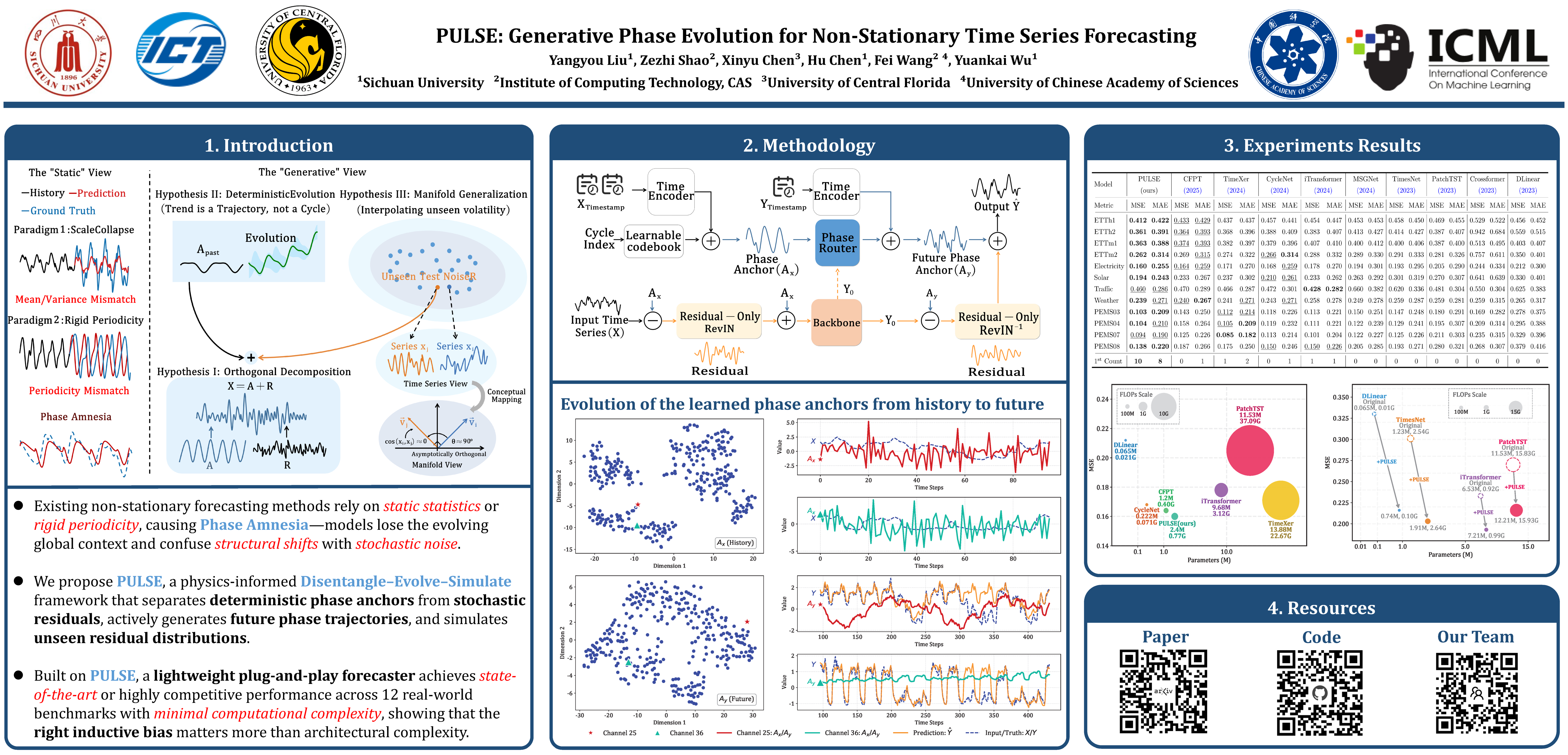
Time series forecasting under non-stationarity faces a fundamental tension between capturing stable representations and adapting to distribution shifts. Existing methods implicitly rely on static historical assumptions, leading to a critical failure mode we term Phase Amnesia, where models become blind to the evolving global context. To resolve this, we formalize non-stationary dynamics through three physical hypotheses: wold decomposition, dynamical phase evolution, and heteroscedastic manifold generation. These principles inspire PULSE, a physics-informed, plug-and-play framework adopting a Disentangle--Evolve--Simulate design philosophy. Specifically, PULSE utilizes phase-anchored disentanglement to resolve optimization interference caused by dominant trends, employs a Phase Router to actively generate future trajectories, and introduces Statistic-Aware Mixup (SAM) to ensure robustness against out-of-distribution volatility. Empirically, PULSE enables a simple MLP backbone to achieve state-of-the-art or highly competitive performance across 12 real-world benchmarks. This validates that a correct physics-informed inductive bias is far more critical than raw architectural complexity for non-stationary forecasting. The code is available at: https://github.com/Gemost/PULSE.
Lay Summary
Many real-world forecasting tasks, such as predicting electricity use, traffic flow, or weather, are difficult because data patterns often change over time. A model that mainly depends on past statistics or repeated history may make poor predictions when future behavior changes. This paper presents PULSE, a forecasting framework designed to better handle these changing patterns. Instead of treating a time series as one mixed signal, PULSE separates stable long-term structure from short-term changes. It then learns how the stable structure may move into the future and uses this knowledge to make more reliable predictions. On 12 real-world datasets, PULSE reaches state-of-the-art or highly competitive performance while remaining efficient. These results show that learning how temporal patterns change over time can be more useful than simply building larger forecasting models.