
Tailoring Strictly Proper Scoring Rules for Downstream Tasks: An Application to Causal Inference
Abstract
Lay Summary
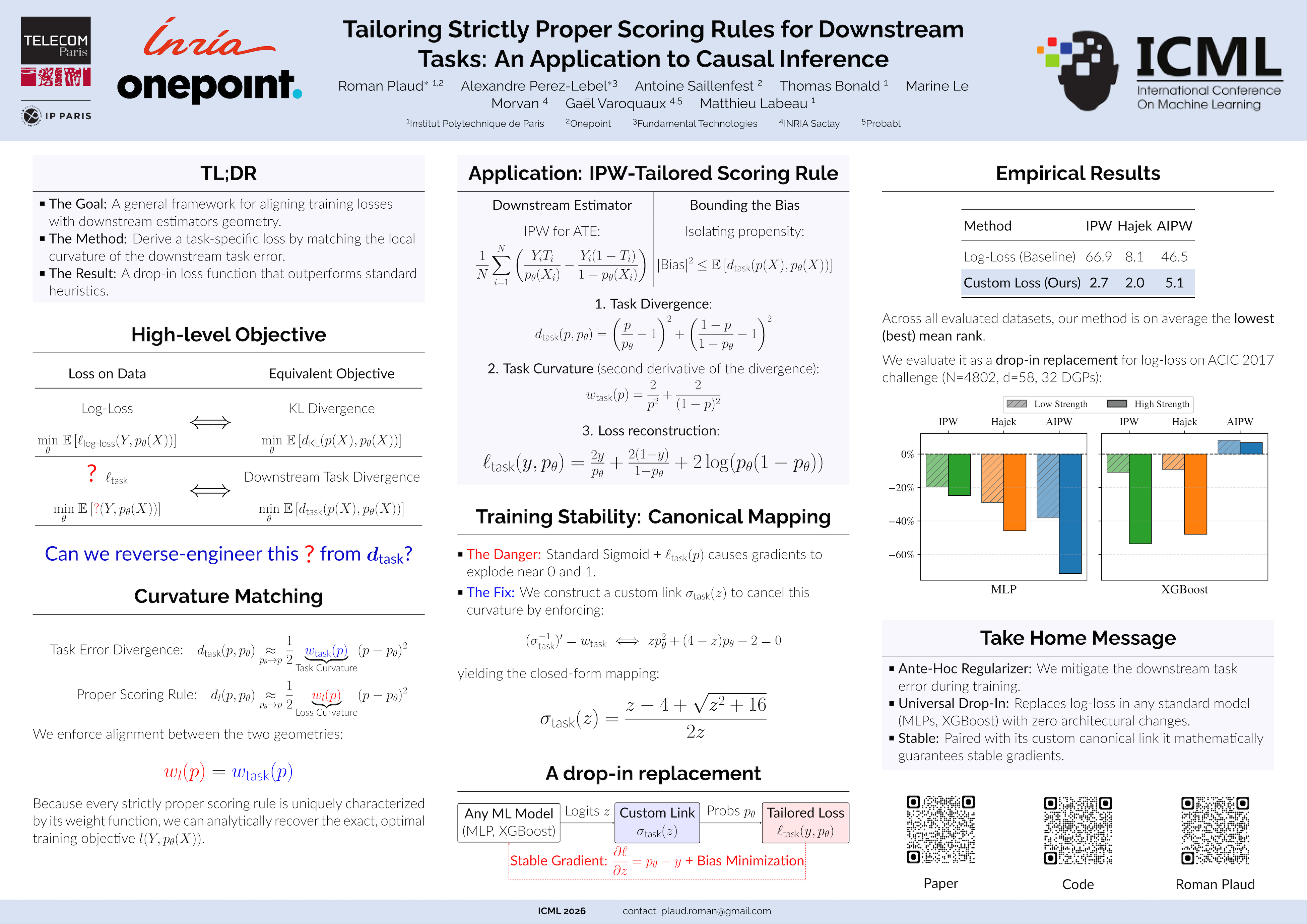
To see if a medical treatment works using past records, we need fair comparisons. Because sicker patients often get the drug, simply comparing who took it and who didn't biases the results. To fix this, math gives extra "weight" to rare patients. If a healthy person takes the drug, their data is multiplied, based on the inverse of their probability of getting the treatment, to represent all the healthy people who didn't. Usually, machine learning models are used to estimate this probability. However, machine learning models aren't perfect. If a model makes a tiny error for an unusual patient, for example, estimating a 0.1% chance instead of 1%, their mathematical weight explodes, ruining the calculation. Standard training treats this catastrophic error the exact same as a harmless one. To deal with this, we created a new training rule based on the final goal: correctly estimating the treatment effect. We designed a training rule that punishes the model's errors exactly as much as those errors distort the final answer. When tested, this custom training gave more accurate treatment effect estimation and it is a simple upgrade that plugs directly into existing machine learning models.