
SpeedCP: Fast Kernel-based Conditional Conformal Prediction
Abstract
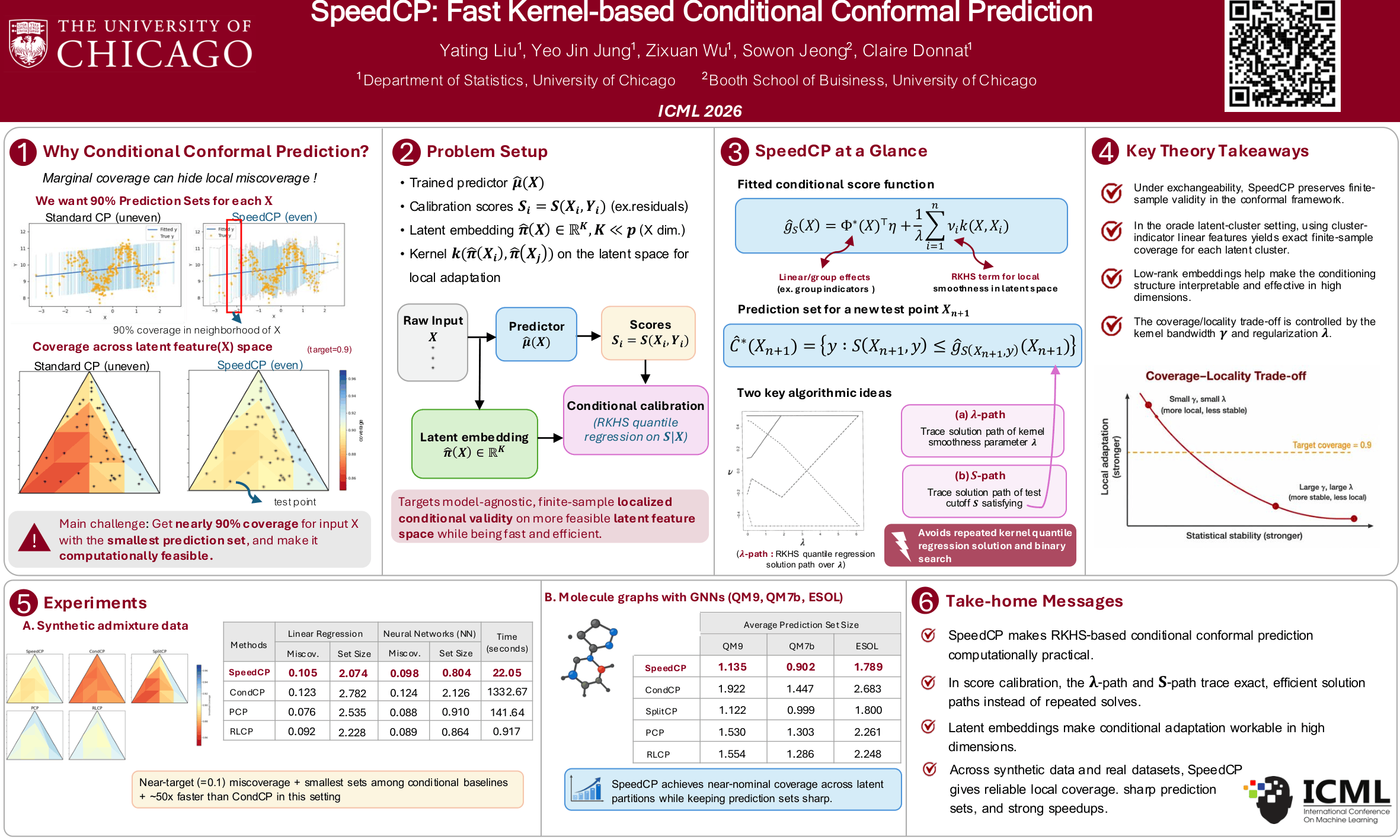
Conformal prediction provides distribution-free prediction sets with finite-sample conditional guarantees. RKHS-based frameworks—while promising for complex covariate shifts—suffer from prohibitive computational costs. To guarantee conditional validity under such shifts while ensuring feasibility, we build upon the framework of Gibbs et al. (2025) by introducing a stable and efficient algorithm that computes the full solution path of the regularized RKHS conformal optimization problem, at essentially the same cost as a single kernel quantile fit. Our approach provides simultaneous hyperparameter tuning which provides smoothness control and data-adaptive calibration. To extend the method to high-dimensional settings, we further integrate our approach with low-rank latent embeddings that capture conditional validity in a data-driven latent space. Empirically, our method provides reliable conditional coverage across a variety of modern black-box predictors, improving the interval length of Gibbs et al. (2025) by 30%, while achieving a 40-fold speedup.
Lay Summary
When AI models make predictions—say, estimating a patient's risk or forecasting energy demand—we often want not just a single guess but a reliable range of plausible values. Crucially, that reliability should hold consistently across all types of inputs: a model predicting patient risk should be equally well-calibrated for the young and the elderly, across diseases and demographics. Existing methods that provide this guarantee are far too slow to be practical. We developed a fast algorithm that automatically finds the best way to calibrate these prediction ranges, even when real-world data looks different from training data. Rather than running many expensive computations independently, our method solves the entire family of calibration problems in roughly the time it takes to solve just one. We also extended the approach to high-dimensional settings by learning compact, data-driven representations of the inputs. Our method produces prediction ranges that are 30% tighter than the leading alternative and 40 times faster to compute, making rigorous, consistent uncertainty quantification practical for real-world AI systems.