
Two-dimensional quantization for geometry-aware audio coding
Abstract
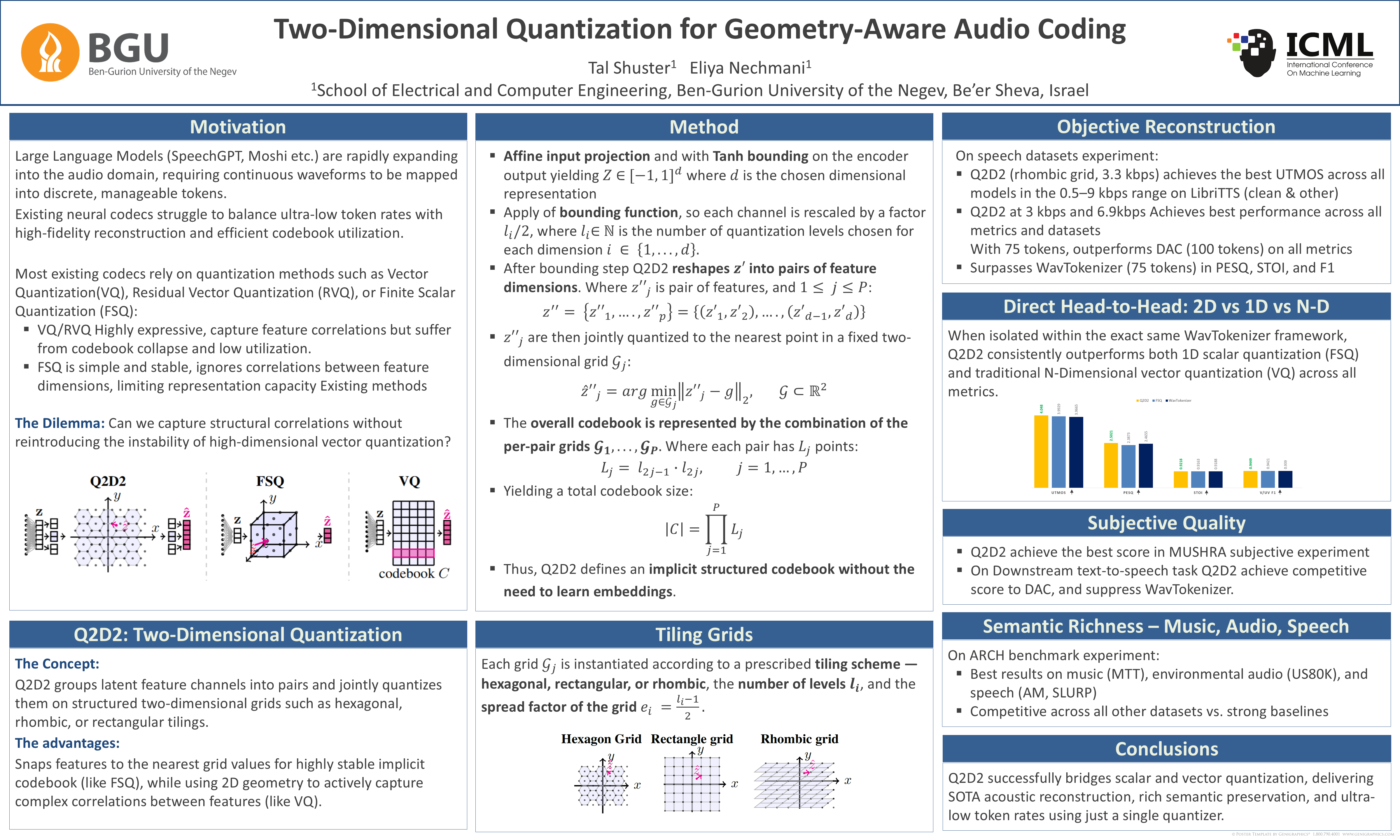
Recent neural audio codecs have achieved impressive reconstruction quality, typically relying on quantization methods such as Residual Vector Quantization (RVQ), Vector Quantization (VQ) and Finite Scalar Quantization (FSQ). However, these quantization techniques limit the geometric structure of the latent space, make it harder to capture correlations between features leading to inefficiency in representation learning, codebook utilization and token rate. In this paper we introduce Two-Dimensional Quantization (Q2D2), a quantization scheme in which feature pairs are projected onto structured 2D grids, such as hexagonal, rhombic, or rectangular tiling and quantized to the nearest grid values, yielding an implicit codebook defined by the product of grid levels, with codebook sizes comparable to conventional methods. Despite its simple geometric formulation, Q2D2 improves audio compression efficiency, with low token rates and high codebook utilization while maintaining state of the art reconstruction quality. Specifically, Q2D2 achieves competitive to superior performance in various objective and subjective reconstruction metrics, across extensive experiments in speech, audio and music domains compared to state of the art models. Comprehensive ablation studies further confirm the effectiveness of our design choices.
Lay Summary
Neural audio codecs are AI systems that compress speech and audio into small digital representations while trying to keep the sound natural and clear. Most existing methods either process audio information channels separately or rely on very large lookup tables, which can make compression less efficient. In this paper, we introduce Q2D2, a new audio compression method inspired by simple geometric shapes such as hexagons and rhombuses. Instead of compressing each piece of information independently, Q2D2 groups information channels in pairs and places it on structured 2D grids. This allows the system to represent speech more efficiently and preserve important patterns in the sound. Using this geometric approach, Q2D2 can produce high-quality reconstructed speech while using fewer tokens and lower bitrates than many existing methods. Experiments show that Q2D2 achieves competitive or better performance compared to state-of-the-art neural audio codecs in both automatic measurements and human listening tests. These results suggest that simple geometric structures can improve how future AI systems compress and transmit audio.