
Dissect and Prune: Enhancing Robustness in AI-Generated Image Detection
Abstract
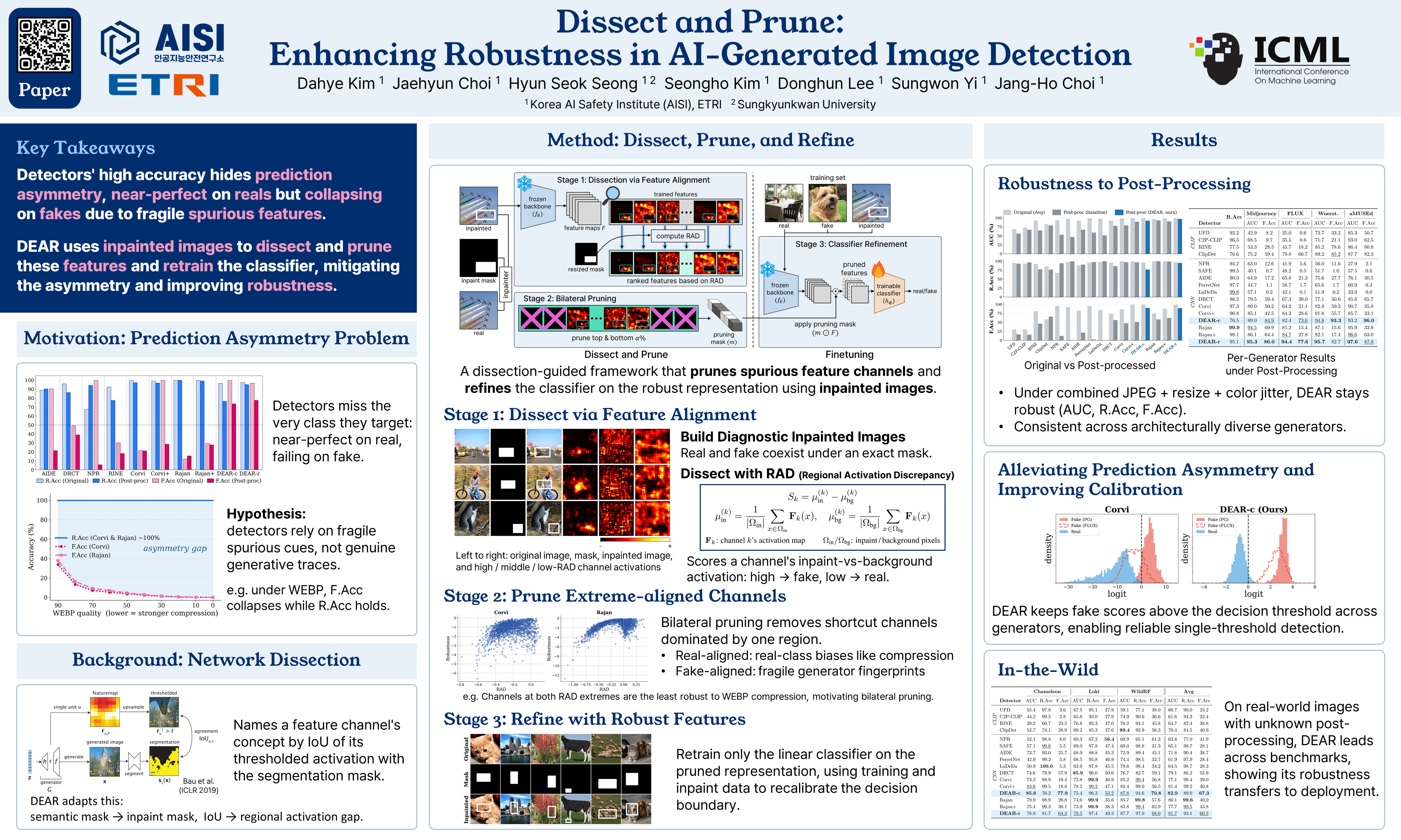
While existing AI-generated image detectors report high performance, we identify that this is largely driven by a critical prediction asymmetry: a bias toward the real class that severely limits sensitivity to generated content, especially under standard post-processing operations such as compression and resizing. We hypothesize that this stems from the model's reliance on spurious features, distracting signals that obscure true generative artifacts. To address this, we propose DEAR (Dissect and Prune), which leverages inpainted images to identify and prune these interfering components. Specifically, we find that features strongly aligned to either inpainted or non-inpainted regions are less robust to post-processing. By measuring the alignment between channel activations and inpaint masks, DEAR removes features at both extremes, retaining only those that capture genuine generative artifacts. Experimental results demonstrate that our approach significantly enhances robustness against unseen generators and post-processing, effectively mitigating the prediction asymmetry. Our code is available at https://github.com/dahyedahye/dear.
Lay Summary
AI can now make images that look like real photographs, so we need reliable tools that separate real photos from AI-generated ones. Today's tools report high accuracy, but this is misleading, because it comes mostly from recognizing real photos, not from catching AI-generated images. They grow unreliable once an image is compressed or resized, which happens whenever pictures are shared online, and on images from newer AI models. In these cases they often miss the fakes and simply label most images as real. The reason is that they lean on shallow clues that are easily erased, instead of the genuine traces left by AI generation. To study this, we made test images in which only a small region was generated by AI and the rest stayed a real photo. By comparing how a tool reacted to the real and the generated parts, we kept its dependable inner parts, removed the unreliable ones, and retrained the final decision step. The adjusted tools detect AI-generated images more consistently, including images from AI models they never saw and images that were compressed or resized. This can help limit misinformation and the misuse of AI-generated images.