
IPMark: A Sentence-Level Watermark for LLMs with Hierarchical Personalization and Efficient Detection
Abstract
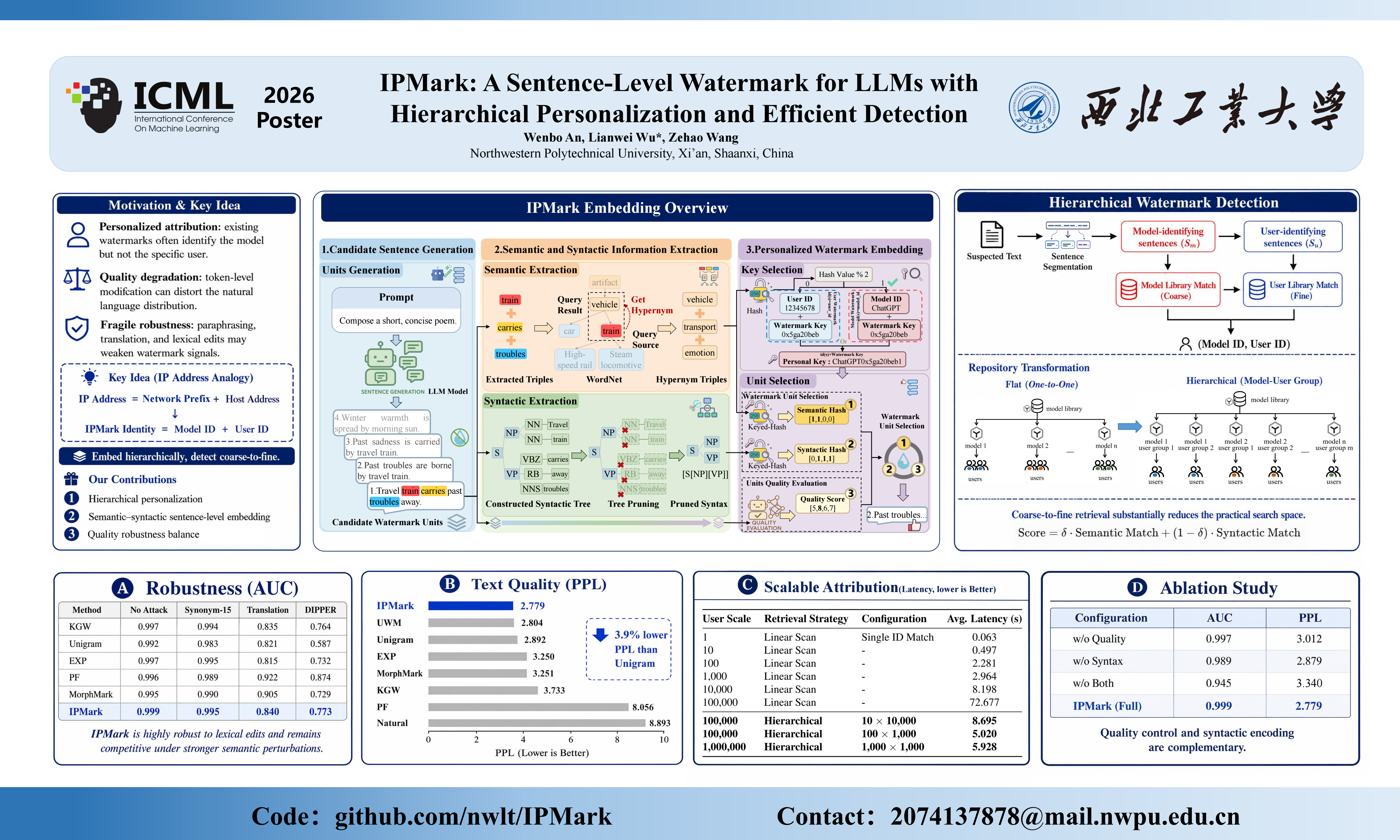
Watermarking has emerged as a critical solution for the detection and provenance tracing of content generated by large language models. However, existing methods still suffer from significant limitations, including difficulties in achieving efficient and personalized attribution, substantial degradation of generation quality, and low robustness against attacks. To address these challenges, we propose IPMark, the first IP-inspired hierarchical personalized watermarking framework. Specifically, to enable personalization and efficient detection, IPMark employs a hierarchical addressing framework to structurally organize model and user identities. Subsequently, addressing the inherent semantic distortion caused by token-level watermarking, we design a semantic-syntactic dual-stream embedding strategy. Centered on sentence-level candidate selection and reinforced by dual signals from syntactic and semantic features, this approach optimizes the injection process, thereby significantly enhancing generation quality while ensuring strong robustness. Experimental results demonstrate that IPMark achieves the lowest perplexity among baselines, ensuring superior generation quality while maintaining strong robustness and significantly reducing detection latency through hierarchical retrieval. Our code is available at https://github.com/nwlt/IPMark.
Lay Summary
Large language models can write convincingly human-like text, but this also makes them easy to misuse for disinformation. To trace the origin of AI-written content, researchers have developed digital watermarks. Existing watermarking methods, however, often degrade the quality of the writing, are slow to identify the source, and cannot distinguish between different models or users. Inspired by how IP addresses assign layered numbers to households, we designed a watermarking framework called IPMark. It gives models and users a hierarchical digital identity—like a street address—and subtly embeds watermarks into the word choices within sentences. By simultaneously considering whether a sentence remains grammatically natural and semantically coherent, our method picks the most fitting words, much like writing with invisible ink that preserves the original meaning and flow. Our experiments show that IPMark produces the most fluent text among all tested methods while still being highly resilient to tampering. It can rapidly pinpoint exactly which model and user generated a piece of content—even if the text has been deliberately paraphrased. This work offers a more practical and reliable foundation for responsibly tracking and managing AI-generated text.