
From Representation to Action: A Unified Laplacian Framework for Spatial Representation and Path Planning
Abstract
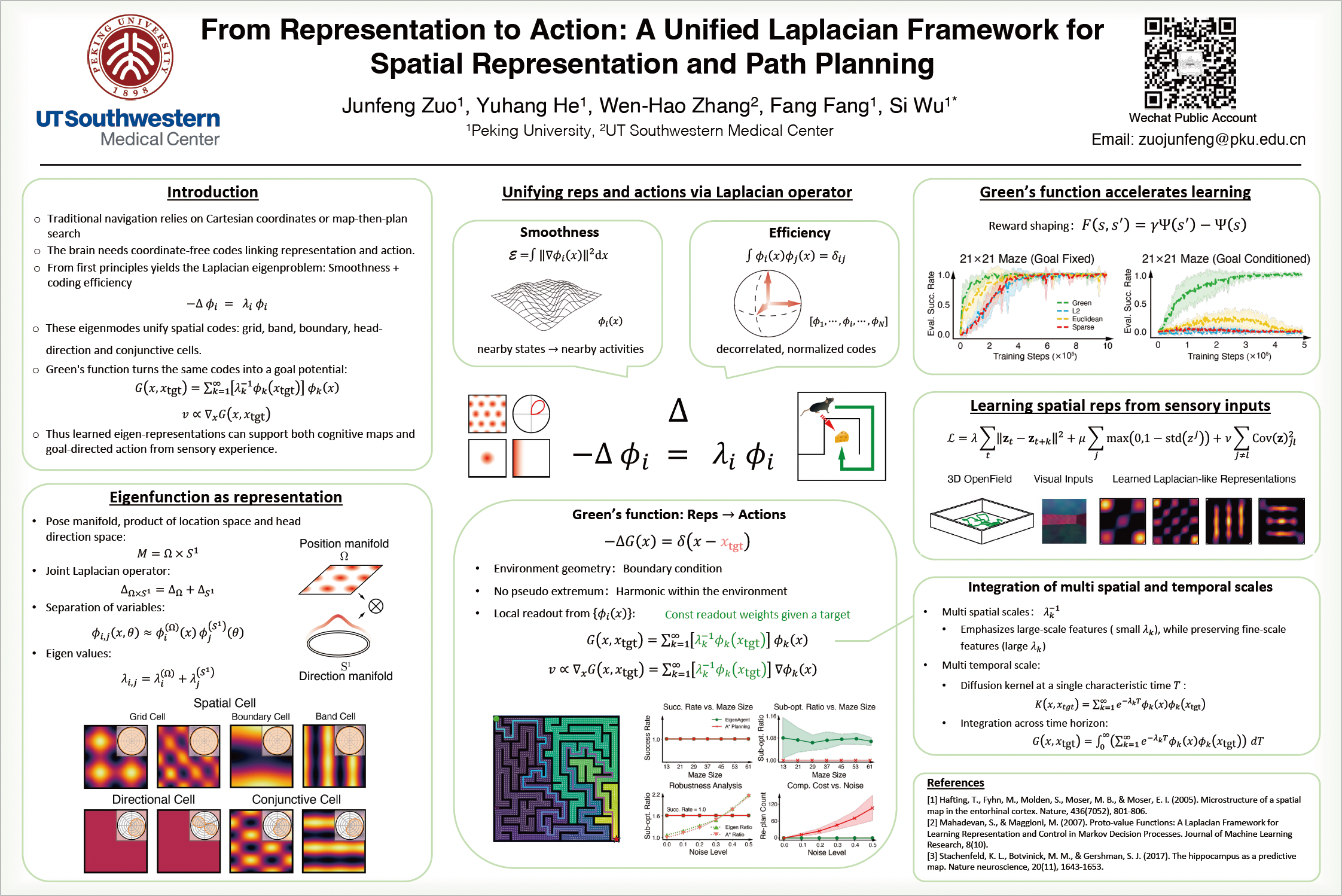
Navigation in complex environments relies on internal spatial representations that guide action. While the brain employs a diverse repertoire of spatial tuning cells—including grid, place, and head-direction cells—a normative theory linking these static neural codes to the dynamic process of navigation remains elusive. In this work, we propose a Unified Laplacian Framework derived from first principles of representational smoothness and efficiency. We first demonstrate that diverse spatial codes emerge naturally as spectral decompositions of the Laplace operator. Crucially, bridging the gap from representation to action, we derive a computational-level navigation policy based on the Green's function potential. We show that this potential encodes the environment's intrinsic geometry to enable geometry-aware gradient ascent, achieving improved sample efficiency and generalization in goal-reaching tasks. Furthermore, we demonstrate that these spectral representations can be learned directly from high-dimensional visual inputs, supporting their learnability from sensory experience. Our results suggest that the ``cognitive map" can be viewed as a spectral embedding of the Laplacian, providing a normative computational account that is biologically consistent with observed spatial-code phenomenology and useful for artificial agents.
Lay Summary
How do brains and artificial agents know where they are and decide where to go? This paper proposes that the same kind of internal map can support both tasks: representing space and choosing actions. We show that if an agent builds a smooth and efficient map of its surroundings, the resulting patterns resemble several well-known navigation-related brain signals, such as cells that respond to places, directions, boundaries, or repeated spatial patterns. Importantly, this map is not only useful for recognizing locations. It can also be used to guide movement toward a goal, especially in environments with walls or obstacles where simply moving straight toward the target would fail. We test this idea in maze-like navigation tasks and show that this map-based guidance helps learning and generalization. We also show that similar spatial structure can be learned from raw visual experience, without directly giving the agent its position. Overall, the work suggests a unified way to understand spatial representation and navigation as two uses of the same internal map.