
IRPM: Intergroup Relative Preference Modeling for Pointwise Generative Reward Models
Abstract
Lay Summary
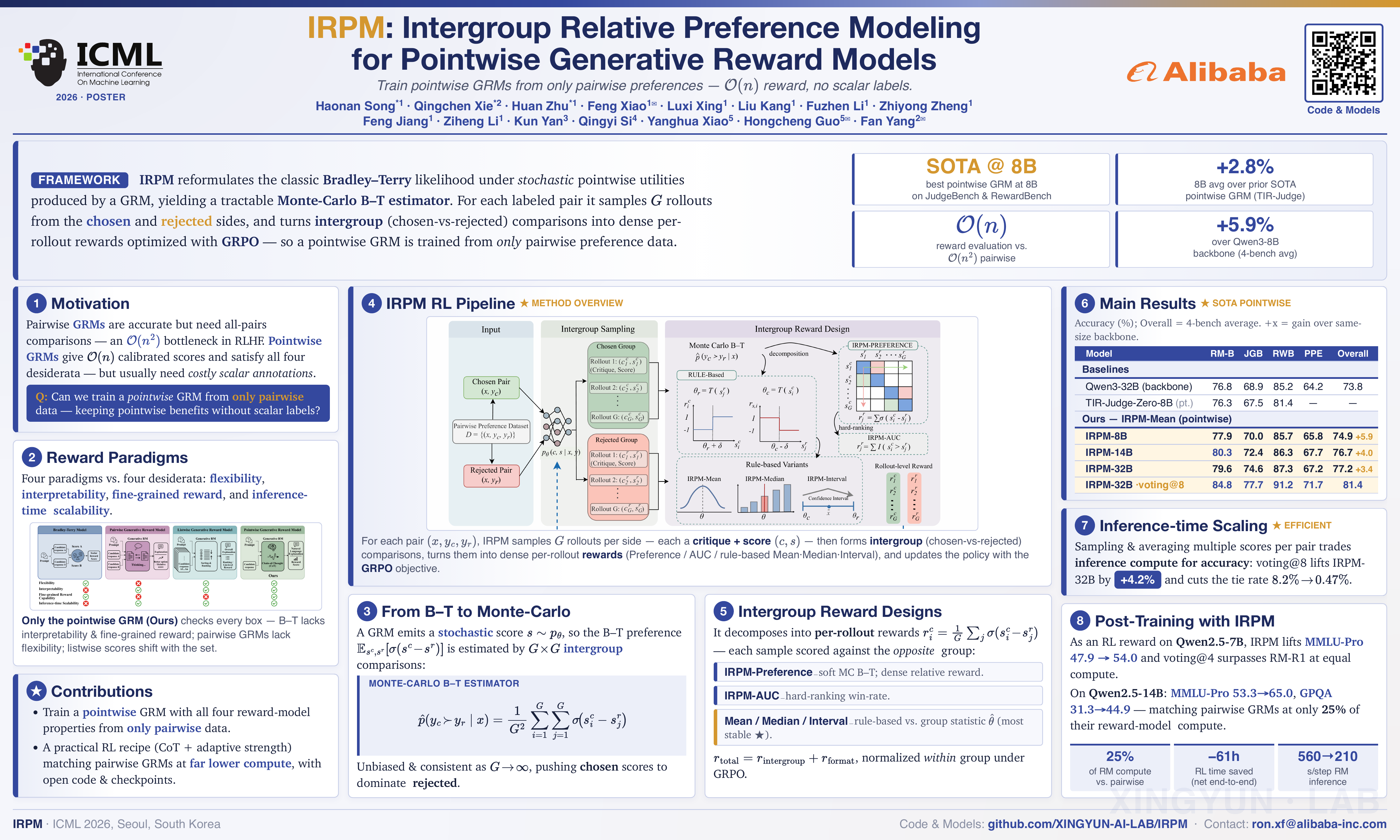
AI systems are often trained with the help of reward models, which act like judges that score how good a response is. The most accurate judges today usually compare answers in pairs, choosing which of two is better. This works well, but it is costly: evaluating 100 candidate answers can require nearly 5,000 pairwise comparisons. We propose IRPM, a method that uses only this comparison data to train a judge that can later score each answer independently. During training, the system generates multiple evaluations for both a preferred and a non-preferred answer, then cross-references the two groups to calibrate a consistent scoring standard. In experiments, IRPM matches the accuracy of strong pairwise methods at a fraction of the cost, while also allowing the judge to improve its accuracy by reasoning longer before giving a score. By enabling accurate independent scoring from cheap comparison data, IRPM lowers a key computational barrier in building AI systems that reliably follow human preferences.