
One-Step Graph-Structured Neural Flows for Irregular Multivariate Time Series Classification
Abstract
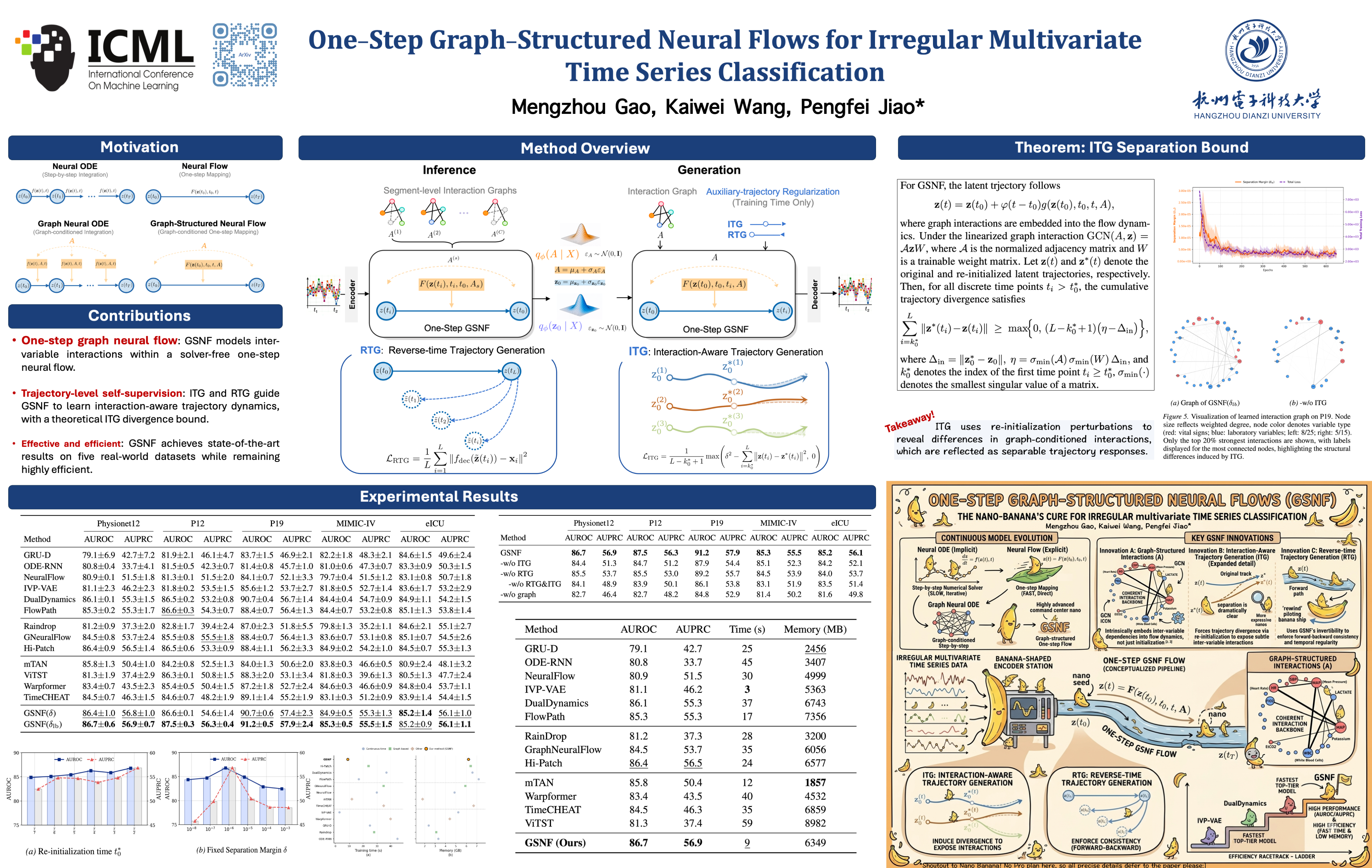
Neural Flows efficiently model irregular multivariate time series by directly learning ODE solution trajectories with neural networks, bypassing step-by-step numerical solvers. Despite their efficiency, many existing approaches treat variables independently, leaving inter-variable interactions underexplored. Moreover, their one-step mapping makes interaction modeling inherently challenging, as it removes the iterative refinement of interactions during learning. To address this challenge, we propose one-step Graph-Structured Neural Flows (GSNF), which introduce two auxiliary-trajectory self-supervision strategies to strengthen interaction learning: (i) interaction-aware trajectory generation via re-initialization, which induces trajectory divergence to expose graph-induced interactions, with a theoretically derived lower bound on divergence; and (ii) reverse-time trajectory generation, which enforces forward–backward consistency to regularize graph learning, enabled by flow invertibility. Experiments on five real-world datasets show that GSNF achieves state-of-the-art classification performance with highly competitive training time and memory usage. The code is available at https://github.com/mzgaooo/GSNF.
Lay Summary
Irregular and incomplete multivariate time series are common in real-world data, where observations are collected at uneven time intervals and may contain missing values. This makes it difficult to model how multiple variables evolve over time and interact with each other. Neural flow models are well suited to this setting because they can directly process irregular observations in a one-step manner without iterative computation. However, most existing methods do not explicitly model interactions between variables, which limits their ability to capture structured dependencies. We propose Graph-Structured Neural Flows (GSNF), a one-step model that learns how multivariate systems evolve over time while also discovering how variables are related through a latent interaction structure. To better capture these interactions, we introduce a training strategy that includes re-initializing trajectories from intermediate time points during generation, and comparing the resulting re-initialized trajectories with the original ones. This provides a self-supervised signal that reveals how interactions affect system evolution. We also introduce a reverse-time learning objective that enforces consistency when generating trajectories forward and backward in time. We further derive a theoretical lower bound that determines how much trajectory separation is needed to reliably learn interactions, reducing the need for manual tuning. Experiments on multiple benchmarks show that GSNF improves classification performance while maintaining the efficiency of one-step neural flow models.