
Reduction of Probabilistic Chemical Reaction Networks
Abstract
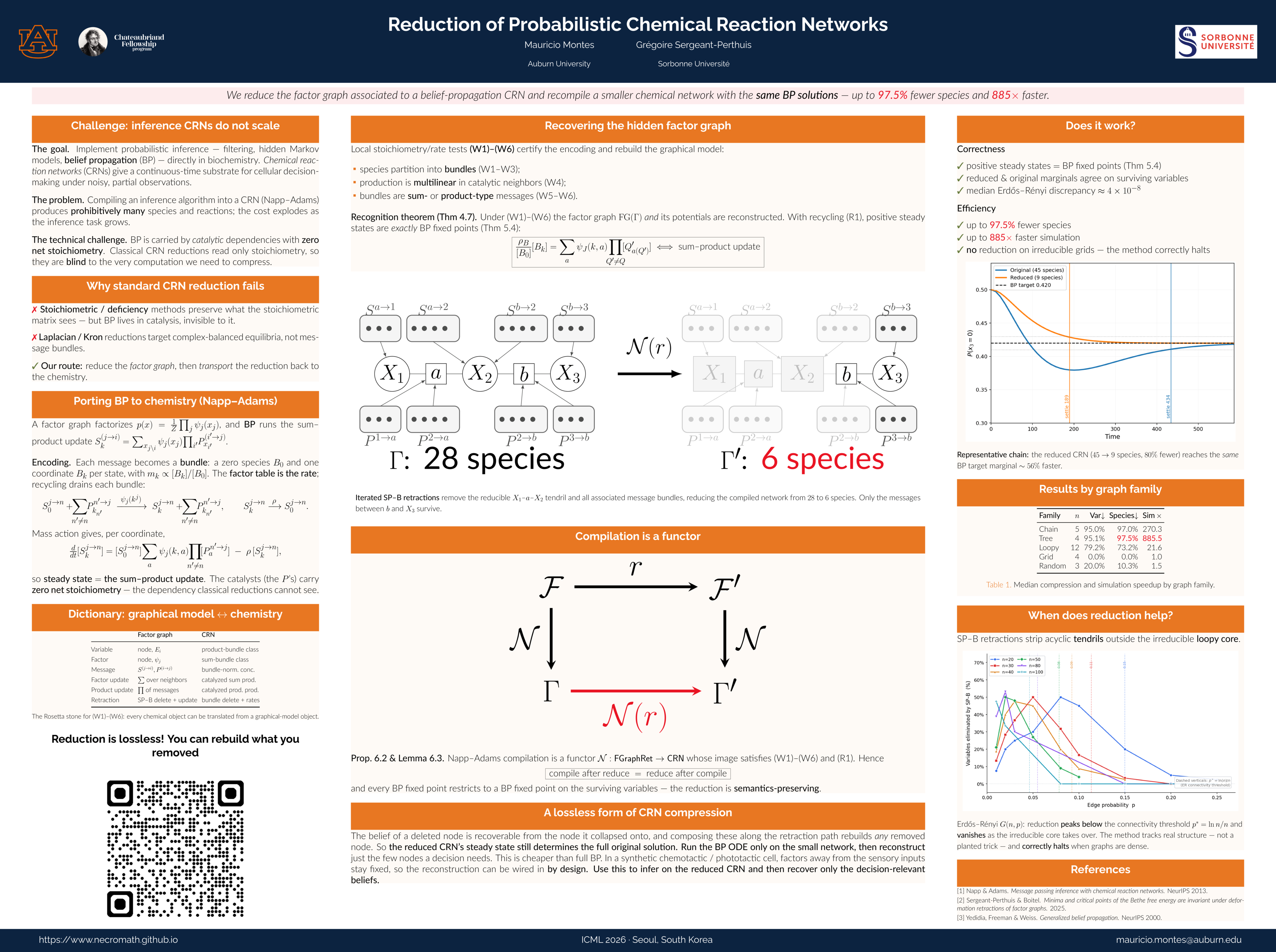
Programming adaptive behaviors at the cellular level is a long-standing goal that raises the question of how probabilistic computation can be implemented in biochemical systems. Chemical reaction networks (CRNs) provide such a substrate and have been shown to realize probabilistic models, including hidden Markov models and factor graphs, with dynamics reproducing Bayesian inference and belief propagation. However, encoding these algorithms typically requires prohibitively large reaction networks, and classical CRN reduction techniques do not directly apply. By recovering the factor graph structure encoded in Napp--Adams-compiled CRNs, we transport recent factor-graph reduction results to their chemical implementations, obtaining significantly smaller CRNs while preserving the belief-propagation fixed points on surviving variables.
Lay Summary
Living cells must constantly make decisions under uncertainty, inferring the state of their environment from noisy molecular signals. A long-standing goal in synthetic biology is to engineer cells that perform this kind of probabilistic reasoning deliberately, using networks of chemical reactions as the computational substrate. While methods exist to design such networks, the networks required grow prohibitively large as the inference problems become more complex, quickly exceeding what can be physically realized inside a cell. We address this bottleneck directly. Given a chemical reaction network deliberately engineered to perform probabilistic inference, we show how to identify and remove chemical species that carry redundant information, replacing the large network with a smaller one that performs exactly the same inference on the remaining variables. The influence of removed species is absorbed into updated reaction rates, so no information is lost. In practice this reduces network size by up to 97% and speeds up simulation nearly 900-fold, bringing complex probabilistic computation meaningfully closer to experimental realization in living cells.