
Spectral-Informed Neural Networks Outperform Spectral methods in High-dimensional PDEs
Tianchi Yu ⋅ Ivan Oseledets
Abstract
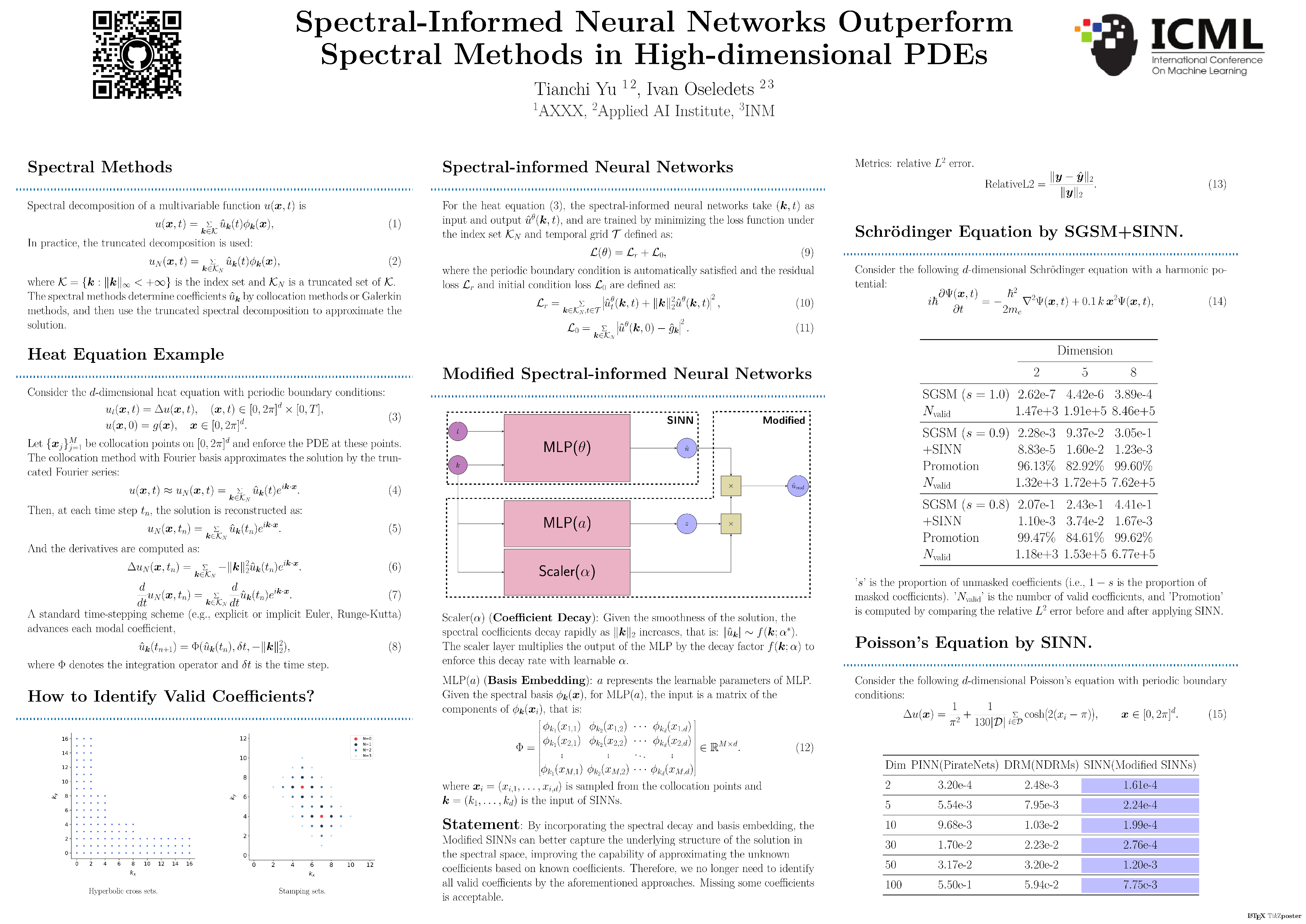
For low-dimensional problems ($d\leq3$), spectral methods can achieve exceptionally high accuracy. For middle-dimensional problems ($4 \leq d \lesssim 10$), spectral methods remain feasible through specific techniques such as sparse grids or hyperbolic cross. However, for high-dimensional problems ($d\gg 10$), spectral methods suffer from the curse of dimensionality. Physics-informed neural networks (PINNs) have emerged as a promising approach to overcome this challenge, offering scalability to high dimensions, but often suffer from limited accuracy and efficiency. Recently proposed spectral-informed neural networks (SINNs) combine spectral methods with PINNs, operating directly in the spectral domain to avoid spatial derivative computations and to reduce memory consumption. In this work, we introduce Modified SINNs, which integrate coefficient decay scaling and basis embeddings motivated by harmonic analysis to enhance accuracy in high-dimensional problems and enable accurate approximation of unknown spectral coefficients. Numerical experiments on steady and time-dependent partial differential equations demonstrate that Modified SINNs outperform sparse grid spectral methods on middle-dimensional problems with incomplete spectral information and achieve superior accuracy compared to PINNs on high-dimensional problems.
Video
Chat is not available.
Successful Page Load