
Is Graph Mixup Beneficial? Investigating Interpolation And Empirical Performance of Graph Mixup Methods
Abstract
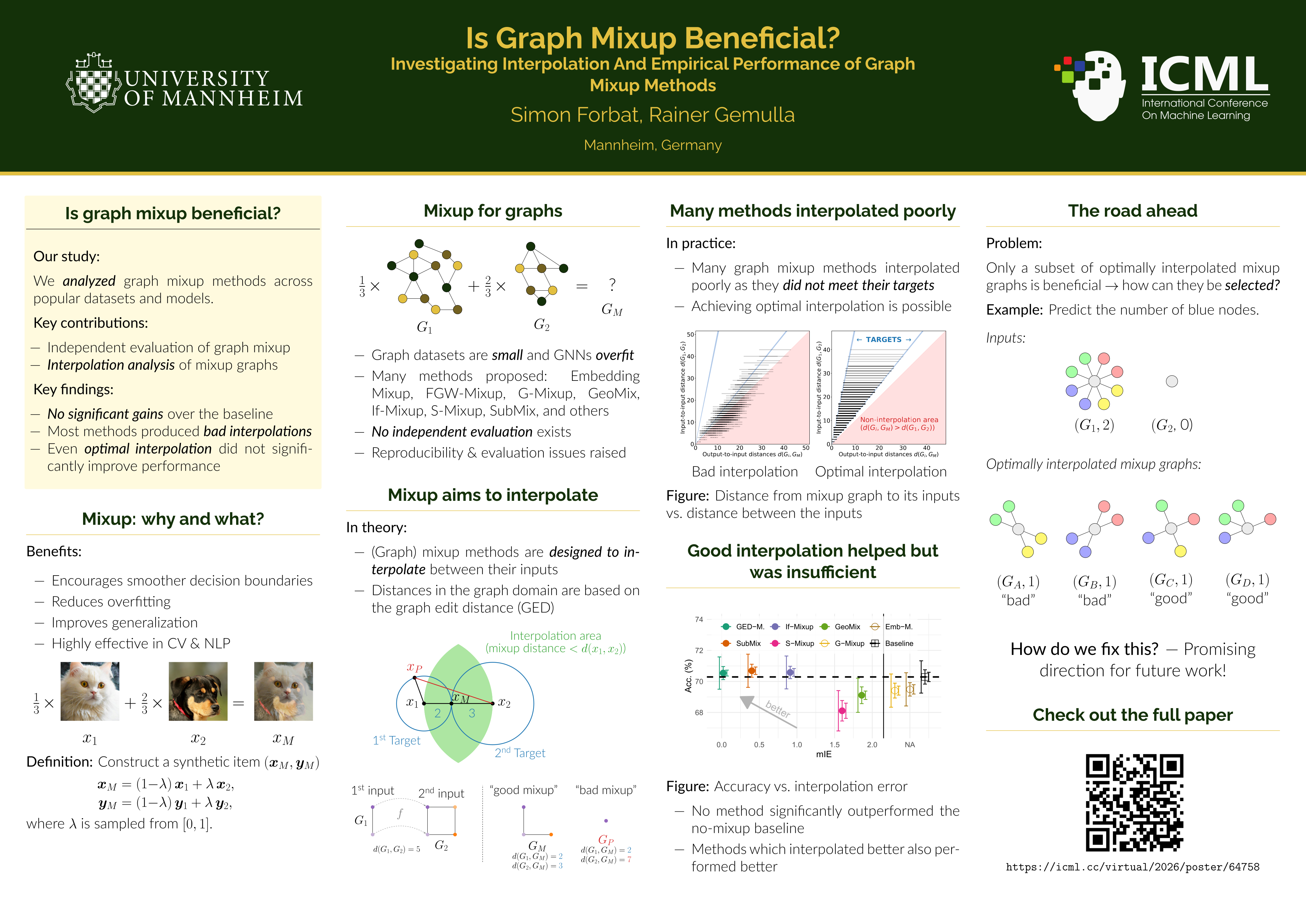
Mixup is a widely used data augmentation technique that constructs new training examples by interpolating between existing ones. While simple and effective in domains like vision and language, applying mixup to graph data is non-trivial and there is no independent empirical evidence for its effectiveness. To fill this gap, we conducted an extensive evaluation study following a unified, established evaluation protocol for graph classification. In contrast to prior results, we found that none of the state-of-the-art mixup methods yielded statistically significant improvements over the no-mixup baseline. To obtain further insights, we analyzed the graphs generated from these mixup methods from an interpolation perspective. We found that (i) many mixup methods failed to interpolate well, (ii) high interpolation error led to performance degradation, and (iii) even good interpolation properties did not lead to performance improvements. Our findings question the efficacy of existing graph mixup methods and highlight the need for a more rigorous exploration and evaluation.
Lay Summary
Machine learning models require a large amount of data, which is often hard to come by. One clever trick to obtain more data for free is "mixup": blend existing data points together to create new ones, like mixing two colors to get a third one. In our work, we studied whether this trick is beneficial for graph problems. Graphs can be understood as collection of things that are related to each other. Many real-world phenomena can be modeled as graphs: for instance, social networks as people and their relationships or molecules as atoms held together by bonds. Researchers have proposed several potential ways to perform mixup for graphs. But no one had independently checked whether these techniques actually work. We tested leading graph mixup methods under the same fair conditions and found that none of them performed significantly better than using no mixup at all. Moreover, these methods often did not produce sensible blended graphs. And even if they did, performance was not improved. Our work is important because it suggests that the problem of successful graph mixup runs deeper than currently understood, and our findings may pave the way for better methods in the future.