
Multimodal Function Vectors for Visual Relations
Abstract
Lay Summary
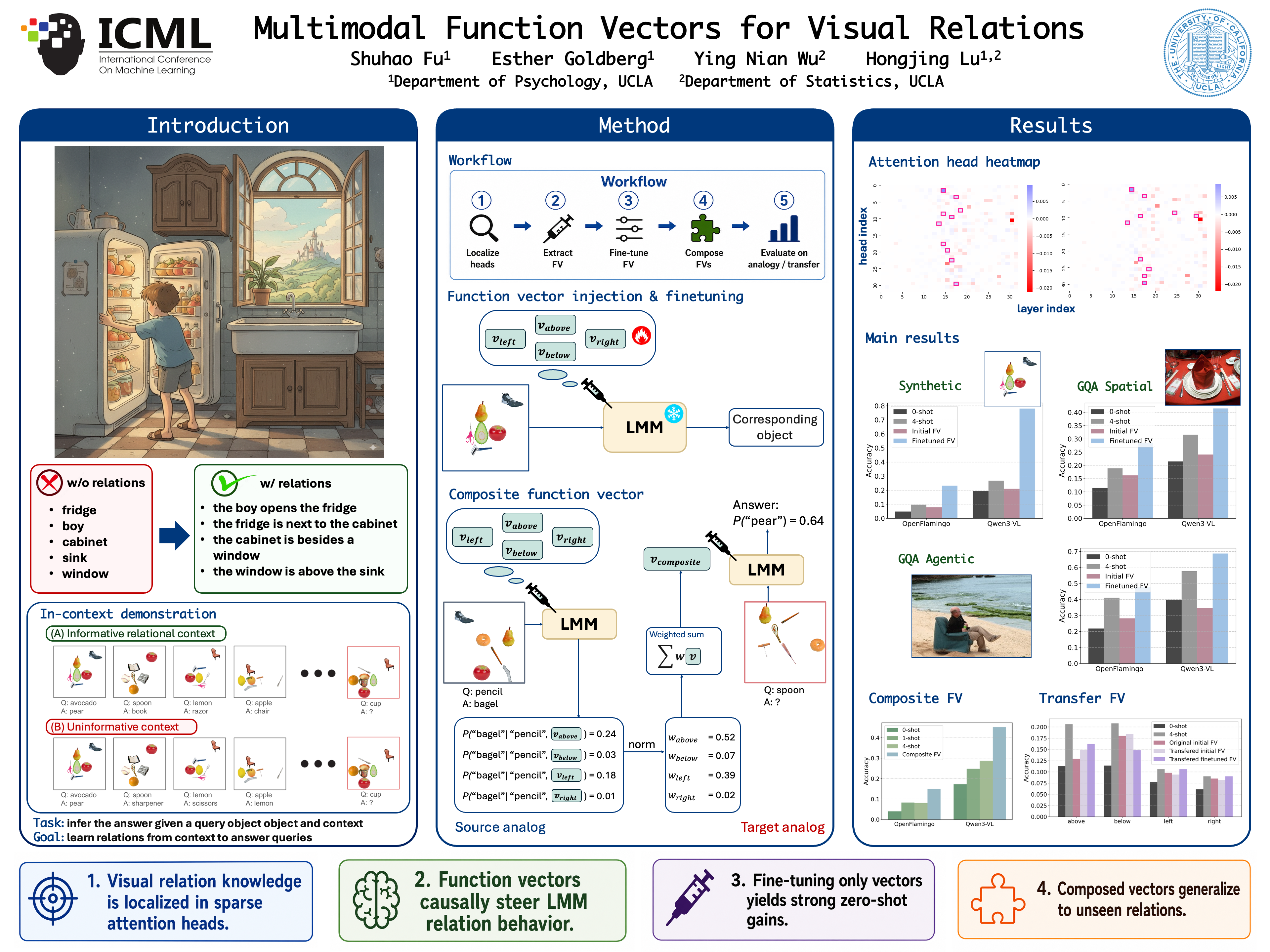
When we look at a kitchen, we don't just see a list of objects like "fridge, boy, cabinet." We see relationships: a boy opening the fridge, a cabinet next to a window. These relationships are what make a scene meaningful, but they aren't directly visible in any single pixel. AI systems that combine vision and language still struggle to recognize them reliably. We asked whether knowledge of visual relationships might already exist inside these models, hidden in a small part of their internal machinery. We found that roughly ten components out of thousands carry most of the information about a given relation, such as "above" or "holding." We can extract this as a compact numerical signature and inject it back into the model to substantially improve its accuracy, even without showing it any examples. These signatures can also be combined like building blocks: by mixing the signatures for "above" and "right," the model can recognize "above-right". This suggests vision-language models organize relational knowledge in a structured, modular way that researchers can read out, edit, and recombine.