
Let the Prototype Guide You: Robust Aggregation of Sparse Multi-Class Annotations via Annotator Prototype Learning
Abstract
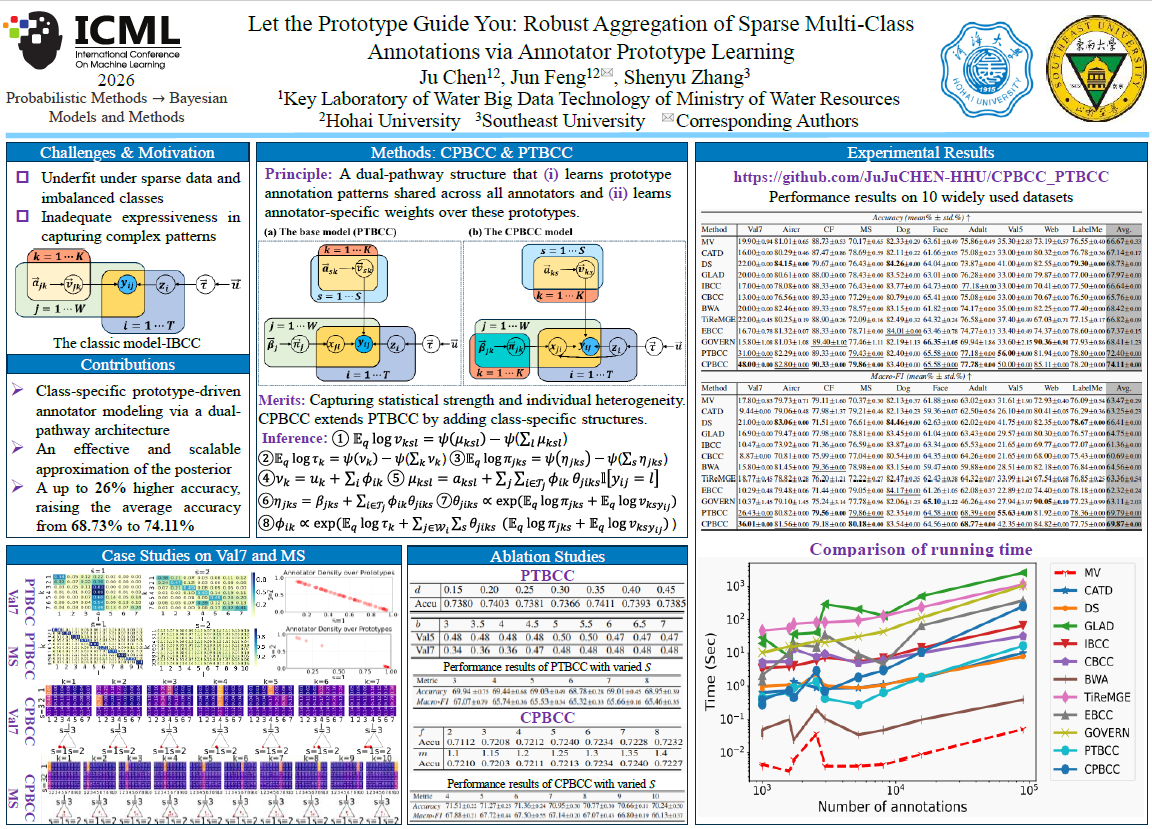
Truth inference is a critical technique for aggregating noisy and biased multi-class classification annotations. State-of-the-art approaches model each annotator using an individual confusion matrix. While well-grounded, they suffer from two fundamental bottlenecks: 1) confusion matrices are underfit when annotators label only a small subset of tasks or when classes are imbalanced, and 2) a single confusion matrix per annotator is inadequate for capturing complex annotator behaviors, leading to class-level collapse when tasks are extremely difficult. Simultaneously addressing these challenges is non-trivial, as it demands both robustness to data sparsity and sufficient expressiveness for complex annotator patterns. In this paper, we propose \textbf{CPBCC} (\textbf{C}lass-specific \textbf{P}rototype-driven \textbf{B}ayesian \textbf{C}lassifier \textbf{C}ombination), which creatively models annotators through a dual-pathway architecture: (i) learning class-specific prototype annotation patterns across all annotators, and (ii) learning annotator-specific weights over prototypes. This framework addresses the bottlenecks and achieves a robust yet rich annotator characterization. Experiments across 10 real-world datasets spanning five domains demonstrate that CPBCC yields a 26\% accuracy improvement in the best case, and boosts average accuracy from 68.73\% to 74.11\%. Our source code is available at \url{https://github.com/JuJuCHEN-HHU/CPBCC_PTBCC}.
Lay Summary
When multiple people label the same task, their answers are often noisy, biased, and inconsistent, making it difficult to determine the true label. Existing methods usually model each annotator with a single confusion matrix, but this can fail when annotators label only a few tasks, when classes are imbalanced, or when tasks are very difficult. To address these issues, we propose CPBCC, a method that learns shared annotation patterns across annotators while also capturing each annotator’s personalized multi-dimensional tendencies. This design makes the model both robust and expressive. Experiments on 10 real-world datasets spanning domains, e.g., NLP, CV, Video, and Audio, show that CPBCC substantially improves truth inference performance, increasing average accuracy from 68.73% to 74.11%, with gains of up to 26% in the best case.