
DiffCrossGait: Trajectory-Level Alignment for 2D-3D Cross-Modal Gait Recognition via Latent Diffusion
Abstract
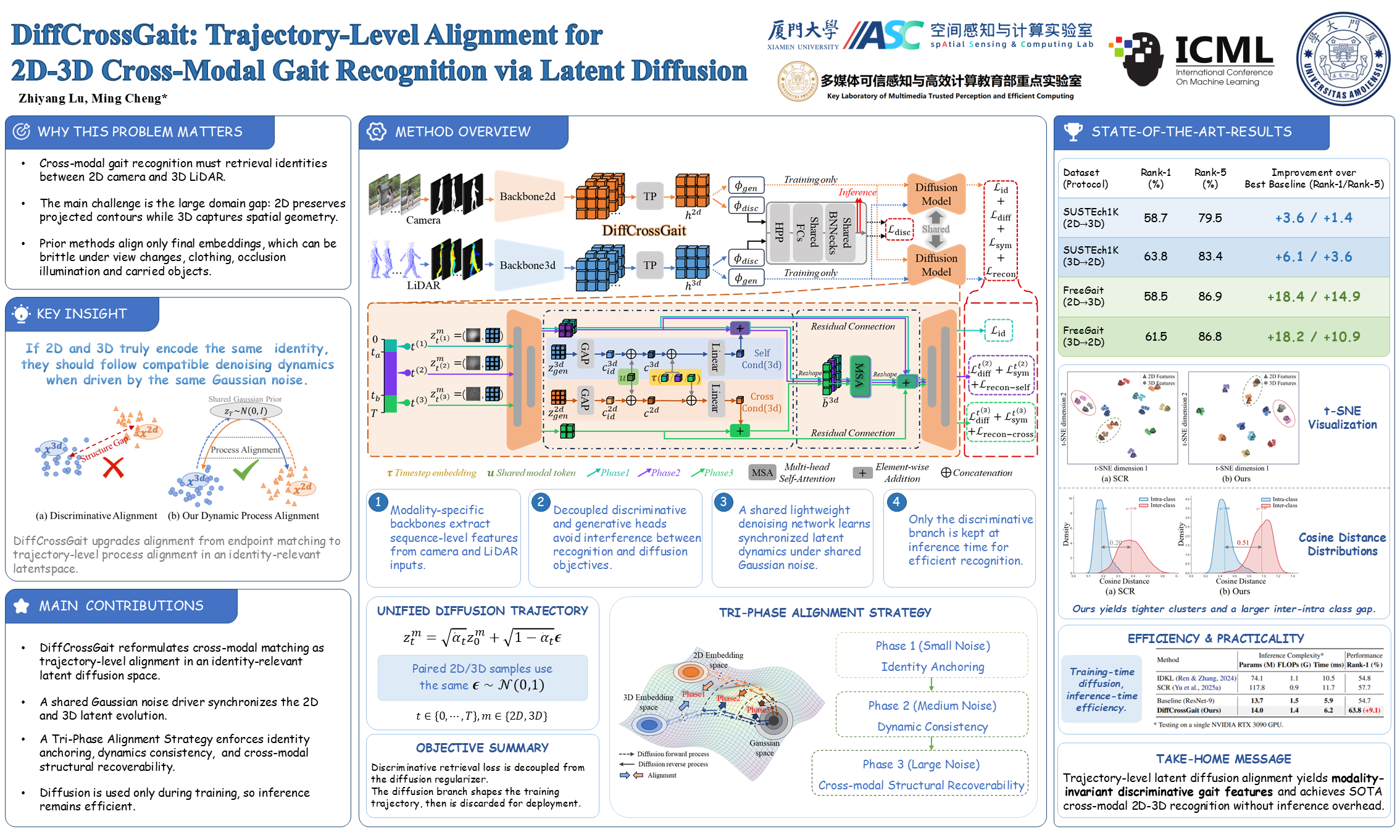
Cross-modal 2D–3D gait recognition is impeded by inherent domain discrepancies between 2D silhouette and 3D point cloud distributions. While prior methods align only final embeddings, we propose DiffCrossGait, which enforces trajectory-level alignment by driving both modalities with shared noise in a unified latent diffusion process. By driving both modalities with shared Gaussian noise within a latent space, we enable continuous alignment throughout the generative evolution. We introduce a Tri-Phase Alignment Strategy that exploits varying noise intensities to enforce identity anchoring, dynamics consistency, and cross-modal structural recoverability, thereby constraining both modalities to share denoising dynamics and bottleneck structure, which promotes modality-invariant gait features. Crucially, our framework decouples generative alignment from the discriminative backbone; the diffusion mechanism serves exclusively as a training objective, ensuring high inference efficiency by eliminating the computational overhead of iterative denoising. Extensive experiments on the SUSTech1K and FreeGait benchmarks demonstrate that DiffCrossGait achieves state-of-the-art performance.
Lay Summary
Gait recognition identifies people by the way they walk, but camera images and 3D laser sensor data describe walking in very different ways. This paper presents DiffCrossGait, a method that helps a computer connect these two types of walking data more reliably. The key idea is to train the system to compare not only the final walking descriptions, but also the way those descriptions gradually become cleaner and more consistent during training. Experiments on two public datasets, SUSTech1K and FreeGait, show that the method improves identification accuracy across cameras and 3D sensors without making the final recognition system slower. Because gait recognition is a biometric technology, real-world use should carefully consider privacy, consent, legal authorization, access control, and possible bias.