
TadA-Bench: A Million-Variant Benchmark for Future-Round Discovery Toward Agentic Protein Engineering
Abstract
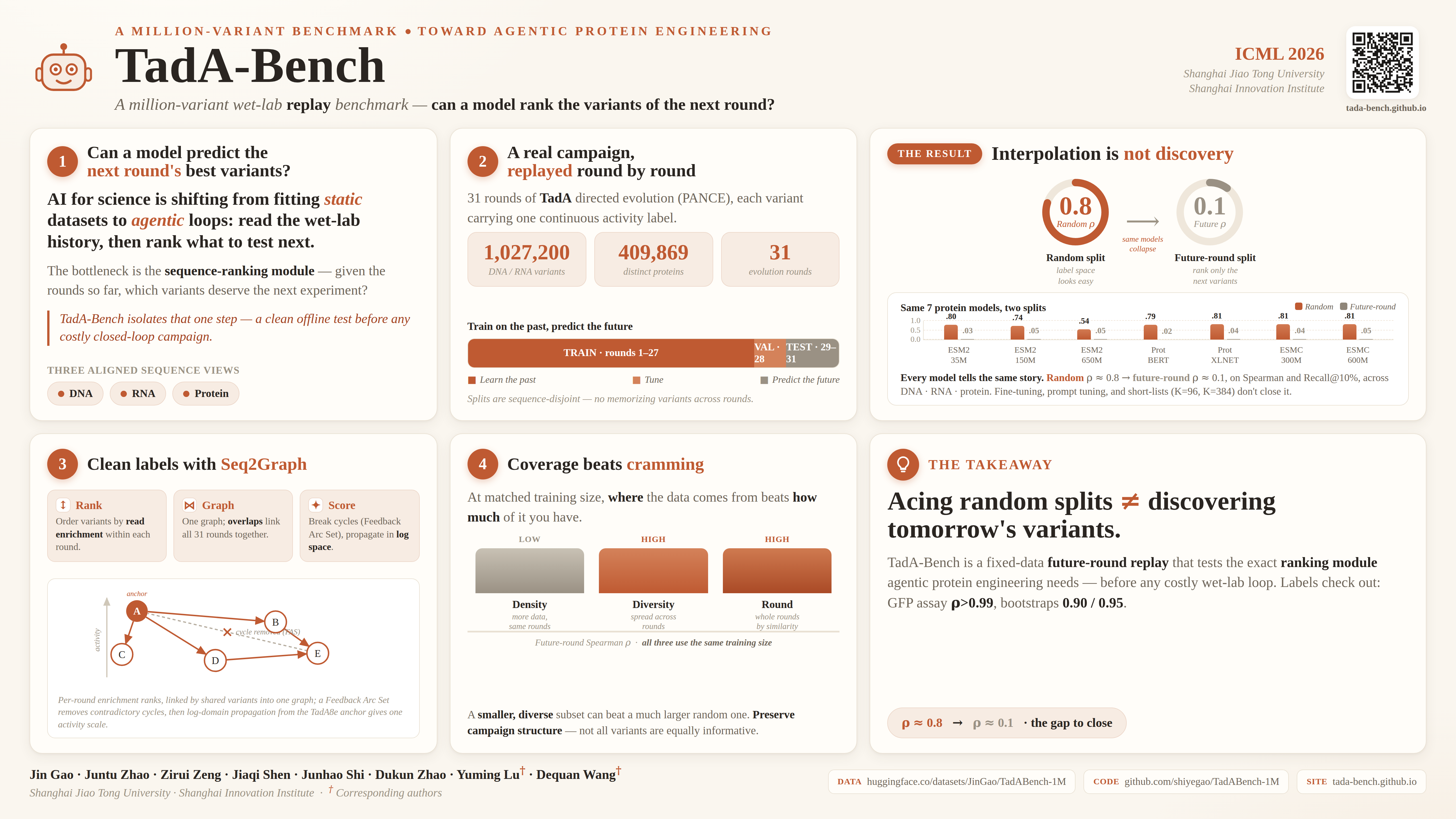
AI for scientific discovery is entering an agentic era, where protein-engineering systems are expected to prioritize future wet-lab experiments rather than merely fit static measurements. We introduce TadA-Bench, a million-variant wet-lab replay benchmark from 31 TadA directed-evolution rounds for future-round discovery toward agentic protein engineering. TadA-Bench preserves the campaign chronology and defines a fixed-data replay task: given earlier experimental rounds, models rank variants that appear only in later rounds. It provides aligned DNA, RNA, and protein views, and uses Seq2Graph, a graph-based label-unification pipeline, to reconcile noisy enrichment measurements into consistent cross-round activity labels. Random-split controls show strong interpolation, but future-round ranking and finite-budget candidate selection are much weaker. Controlled analyses suggest that evolutionary coverage is more informative than local data density, positioning TadA-Bench as a reproducible wet-lab replay substrate for future-round discovery toward agentic protein engineering; the data and code are released on Hugging Face and GitHub.
Lay Summary
Designing better proteins often requires many rounds of laboratory testing. In each round, scientists create many new versions of a protein, measure how well they work, and decide what to test next. Future AI assistants for protein engineering should be able to help with this process: they should not only explain past results, but also identify promising protein versions before future experiments are run. We introduce TadA-Bench, a large benchmark built from 31 real laboratory rounds of engineering TadA, a protein used in base-editing technology. TadA-Bench turns this experimental history into a replay task: an AI model is given results from earlier rounds and must rank protein versions that only appear in later rounds. We also provide a method for combining noisy measurements across rounds into consistent activity scores. Our results show that current biological AI models can perform well when data are randomly mixed, but struggle when asked to predict later experimental rounds. This suggests that today’s models are not yet reliable enough for guiding future protein-engineering experiments. TadA-Bench provides a public testbed for developing and comparing such models before using them in costly laboratory campaigns.