
JADE: Bridging the Strategic-Operational Gap in Dynamic Agentic RAG
Abstract
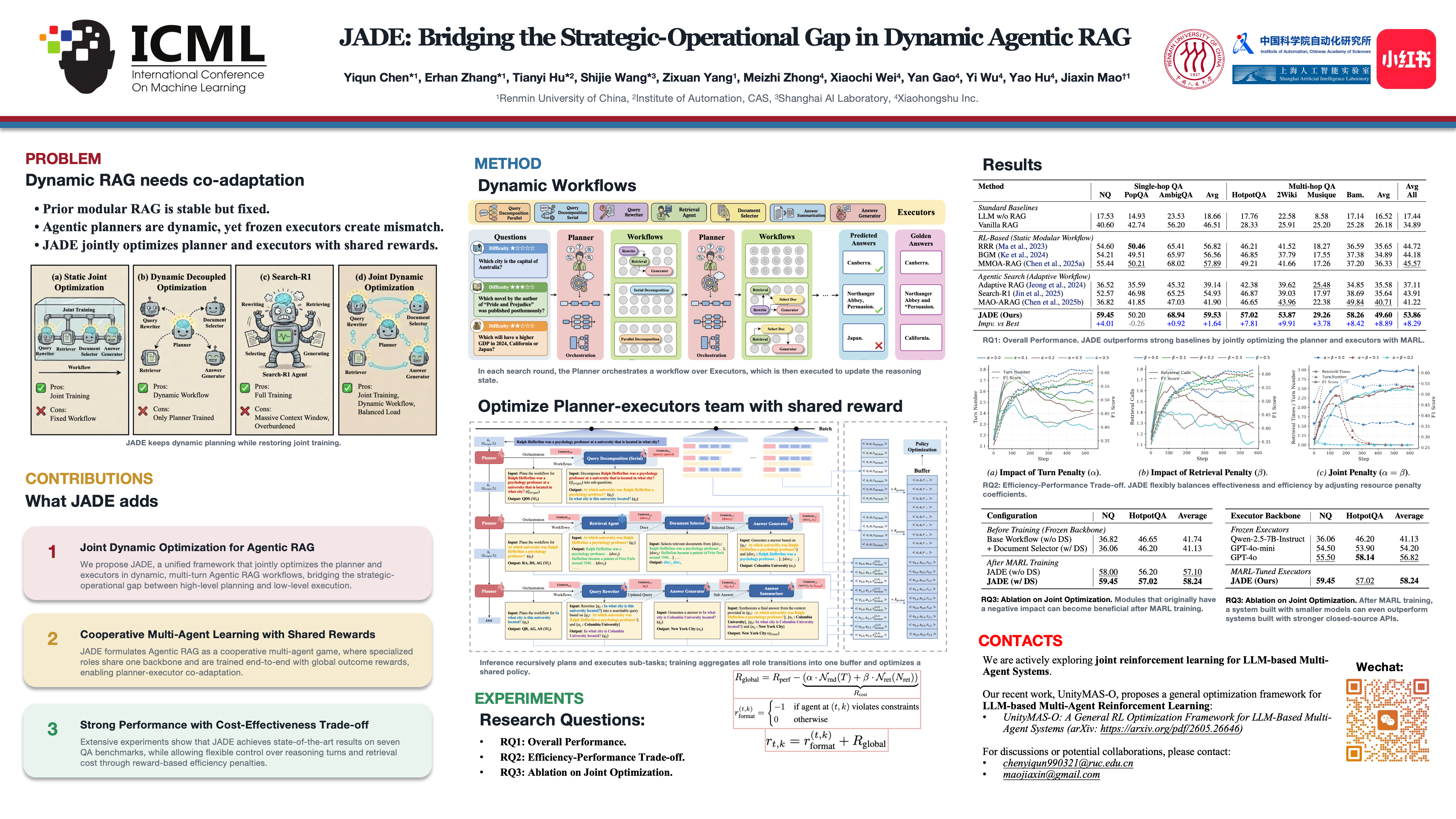
The evolution of Retrieval-Augmented Generation (RAG) has shifted from static retrieval pipelines to dynamic, agentic workflows where a central planner orchestrates multi-turn reasoning. However, existing paradigms face a critical dichotomy: they either jointly optimize modules within rigid, fixed-graph architectures, or enable dynamic planning while treating executors as frozen, black-box tools. We identify that this \textit{decoupled optimization} creates a ``strategic-operational mismatch,'' where sophisticated planning strategies fail to materialize due to unadapted local executors, often causing negative gains despite increased system complexity. In this paper, we propose \textbf{JADE} (\textbf{J}oint \textbf{A}gentic \textbf{D}ynamic \textbf{E}xecution), a unified framework for joint optimization of planning and execution within dynamic, multi-turn workflows. By modeling the system as a cooperative multi-agent team with a shared backbone, JADE enables end-to-end learning driven by outcome-based rewards. This approach facilitates \textit{co-adaptation}: the planner learns to operate within executor capability boundaries, while executors evolve to align with strategic intent. Empirical results demonstrate that JADE transforms disjoint modules into a synergistic system, yielding strong performance improvements via joint optimization and enabling a flexible balance between efficiency and effectiveness through dynamic workflow orchestration.
Lay Summary
Modern AI systems often need to search for information before answering complex questions. However, many current systems either follow a fixed search process for every question, or let one central decision-maker plan the search while the smaller components that carry out the plan remain unchanged. This can cause a mismatch: the plan may look good, but the components may not be able to execute it well. In this paper, we introduce JADE, a method that trains the planning and execution parts of a search-based AI system together. Instead of treating different parts as isolated tools, JADE encourages them to work as a coordinated team. The planner learns to choose search and reasoning steps that the executors can actually handle, while the executors improve to better support the planner’s decisions. Our experiments show that this joint training approach helps the system answer knowledge-intensive questions more accurately and efficiently. The results suggest that well-coordinated smaller AI components can sometimes outperform systems that rely on larger but less coordinated models. This may help build more reliable and cost-effective AI assistants for tasks such as research support, education, and enterprise knowledge search.