
Student-Centered Distillation Narrows the Agentic Gap Between Small and Large LLMs
Abstract
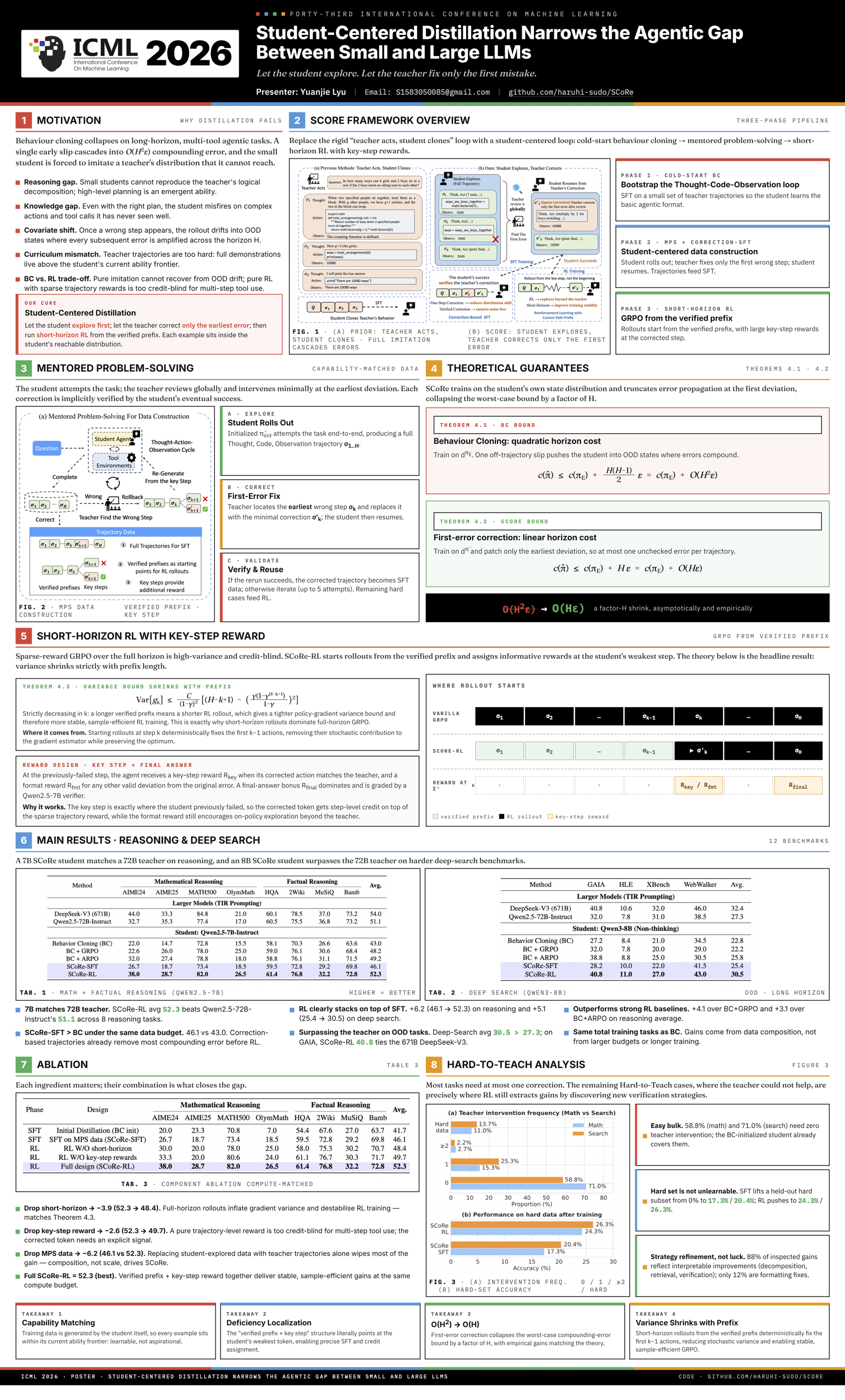
Large Language Model agents achieve strong performance on multi-step reasoning and tool-use tasks, but their impressive capabilities typically rely on extremely large backbones. Existing distillation approaches train smaller students to imitate full teacher trajectories, yet reasoning and knowledge gaps between the teacher and student can cause compounding errors. We propose SCoRe, a student-centered framework in which the student generates training trajectories and the teacher corrects only the earliest error, producing training data matched to the student's abilities and exposing specific weaknesses. The student is first fine-tuned on corrected trajectories. Subsequently, short-horizon reinforcement learning starts from the verified prefix preceding the earliest error, with target rewards assigned at that step. This design enables the student to solve problems through unconstrained RL exploration rather than teacher imitation, while the short-horizon setup improves training stability. On 12 challenging benchmarks, a 7B-parameter student distilled with SCoRe closes the agentic performance gap with a 72B-parameter teacher.
Lay Summary
Modern AI assistants can solve complex problems by reasoning step by step and using tools such as search engines or code. However, these abilities usually rely on very large and expensive models. Training smaller models to copy the full reasoning process of large models often fails, because small mistakes early on can quickly lead to many more errors. We propose SCoRe, a training method where a smaller model first attempts a solution. A larger teacher model then reviews the process and corrects the first mistake. The student continues from this correction and completes the remaining steps on its own. This produces training examples that match the students' abilities and highlight where they need improvement. The model then learns from these corrected trajectories and further improves through reinforcement learning.