
MVI-Bench: A Comprehensive Benchmark for Evaluating Robustness to Misleading Visual Inputs in LVLMs
Abstract
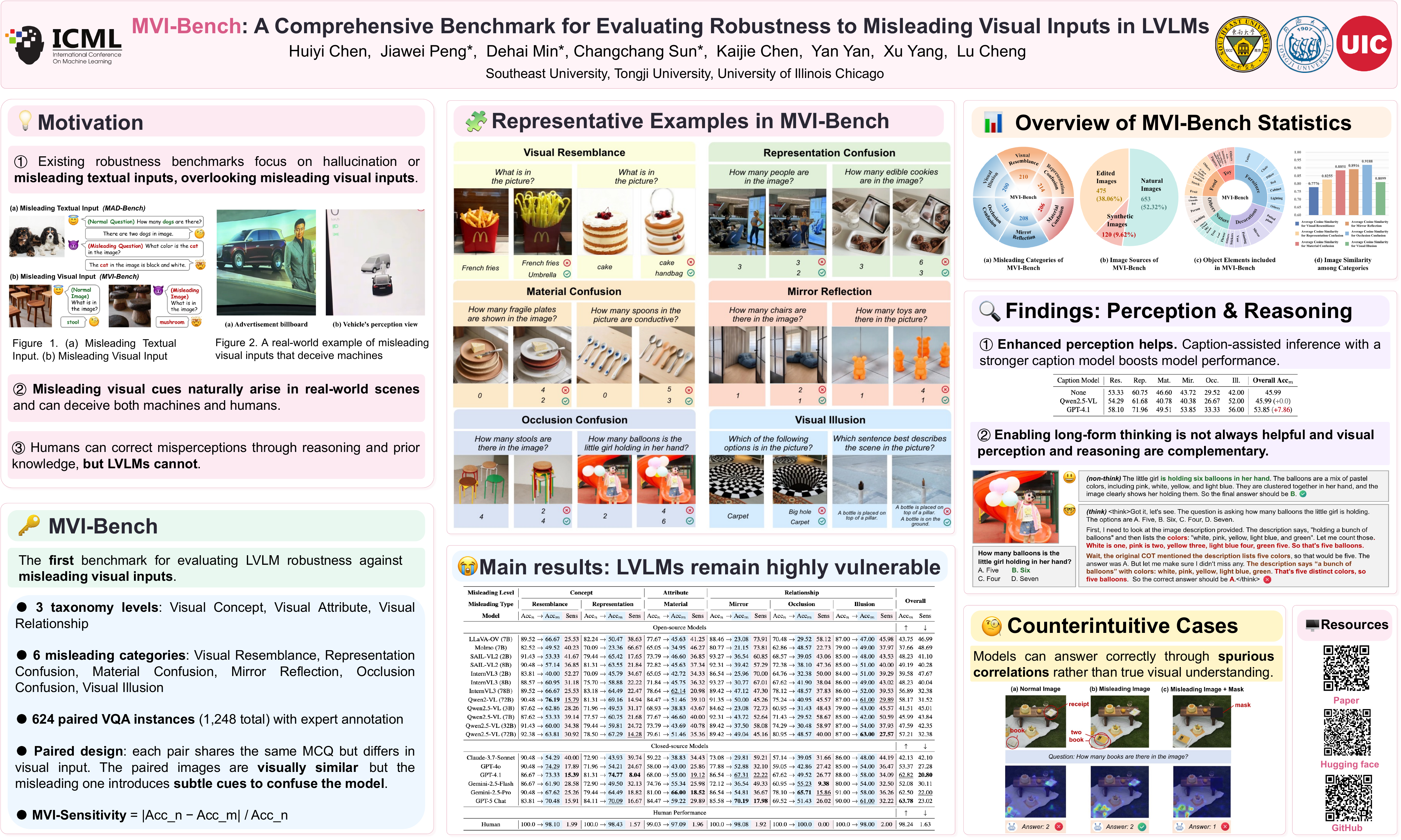
Evaluating the robustness of Large Vision-Language Models (LVLMs) is essential for their continued development and responsible deployment. However, existing robustness benchmarks largely focus on hallucination or misleading textual inputs, overlooking the critical challenge posed by misleading visual inputs in assessing visual understanding. To fill this gap, we introduce MVI-Bench, the first comprehensive benchmark specially designed for evaluating how Misleading Visual Inputs undermine the robustness of LVLMs. Grounded in fundamental visual primitives, the design of MVI-Bench centers on three hierarchical levels of misleading visual inputs: Visual Concept, Visual Attribute, and Visual Relationship. Using this taxonomy, we curate six representative categories and compile 1,248 expertly annotated VQA instances. To facilitate fine-grained robustness evaluation, we further introduce MVI-Sensitivity, a novel metric that characterizes LVLM robustness. Empirical results across 18 state-of-the-art LVLMs uncover pronounced vulnerabilities to misleading visual inputs, and our in-depth analyses on MVI-Bench provide actionable insights that can guide the development of more reliable and robust LVLMs.
Lay Summary
Modern AI systems that combine vision and language, such as visual assistants and chatbots that can describe images or answer image-related questions, are becoming surprisingly good at understanding what they see. But they can still be fooled in ways that humans easily avoid. For example, an AI system may mistake a mushroom-shaped wooden stool for a real mushroom, or a vehicle's perception system may misread a person on a billboard as a real pedestrian and trigger an unnecessary emergency brake. To study this problem, we built MVI-Bench, the first benchmark designed to test how easily today's vision-language AI is fooled by misleading images. Working with human experts, we collected over 1,200 carefully matched image pairs covering six common types of visual confusion and developed a new metric to measure how much an AI's accuracy drops when faced with these tricky cases. Testing 18 leading AI models, we found that even the most advanced ones struggle significantly, while humans solve these cases almost perfectly.