
CARD: Coarse-to-fine Autoregressive Modeling with Radix-based Decomposition for Transferable Free Energy Estimation
Abstract
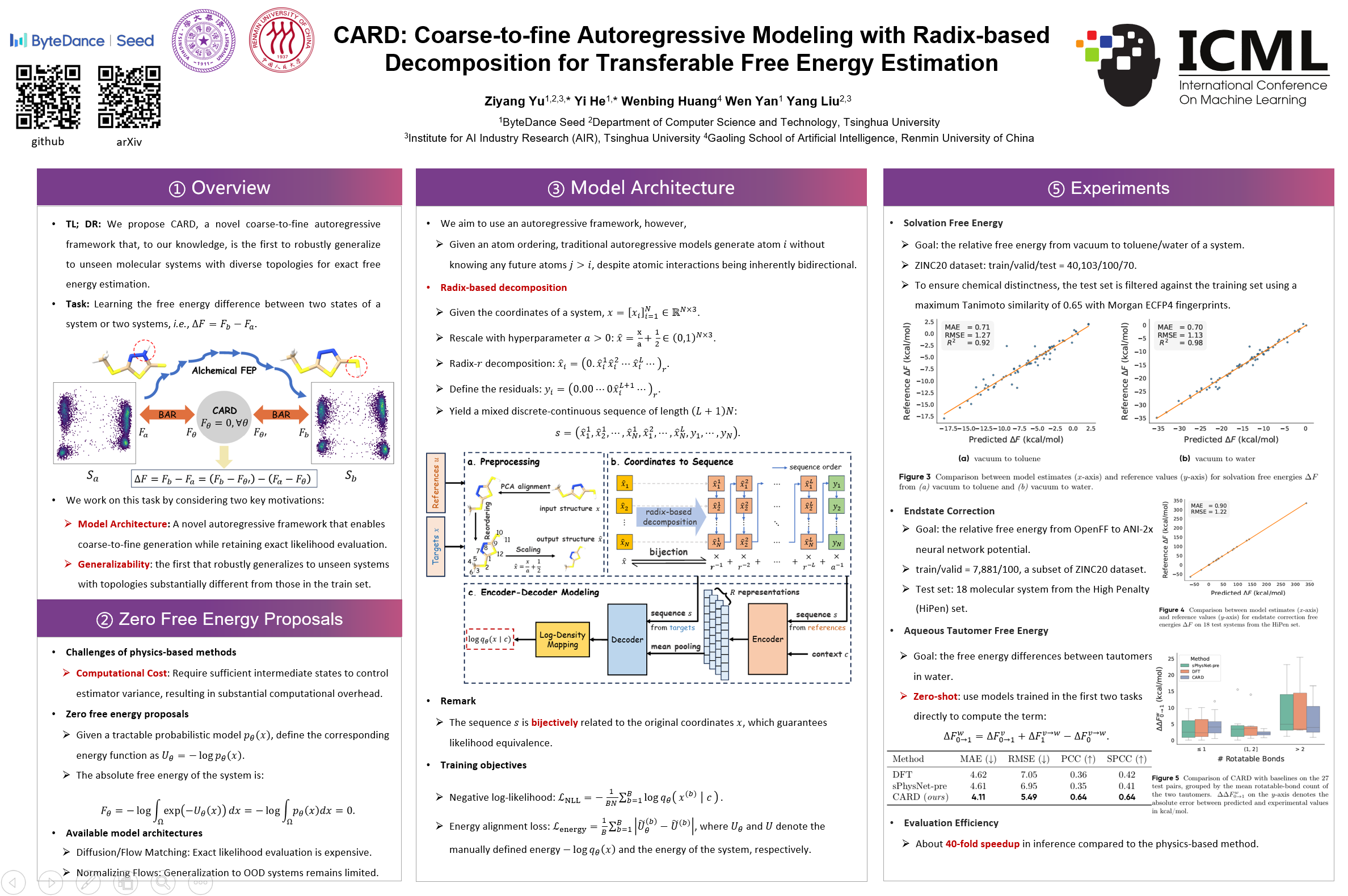
Estimating free energy differences quantifies thermodynamic preferences in molecular interactions, which is central to chemistry and drug discovery. Despite fruitful progress, existing methods still face key limitations: classical computational approaches remain prohibitively expensive due to their reliance on extensive molecular dynamics simulations, while deep learning-based methods are constrained by either less-expressive generative models or input dimensions tied to a specific system, resulting in negligible generalization. To address these challenges, we propose CARD, a generative framework that employs a novel radix-based decomposition to bijectively convert 3D coordinates into mixed discrete-continuous sequences, enabling coarse-to-fine autoregressive modeling with enhanced expressiveness. Notably, the model corresponds to a distribution with zero free energy, serving as a proposal for absolute free energy computation of arbitrary systems without relying on alchemical pathways. Experiments across diverse tasks demonstrate that CARD matches the accuracy of classical computational methods on unseen systems with diverse topologies, while achieving an approximately 40-fold speedup in inference.
Lay Summary
Estimating free energy helps scientists understand which molecular interactions are most favorable, a key challenge in chemistry and drug discovery. Currently, existing methods are either too slow because they rely on extensive physics simulations, or too specialized to work well on new, unseen molecules. We address this problem by using a powerful generative AI model. Our paper introduces a novel "coarse-to-fine" approach to model the 3D coordinates of molecular systems. This algorithm solves a critical flaw in traditional step-by-step (autoregressive) AI models, ensuring that an atom's position is influenced by the entire molecule rather than just the preceding atoms. Surprisingly, our model generalizes exceptionally well to unseen molecular systems with varying sizes, overcoming the limitations of previous deep learning models that require fixed-size inputs. Furthermore, we found that our method matches the accuracy of traditional physics-based approaches while running about 40 times faster. Our findings show that generative models can make complex thermodynamic calculations highly practical for real-world scientific applications. Additionally, our framework's design opens the door to using successful techniques from Large Language Models (LLMs) to scale these predictions to even larger molecular systems.