
RA-Det: Towards Universal Detection of AI-Generated Images via Robustness Asymmetry
Abstract
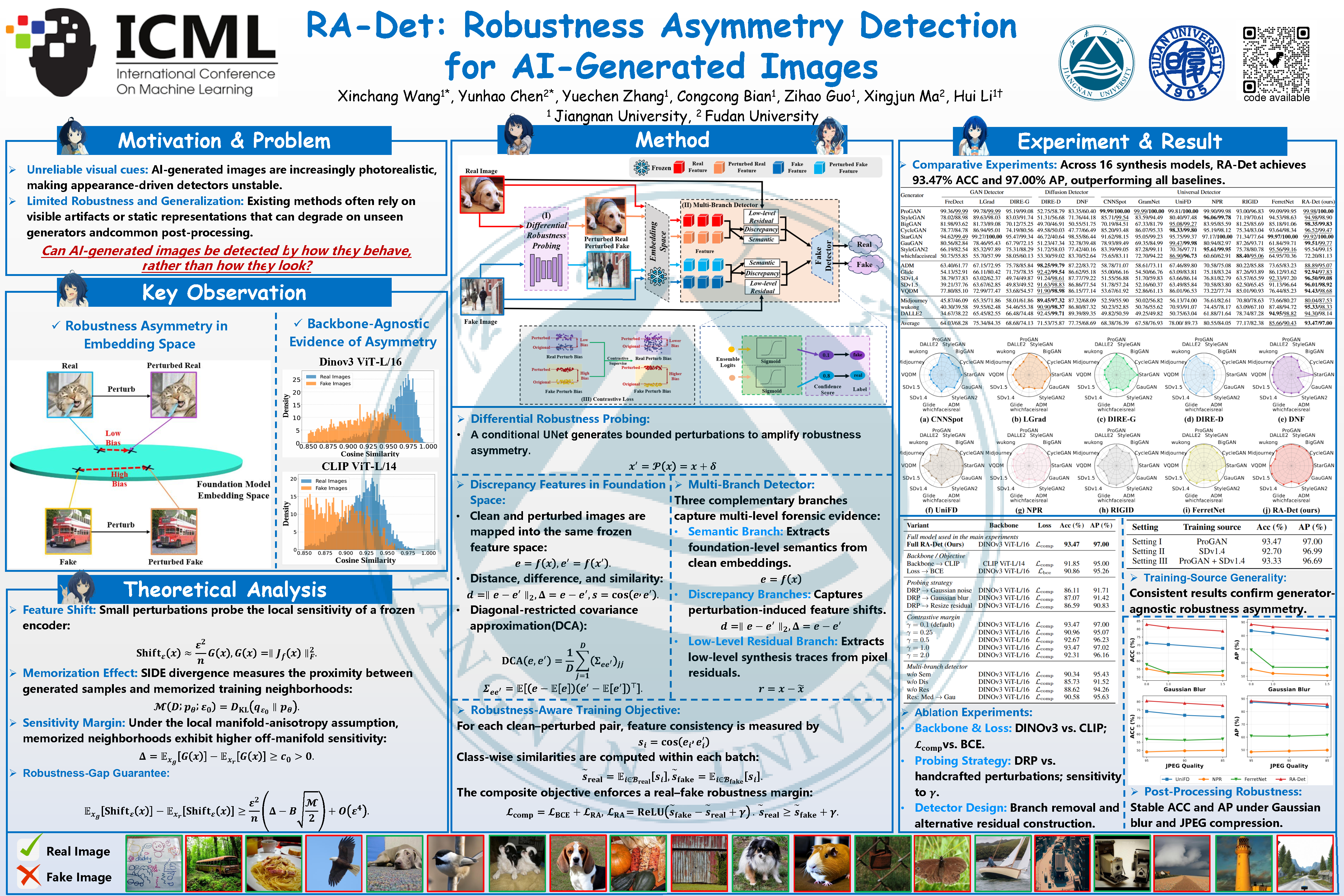
Recent image generators produce photo-realistic content that undermines the reliability of downstream recognition systems. As visual appearance cues become less pronounced, appearance-driven detectors that rely on forensic cues or high-level representations lose stability. This motivates a shift from appearance to behavior, focusing on how images respond to controlled perturbations rather than how they look. In this work, we identify a simple and universal behavioral signal. Natural images preserve stable semantic representations under small, structured perturbations, whereas generated images exhibit markedly larger feature drift. We refer to this phenomenon as \textbf{robustness asymmetry} and provide a theoretical analysis that establishes a lower bound connecting this asymmetry to memorization tendencies in generative models, explaining its prevalence across architectures. Building on this insight, we introduce Robustness Asymmetry Detection (RA-Det), a behavior-driven detection framework that converts robustness asymmetry into a reliable decision signal. Evaluated across 14 diverse generative models and against more than 10 strong detectors, RA-Det achieves superior performance, improving the average performance by 12.92\%. The method is data- and model-agnostic, requires no generator fingerprints, and transfers across unseen generators. Together, these results indicate that robustness asymmetry is a stable, general cue for synthetic-image detection and that carefully designed probing can turn this cue into a practical, universal detector.
Lay Summary
AI-generated images are now highly realistic, making real and synthetic images harder to distinguish and raising concerns about visual trust and data security. Instead of looking only for visible flaws in an image, we test how the image reacts to small changes. A real image usually keeps the same meaning after these small changes. For example, a slightly changed photo of a dog is still understood as a dog. In contrast, an AI-generated image is more likely to cause larger changes in the way a model understands it. We call this difference robustness asymmetry. Based on this observation, we designed RA-Det to use this stability difference for detecting AI-generated images. Surprisingly, this simple idea works very well across many kinds of image generators. This suggests that how an image responds to small changes can be a useful clue for identifying synthetic content.